Children deserve a safe environment where they can grow, learn, and live without fear. Unfortunately, cases of child sexual abuse continue to surface across India, making awareness about child protection laws more important than ever. Many parents, teachers, guardians, and even young adults have heard about the POCSO Act but are unsure about what it actually covers, how complaints are handled, or what rights a child has during legal proceedings.
Understanding the Protection of Children from Sexual Offences (POCSO) Act is not just for lawyers or police officers. It helps parents recognize warning signs, enables schools to create safer spaces, and encourages citizens to report crimes without hesitation. Whether you are a parent, educator, healthcare worker, or simply a responsible citizen, knowing the basics of this law can make a real difference in protecting children.
POCSO Act at a Glance
| Topic | Details |
|---|---|
| POCSO Act Full Form | Protection of Children from Sexual Offences Act |
| Enacted | 2012 |
| Applicable To | Every child below 18 years of age |
| Purpose | Protection of children from sexual offences and exploitation |
| Covers | Sexual assault, harassment, pornography, online abuse, aggravated offences |
| Special Courts | Yes, for speedy trials |
| Child-Friendly Process | Yes, from reporting to trial |
| Gender Neutral | Protects both boys and girls |
| Mandatory Reporting | Yes, certain persons are legally required to report offences |
What is the POCSO Act?
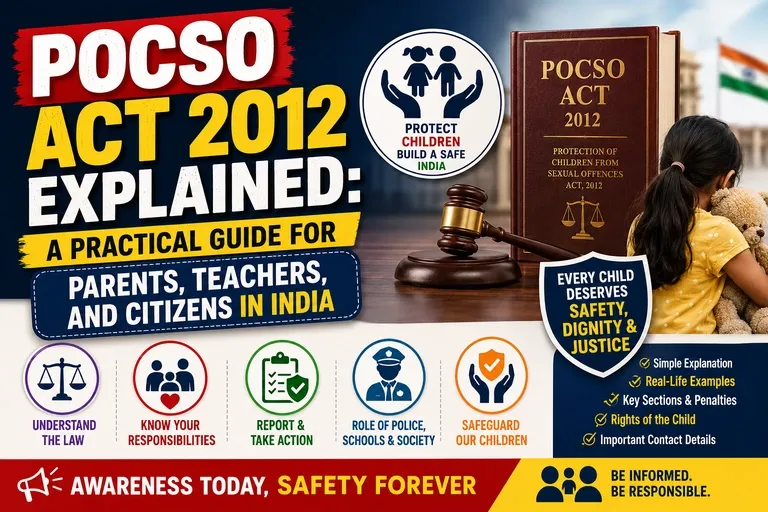
The Protection of Children from Sexual Offences (POCSO) Act, 2012 is a special law enacted by the Government of India to protect children from sexual abuse, sexual harassment, and exploitation.
The law recognizes that children require greater legal protection because they are vulnerable and often unable to defend themselves. It also ensures that investigations and court proceedings are conducted in a child-friendly manner to reduce trauma.
Unlike many earlier laws that focused mainly on female victims, the POCSO Act is gender-neutral, meaning it protects every child below the age of 18, regardless of gender.
Why Was the POCSO Act Introduced?
Before 2012, India did not have a comprehensive law dealing exclusively with child sexual offences. Existing legal provisions under the Indian Penal Code were limited and did not adequately address various forms of abuse.
The POCSO Act was introduced to:
- Protect children from all forms of sexual abuse
- Clearly define different sexual offences
- Ensure quick investigation and trial
- Provide child-friendly legal procedures
- Prevent intimidation of child victims during court proceedings
- Punish offenders with strict penalties
The Act has also been amended over the years to strengthen punishments for serious offences.
Who is Considered a Child Under the POCSO Act?
Under the Act, any person below 18 years of age is legally considered a child.
This means the protection applies equally to:
- Boys
- Girls
- Children with disabilities
- Children from any religion, caste, or background
The child’s consent is generally not treated as a valid defence because the law considers minors incapable of giving legal consent for sexual activities.
Offences Covered Under the POCSO Act
The Act covers several categories of offences to ensure comprehensive protection.
1. Sexual Assault
This involves inappropriate physical contact with sexual intent.
Examples include:
- Touching private parts
- Forcing a child to touch someone else
- Any unwanted sexual contact
2. Penetrative Sexual Assault
This is one of the most serious offences under the Act and includes various forms of sexual penetration involving a child.
Punishments are severe and may extend to life imprisonment depending on the circumstances.
3. Aggravated Sexual Assault
The offence becomes aggravated when committed by persons in positions of trust or authority, such as:
- Teachers
- Police officers
- Family members
- Hospital staff
- Religious leaders
- Public servants
Stronger punishments apply in such cases.
4. Sexual Harassment
Sexual harassment does not always involve physical contact.
It may include:
- Making sexually coloured remarks
- Showing obscene gestures
- Following a child with sexual intent
- Sending inappropriate messages
- Demanding sexual favours
5. Child Pornography and Online Exploitation
With increasing internet usage, online exploitation has become a major concern.
The Act covers offences such as:
- Creating child sexual abuse material
- Sharing explicit images of children
- Recording abusive videos
- Online grooming
- Using children in pornographic content
Digital evidence is also admissible during investigations.
Mandatory Reporting Under the POCSO Act
One of the unique features of the law is mandatory reporting.
If a person becomes aware of a child sexual offence, they should report it to the police or the Special Juvenile Police Unit.
Schools, hospitals, institutions, and professionals dealing with children are expected to report such incidents.
Failure to report certain offences may attract legal consequences under the Act.
Child-Friendly Investigation Process
The law emphasizes protecting the emotional well-being of the child during the investigation.
Some important safeguards include:
- Statement recorded at the child’s residence or a comfortable location
- Female police officer preferred wherever possible
- No child should be detained at the police station overnight
- Identity of the child must remain confidential
- Frequent questioning should be avoided
- Child-friendly language should be used
These measures help reduce fear and trauma.
Role of Special Courts
The POCSO Act provides for Special Courts that exclusively handle cases involving child sexual offences.
These courts aim to:
- Conduct speedy trials
- Protect the child’s privacy
- Minimize repeated appearances
- Record evidence in a child-sensitive manner
Where possible, proceedings are conducted without exposing the child to the accused unnecessarily.
Punishments Under the POCSO Act
Punishments depend on the nature and seriousness of the offence.
Some offences may attract:
- Imprisonment for several years
- Rigorous imprisonment
- Life imprisonment in serious cases
- Monetary fines
- Additional punishment for repeat offenders
The exact punishment varies according to the offence proved before the court.
Rights of Child Victims
Children protected under the POCSO Act have several important rights.
These include:
- Right to privacy
- Right to dignity
- Right to legal assistance
- Right to medical treatment
- Right to compensation in eligible cases
- Right to counselling and psychological support
- Right to a speedy trial
Courts are expected to prioritize the child’s best interests throughout the legal process.
Responsibilities of Parents, Schools, and Society
Protecting children is a shared responsibility.
Parents should:
- Teach children about safe and unsafe touch.
- Encourage open communication.
- Believe children when they report discomfort.
- Monitor online activities without invading privacy.
Schools should:
- Conduct child safety awareness programmes.
- Perform background verification of staff.
- Establish clear complaint mechanisms.
- Train teachers to identify signs of abuse.
Society should:
- Report suspected abuse immediately.
- Avoid spreading the child’s identity.
- Support victims instead of blaming them.
- Promote awareness about child protection laws.
Common Misconceptions About the POCSO Act
“It only protects girls.”
Incorrect. The Act protects both boys and girls below 18 years of age.
“Physical injury is necessary.”
No. Many offences under the Act do not require physical injuries to establish abuse.
“Only family members can file complaints.”
Anyone with knowledge of an offence may report it to the police.
“Online abuse is not covered.”
False. Online grooming, sharing child sexual abuse material, and digital exploitation are covered under the law.
Recent Importance of the POCSO Act
With increasing use of smartphones, social media, gaming platforms, and messaging applications, children today face risks that extend beyond physical spaces. The POCSO Act has become even more relevant in addressing cyber exploitation, digital harassment, and online grooming. Awareness campaigns in schools, stricter enforcement, and greater public understanding continue to play an important role in preventing offences and ensuring timely justice for child victims.
Frequently Asked Questions (FAQs)
1. Can a child directly report an offence under the POCSO Act?
Yes. A child, parent, guardian, teacher, neighbour, or any person aware of the offence can report it to the police or the Special Juvenile Police Unit.
2. Does the POCSO Act apply to online sexual abuse?
Yes. The Act covers online grooming, sharing child sexual abuse material, creating explicit content involving children, and other forms of digital exploitation.
3. Is the identity of the child made public?
No. The identity of the child victim is legally protected. Publishing or revealing identifying details is prohibited except in limited circumstances permitted by law.
4. What should parents do if a child discloses abuse?
Parents should remain calm, listen carefully without blaming the child, ensure the child’s immediate safety, seek medical help if required, and report the matter to the police as soon as possible. Emotional support and professional counselling can also help the child recover.
Disclaimer: The information provided in this article is for educational purposes only and does not constitute legal advice. Please consult a qualified legal professional for advice regarding your specific situation.