
Have you ever wondered how government funds are spent in your area, why a public service has been delayed, or what action has been taken on your application submitted to a government office? In many situations, people feel helpless because they do not know how to access official information. The Right to Information (RTI) Act, 2005 empowers every citizen to seek information from public authorities, making governance more transparent and accountable.
Whether you want to know the status of a government scheme, details of road construction, recruitment procedures, municipal records, or the progress of an application, the RTI Act provides a legal mechanism to obtain information. Understanding this law helps citizens exercise their democratic rights, promotes transparency, and encourages better governance. It is a valuable tool for students, journalists, social workers, professionals, and every responsible citizen of India.
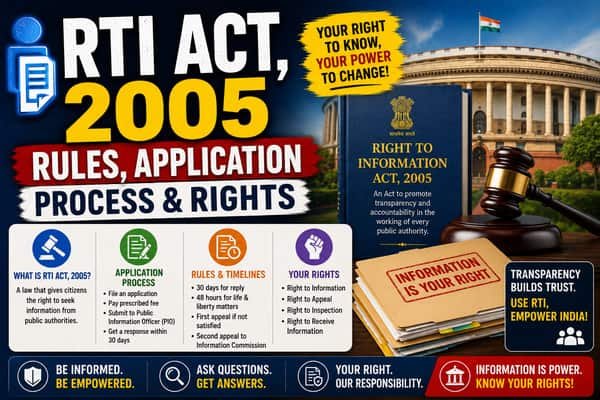
Right to Information (RTI) Act, 2005: Overview
| Particular | Details |
|---|---|
| Full Name | Right to Information Act, 2005 |
| Enacted | 2005 |
| Effective From | 12 October 2005 |
| Objective | Promote transparency and accountability in public authorities |
| Applicable To | Public authorities under the Central and State Governments (subject to certain exemptions) |
| Who Can Apply | Any citizen of India |
| Information Officer | Public Information Officer (PIO) or State Public Information Officer (SPIO) |
| Standard Response Time | Generally within 30 days |
| Appellate Authority | First Appellate Authority and Central/State Information Commission |
What is the Right to Information (RTI) Act?
The Right to Information Act, 2005 gives every Indian citizen the legal right to request information from government departments and public authorities. It requires these authorities to provide information that is available in their records unless the requested information falls under specific exemptions provided by the Act.
The law promotes openness in government functioning and enables citizens to question delays, verify public spending, and obtain official records. By increasing transparency, the RTI Act has become one of India’s most significant governance reforms.
Objectives of the RTI Act
The Act was introduced with several important objectives.
These include:
- Promote transparency in government functioning.
- Increase accountability of public authorities.
- Reduce corruption by enabling public scrutiny.
- Strengthen citizen participation in governance.
- Ensure timely access to official information.
- Improve public confidence in government institutions.
The RTI Act supports the principle that information held by public authorities belongs to the people, subject to reasonable legal restrictions.
Who Can File an RTI Application?
Any citizen of India can submit an RTI application.
Applicants may include:
- Students
- Employees
- Senior citizens
- Journalists
- Social activists
- Business owners
- Farmers
- Homemakers
- Any other Indian citizen
Generally, applicants are not required to provide reasons for seeking information.
Which Organizations Come Under the RTI Act?
The Act applies to a wide range of public authorities.
These include:
- Central Government ministries
- State Government departments
- Municipal corporations
- Panchayats
- Government schools and colleges
- Public sector undertakings (PSUs)
- Constitutional authorities
- Government-funded institutions
- Statutory bodies
- Local authorities
Certain organizations may be exempt under the Act, except in cases involving allegations of corruption or human rights violations, as provided by law.
What Information Can Be Requested?
Citizens may request information that exists in official records.
Examples include:
- Status of government applications
- Copies of official documents
- Government orders and circulars
- Tender details
- Recruitment procedures
- Project expenditure
- Inspection reports
- Land records
- File notings, where disclosable
- Details of welfare schemes
The Act allows access to existing records but generally does not require authorities to create new information or provide explanations or opinions.
Information That Cannot Normally Be Disclosed
The RTI Act also protects certain sensitive information.
Some exempt categories include:
- Information affecting national security
- Cabinet papers in specified circumstances
- Trade secrets and commercially sensitive information
- Personal information affecting privacy without larger public interest
- Information that may impede investigations
- Information prohibited by courts from disclosure
- Certain confidential records protected under the Act
These exemptions help balance transparency with public interest and security.
How to File an RTI Application
Filing an RTI application is a straightforward process.
Step 1: Identify the Public Authority
Determine which government department holds the information you require.
Step 2: Prepare the Application
Write a simple application mentioning:
- Your name
- Contact details
- Description of the information requested
- Relevant dates or file numbers, if available
The request should be clear and specific.
Step 3: Pay the Prescribed Fee
Most RTI applications require payment of the prescribed application fee, subject to applicable exemptions such as those available for eligible applicants below the poverty line.
Step 4: Submit the Application
The application may be submitted through the prescribed offline or online procedure, depending on the concerned public authority.
Step 5: Receive the Response
The Public Information Officer (PIO) generally provides the requested information within 30 days, subject to the provisions of the Act.
Role of the Public Information Officer (PIO)
Every public authority appoints a Public Information Officer (PIO) to process RTI applications.
The PIO is responsible for:
- Receiving applications.
- Collecting the requested information.
- Providing information within the prescribed time.
- Rejecting requests only where permitted by law.
- Informing applicants about appeal procedures where applicable.
The PIO plays a central role in ensuring effective implementation of the Act.
What If Information Is Not Provided?
If the applicant is dissatisfied with the response or does not receive information within the prescribed period, the RTI Act provides an appeal mechanism.
The applicant may:
- File a First Appeal before the designated First Appellate Authority.
- If still dissatisfied, file a Second Appeal before the Central Information Commission (CIC) or the State Information Commission (SIC), as applicable.
These authorities examine whether the request has been handled in accordance with the law.
Benefits of the RTI Act
The RTI Act has significantly improved transparency in public administration.
Some major benefits include:
- Encourages accountable governance.
- Helps citizens monitor public expenditure.
- Reduces opportunities for corruption.
- Improves delivery of public services.
- Builds trust between citizens and government.
- Empowers individuals to exercise their democratic rights.
It has also encouraged government departments to maintain better records and proactively disclose important information.
Tips for Filing an Effective RTI Application
A well-drafted RTI application increases the chances of receiving a clear response.
Keep these points in mind:
- Ask specific questions.
- Request only existing records.
- Avoid lengthy or vague applications.
- Mention relevant dates where possible.
- Use simple language.
- Submit the application to the correct public authority.
- Preserve copies of the application and acknowledgment.
Clear and focused applications are generally processed more efficiently.
Frequently Asked Questions (FAQs)
1. Can I file an RTI application online?
Yes. Many Central Government departments and several State Government authorities provide online RTI filing facilities. Availability depends on the concerned public authority.
2. Do I need to explain why I want the information?
No. Under the RTI Act, applicants are generally not required to provide reasons for requesting information. They only need to clearly specify the information sought.
3. What happens if the Public Information Officer does not reply within the prescribed time?
If no response is received within the applicable time limit or the applicant is dissatisfied with the decision, they may file a First Appeal before the designated appellate authority and, if necessary, a Second Appeal before the appropriate Information Commission.
4. Can private companies be covered under the RTI Act?
Private companies are not generally covered directly under the RTI Act. However, information relating to private entities may be accessible if it is available with or can be accessed by a public authority under any existing law.
Disclaimer: This article is intended for general informational and educational purposes only. It provides an overview of the Right to Information (RTI) Act, 2005 and should not be considered legal advice. The interpretation and application of the law may vary depending on the facts of each case and any subsequent legal amendments or judicial decisions. For guidance on a specific RTI matter, consult a qualified legal professional or the appropriate public authority.