
Paying income tax is more than just a legal responsibility—it’s an important part of being a financially aware citizen. Whether you’re a salaried employee receiving your first salary, a freelancer, a business owner, or a retiree earning pension and interest income, understanding the Income Tax Act helps you manage your finances better, avoid penalties, and make informed tax-saving decisions.
Many people think income tax is only about filing an Income Tax Return (ITR). In reality, the Income Tax Act governs how income is taxed, who is required to pay tax, what deductions and exemptions are available, how tax is collected, and what rights and responsibilities taxpayers have. India’s income tax law has also undergone significant modernization, with the Income-tax Act, 2025 coming into effect from 1 April 2026 to simplify tax administration while retaining the core taxation framework.
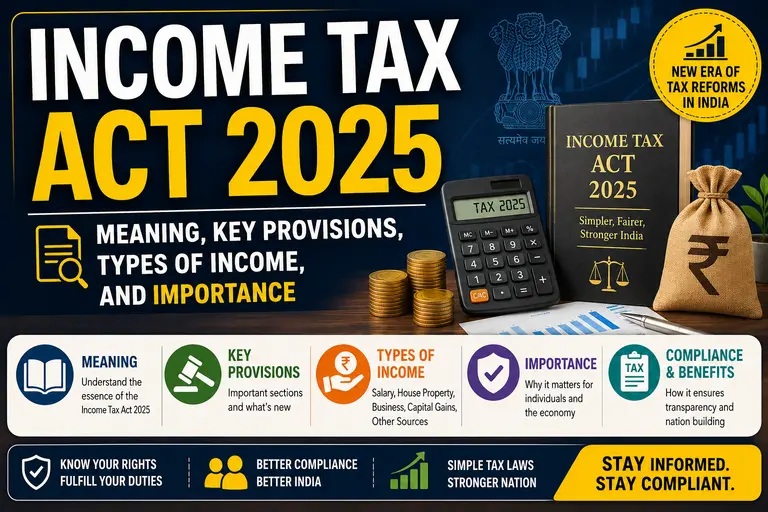
Income Tax Act: Overview
| Particular | Details |
|---|---|
| Governing Law | Income-tax Act, 2025 (effective from 1 April 2026) |
| Purpose | Regulates the levy, collection, assessment, and administration of income tax in India |
| Applicable To | Individuals, HUFs, firms, LLPs, companies, trusts, and other taxable entities |
| Administered By | Income Tax Department, Government of India |
| Covers | Taxable income, deductions, exemptions, TDS, advance tax, assessments, penalties, and appeals |
| Filing Requirement | Applicable to eligible taxpayers based on prescribed conditions |
| Objective | Ensure fair taxation and revenue collection for national development |
What is the Income Tax Act?
The Income Tax Act is the primary law that governs the taxation of income earned in India. It lays down the rules for determining taxable income, calculating tax liability, collecting taxes, granting deductions and exemptions, and resolving tax-related disputes.
The Act applies to various categories of taxpayers, including individuals, Hindu Undivided Families (HUFs), partnership firms, LLPs, companies, trusts, and other entities. It also empowers the Income Tax Department to administer tax laws and ensure compliance.
Why is the Income Tax Act Important?
The Income Tax Act plays a vital role in India’s financial system. Taxes collected under the Act help fund public infrastructure, healthcare, education, defence, railways, digital services, and various welfare schemes.
For taxpayers, the Act provides:
- Clear rules for tax calculation
- Legal tax-saving opportunities
- Rights during assessment and appeals
- Procedures for refunds
- Penalties for non-compliance
- Mechanisms for resolving disputes
Understanding these provisions helps taxpayers stay compliant while making informed financial decisions.
Who Needs to Pay Income Tax?
Income tax may apply to different categories of taxpayers depending on their income and applicable legal provisions.
These include:
- Salaried employees
- Self-employed professionals
- Freelancers
- Business owners
- Partnership firms
- LLPs
- Companies
- Hindu Undivided Families (HUFs)
- Trusts and institutions (subject to applicable provisions)
Tax liability depends on factors such as the type of taxpayer, residential status, taxable income, and the applicable tax regime.
Major Heads of Income Under the Income Tax Act
The Income Tax Act classifies taxable income into different heads to simplify assessment.
1. Income from Salary
This includes:
- Basic salary
- Dearness allowance
- Bonus
- Commission
- Pension
- Perquisites
- Leave encashment (subject to applicable provisions)
2. Income from House Property
Income earned from letting out residential or commercial property generally falls under this category.
Certain deductions may be available as permitted under the law.
3. Profits and Gains from Business or Profession
This head covers income earned through:
- Business activities
- Professional services
- Consultancy
- Freelancing
- Trading
- Manufacturing
4. Capital Gains
Capital gains arise from the transfer of capital assets such as:
- Land
- Buildings
- Shares
- Mutual funds
- Gold
- Other investments
The tax treatment may differ depending on the nature of the asset and the holding period.
5. Income from Other Sources
Income not covered under the above categories generally falls here.
Examples include:
- Bank interest
- Fixed deposit interest
- Dividend income
- Family pension
- Gifts taxable under applicable provisions
- Lottery winnings
Important Provisions of the Income Tax Act
The Act contains several provisions that affect day-to-day taxpayers.
Tax Deductions
Eligible taxpayers may claim deductions under specified provisions for qualifying investments and expenditures, subject to the conditions of the chosen tax regime.
Common examples include:
- Life insurance premiums
- Public Provident Fund (PPF)
- National Pension System (NPS)
- Health insurance premiums
- Education loan interest
- Certain donations
Tax Deducted at Source (TDS)
TDS is a mechanism through which tax is deducted before making certain payments.
It commonly applies to:
- Salaries
- Interest income
- Professional fees
- Rent
- Contract payments
This system helps ensure timely tax collection and reduces tax evasion.
Advance Tax
Taxpayers with substantial tax liability beyond specified limits may need to pay tax in instalments during the financial year instead of paying the entire amount at once.
Income Tax Return (ITR)
Eligible taxpayers are required to file an Income Tax Return within the prescribed due dates.
Timely filing offers several benefits, including:
- Faster refund processing
- Carry forward of eligible losses
- Easier loan approvals
- Better financial documentation
Rights of Taxpayers
The Income Tax Act provides important safeguards to taxpayers.
These include the right to:
- Receive fair treatment
- Seek clarification from tax authorities
- File revised returns where permitted
- Appeal against assessment orders
- Claim eligible refunds
- Protect confidential financial information
Understanding these rights helps taxpayers confidently deal with tax matters.
Consequences of Non-Compliance
Failure to comply with the Income Tax Act may result in legal consequences.
Some common issues include:
- Late filing fees
- Interest on unpaid tax
- Penalties for certain defaults
- Notices from the Income Tax Department
- Assessment proceedings
- Prosecution in serious cases involving wilful tax evasion
Maintaining accurate financial records and filing returns on time can help avoid unnecessary complications.
Recent Developments in India’s Income Tax Law
India has introduced the Income-tax Act, 2025, which came into force on 1 April 2026. The new legislation is designed to simplify tax law by using clearer language, reorganizing provisions, reducing unnecessary complexity, and replacing the earlier Income-tax Act, 1961. While the drafting has been modernized, the objective remains to make tax compliance easier and improve transparency for taxpayers.
Tips to Stay Tax Compliant
Following a few simple practices can make tax compliance much easier:
- Maintain records of income and investments.
- Keep salary slips and Form 16 or equivalent tax documents safely.
- Verify TDS details before filing your return.
- File your ITR before the due date.
- Choose the tax regime after evaluating your financial situation.
- Preserve supporting documents for future reference.
Frequently Asked Questions (FAQs)
1. Who is required to file an Income Tax Return in India?
Individuals and other taxpayers who meet the prescribed filing conditions under the Income Tax Act should file an Income Tax Return within the applicable due date, even if tax has already been deducted at source in certain cases.
2. What is the difference between TDS and Income Tax?
Income tax is the overall tax payable on your taxable income. TDS (Tax Deducted at Source) is a method of collecting part of that tax in advance by deducting it from specified payments such as salary, interest, or professional fees.
3. Can I claim tax deductions while filing my return?
Yes. Eligible taxpayers can claim deductions and other tax benefits as permitted under the applicable provisions of the law, depending on the tax regime they have chosen and their eligibility.
4. What happens if I do not file my Income Tax Return on time?
Late filing may lead to fees, interest on outstanding tax, delays in receiving refunds, and other consequences under the Income Tax Act. Filing within the prescribed timeline helps avoid these issues.
Disclaimer: The information provided in this article is for educational purposes only and does not constitute legal advice. Please consult a qualified legal professional for advice regarding your specific situation.