A safe workplace is essential for every employee to work with confidence, dignity, and peace of mind. Whether you work in a private company, government office, startup, educational institution, NGO, or even as an intern, you have the right to work in an environment free from sexual harassment. Unfortunately, workplace harassment still affects many individuals in India, often leaving victims unsure about their rights or the legal remedies available.
The Prevention of Sexual Harassment (POSH) Act, 2013 was introduced to address this issue by providing a clear legal framework for preventing, prohibiting, and redressing sexual harassment at the workplace. The law places equal importance on protecting employees and ensuring that employers create a safe and respectful work culture. Understanding the POSH Act is valuable not only for employees but also for employers, HR professionals, managers, and business owners responsible for workplace compliance.
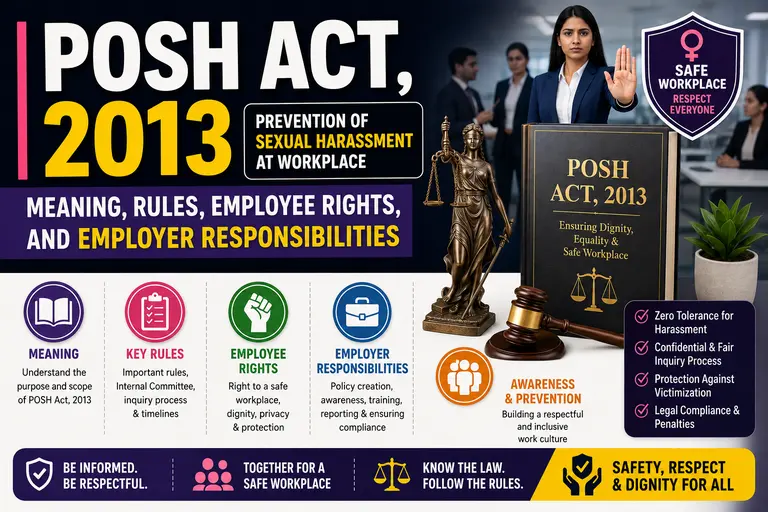
POSH Act 2013: Overview
| Particular | Details |
|---|---|
| Full Name | Sexual Harassment of Women at Workplace (Prevention, Prohibition and Redressal) Act, 2013 |
| Common Name | POSH Act, 2013 |
| Enforced From | 9 December 2013 |
| Objective | Prevent, prohibit, and redress sexual harassment at workplaces |
| Applicable To | Every workplace in India, including government and private organizations |
| Protects | Women employees, interns, trainees, consultants, contract workers, and visitors |
| Complaint Committee | Internal Committee (IC) or Local Committee (LC) |
| Employer Responsibility | Prevent harassment, conduct awareness programmes, and establish complaint mechanisms |
| Penalties | Monetary penalties and other legal consequences for non-compliance |
What is the POSH Act, 2013?
The POSH Act, 2013 is a special law enacted to protect women from sexual harassment at the workplace. It provides a structured process for reporting complaints, conducting inquiries, and taking appropriate action against offenders while ensuring fairness to all parties involved.
The Act applies to almost every type of workplace, regardless of whether it is located in the public or private sector. It also recognizes that workplace harassment can occur during official travel, meetings, training programmes, work-related events, and even virtual interactions connected to employment.
Why Was the POSH Act Introduced?
The Act was enacted to ensure that every woman has the constitutional right to equality, dignity, and a safe working environment.
Its major objectives include:
- Prevent workplace sexual harassment.
- Encourage employees to report incidents without fear.
- Create a transparent complaint mechanism.
- Hold employers accountable for workplace safety.
- Promote gender-sensitive workplaces.
- Ensure timely inquiry and resolution of complaints.
The law also encourages organizations to adopt preventive measures rather than dealing with complaints only after an incident occurs.
What is Considered Sexual Harassment?
Sexual harassment includes any unwelcome act or behaviour of a sexual nature that affects a person’s dignity or creates a hostile work environment.
Examples include:
- Unwanted physical contact
- Sexually coloured remarks
- Inappropriate jokes or comments
- Requests for sexual favours
- Sending offensive emails, messages, or images
- Displaying explicit content
- Repeated unwelcome advances
- Staring or making uncomfortable gestures
- Threatening career consequences for refusing advances
Harassment may occur physically, verbally, digitally, or through non-verbal conduct.
Who is Protected Under the POSH Act?
The POSH Act primarily protects women working in various capacities.
Protection extends to:
- Permanent employees
- Temporary employees
- Contract workers
- Consultants
- Interns
- Apprentices
- Trainees
- Volunteers
- Daily wage workers
- Visitors to the workplace
The protection applies irrespective of salary, designation, or employment status.
What is Covered Under the Term “Workplace”?
The Act adopts a broad definition of workplace.
It includes:
- Corporate offices
- Government departments
- Educational institutions
- Hospitals
- NGOs
- Factories
- Shops and commercial establishments
- Sports institutions
- Work-from-home arrangements related to employment
- Official travel
- Employer-provided transportation
- Conferences and work-related events
This wider definition ensures protection beyond the physical office premises.
Internal Committee (IC)
Every employer with 10 or more employees must constitute an Internal Committee (IC) to receive and investigate complaints.
The committee generally consists of:
- A Presiding Officer (a senior woman employee)
- At least two employee members
- One external member familiar with women’s rights or social work
The Internal Committee plays an important role in conducting fair and confidential inquiries.
Local Committee (LC)
If an organization has fewer than 10 employees or the complaint is against the employer, the complaint can be made before the Local Committee established by the District Officer.
This ensures that women working in smaller organizations also receive legal protection.
Complaint Procedure Under the POSH Act
The Act provides a structured complaint process.
Step 1: Filing the Complaint
The aggrieved woman should generally submit a written complaint to the Internal Committee within the prescribed time limit from the date of the incident, subject to extensions in appropriate circumstances.
Step 2: Preliminary Review
The committee examines whether the complaint falls within the scope of the Act.
Step 3: Inquiry
Both parties are given an opportunity to present evidence and explain their respective positions.
Step 4: Report
After completing the inquiry, the committee submits its findings and recommendations to the employer.
Step 5: Action
Depending on the findings, the employer may initiate disciplinary action as recommended under applicable service rules and legal provisions.
Duties of Employers
The POSH Act places several responsibilities on employers.
They must:
- Establish an Internal Committee where required.
- Display information about the POSH policy.
- Conduct regular awareness and training sessions.
- Organize employee sensitization programmes.
- Maintain confidentiality of complaints.
- Assist during investigations.
- Submit annual compliance reports where applicable.
- Take timely action based on committee recommendations.
Failure to comply with these obligations may attract penalties.
Rights of Employees
Employees are entitled to:
- A safe and respectful workplace.
- File complaints without fear of retaliation.
- Confidential handling of complaints.
- Fair and impartial inquiry.
- Protection against victimization.
- Access to support during the complaint process.
The law emphasizes fairness for both the complainant and the respondent during the inquiry.
Confidentiality Under the POSH Act
Maintaining confidentiality is one of the key features of the Act.
The identity of:
- The complainant
- The respondent
- Witnesses
- Complaint details
- Inquiry proceedings
- Recommendations
should generally not be disclosed publicly except as permitted by law.
Violation of confidentiality may attract legal consequences.
Penalties for Non-Compliance
Employers who fail to comply with the POSH Act may face:
- Monetary penalties
- Cancellation or non-renewal of business licences in repeated cases, where applicable
- Reputational damage
- Increased legal liability
- Regulatory action under applicable laws
Employees found guilty after due inquiry may also face disciplinary action according to organizational policies and service rules.
Importance of POSH Training
Regular POSH awareness programmes help organizations:
- Prevent workplace harassment.
- Educate employees about acceptable workplace behaviour.
- Build trust among employees.
- Reduce legal disputes.
- Promote diversity and inclusion.
- Strengthen organizational culture.
Training should include managers, HR teams, interns, and newly hired employees.
Best Practices for a Safe Workplace
Organizations can create a healthier work environment by:
- Adopting a clear anti-sexual harassment policy.
- Conducting annual POSH training.
- Encouraging respectful communication.
- Creating multiple complaint channels.
- Responding promptly to complaints.
- Maintaining confidentiality.
- Promoting gender sensitivity across all departments.
A proactive approach is often more effective than addressing issues only after complaints arise.
Frequently Asked Questions (FAQs)
1. Does the POSH Act apply to private companies?
Yes. The POSH Act applies to private companies, government organizations, educational institutions, NGOs, hospitals, startups, and many other workplaces across India.
2. Is an Internal Committee mandatory for every employer?
An Internal Committee is mandatory for employers with 10 or more employees. Smaller establishments may rely on the Local Committee constituted by the District Officer.
3. Can incidents during work-from-home or official travel be covered under the POSH Act?
Yes. If the incident is connected to employment or occurs in the course of work, including virtual meetings, official travel, or employer-related events, it may fall within the scope of the Act.
4. What should an employee do if they experience workplace sexual harassment?
The employee should preserve any relevant evidence, report the incident to the Internal Committee (or Local Committee where applicable), cooperate during the inquiry process, and seek support from the organization’s HR department or other appropriate authorities if needed.