A marriage dispute does not always begin with visible violence. Sometimes it starts with repeated demands for money, daily humiliation, threats, isolation from parents or pressure that gradually affects a woman’s physical and mental health. What appears to outsiders as a “private family matter” may, in serious cases, amount to a criminal offence.
Section 85 of the Bharatiya Nyaya Sanhita, 2023 protects a married woman from legally recognised cruelty committed by her husband or his relatives. It replaced the widely known Section 498A of the Indian Penal Code when India’s new criminal laws came into force. Understanding this provision is important for women seeking protection as well as families facing matrimonial complaints, because the law covers serious cruelty but does not automatically criminalise every disagreement between spouses.
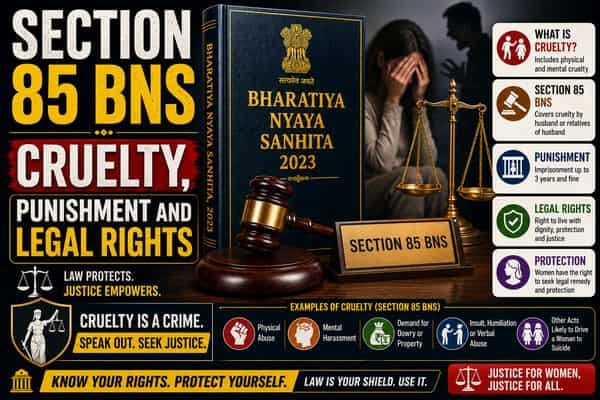
Section 85 BNS Overview
| Particular | Key information |
|---|---|
| Law | Bharatiya Nyaya Sanhita, 2023 |
| Provision | Section 85 |
| Effective from | 1 July 2024 |
| Replaced provision | Section 498A of the Indian Penal Code |
| Persons who may be accused | Husband or relative of the husband |
| Meaning of cruelty | Explained under Section 86 BNS |
| Maximum punishment | Imprisonment up to three years and fine |
| Nature of offence | Cognizable in specified circumstances |
| Bail status | Non-bailable |
| Trial court | Magistrate of the First Class |
| Main purpose | Protection against serious marital cruelty and unlawful property demands |
What Does Section 85 BNS Provide?
Section 85 states that a husband or a relative of the husband who subjects a woman to cruelty may be punished with imprisonment for up to three years and a fine.
The section itself provides the punishment, while Section 86 explains what “cruelty” means. Both provisions must therefore be read together. A complaint should contain conduct that falls within the legal meaning of cruelty rather than relying only on broad statements such as “they treated me badly.”
The provision is primarily aimed at serious abuse within marriage, including conduct that threatens a woman’s safety or pressures her family to satisfy unlawful demands.
What Is Cruelty Under Section 86 BNS?
The law recognises two main forms of cruelty.
Wilful Conduct Causing Serious Danger
The first category covers intentional conduct of such a serious nature that it is likely to:
- Drive the woman to commit suicide
- Cause grave physical or mental injury
- Create danger to her life, limbs or health
Cruelty can therefore be physical or mental. Repeated violence, serious threats, deliberate humiliation, forced isolation, deprivation of essential needs or sustained conduct damaging mental health may become relevant. However, the seriousness, intention, frequency and effect of the behaviour are examined together.
Harassment Connected With an Unlawful Demand
The second category covers harassment intended to force the woman or someone related to her to meet an unlawful demand for property or valuable security.
For example, repeated pressure to bring cash, a vehicle, jewellery, land or money for a business may fall within this category when supported by evidence. Harassment because the woman or her family failed to satisfy such a demand is also covered.
The demand does not have to be made only at the wedding. A demand raised after marriage may also be relevant when it is linked to marital pressure or dowry-related expectations.
Does Every Marital Argument Amount to Cruelty?
No. Normal disagreements, incompatibility, occasional arguments or ordinary domestic irritation do not automatically become criminal cruelty.
Courts generally examine whether the allegations reveal conduct of the seriousness described under Section 86. The complaint should ideally explain:
- What exactly happened
- Who committed the act
- When and where it occurred
- Whether any unlawful demand was made
- How the conduct affected the woman
- Whether the behaviour was repeated or continuing
Similarly, every relative of the husband cannot be included merely because that person belongs to the family. Specific allegations and an identifiable role are important, particularly when relatives live separately or have limited involvement in the couple’s married life.
Who Can Report an Offence Under Section 85?
The offence becomes cognizable when information is given to the police by:
- The woman affected by the cruelty
- A person related to her by blood, marriage or adoption
- A notified public servant where no such relative is available
A court may take cognizance on the basis of a police report or a complaint made by the aggrieved woman. Her parents, siblings, certain close relatives or another relative permitted by the court may also make the complaint.
A woman may approach the local police station, a women’s police station, the district legal services authority or an advocate. Where there is immediate danger, personal safety, medical assistance and a secure place to stay should receive priority.
Evidence That May Support the Complaint
Cruelty often takes place inside the home, where independent witnesses may not be present. Digital and documentary records can therefore become important.
Useful material may include:
- Messages, emails and call records
- Medical reports and injury photographs
- Bank transfers and payment records
- Audio or video material obtained lawfully
- Details of dowry or property demands
- Complaints previously made to authorities
- Statements of neighbours, relatives or colleagues
- A dated record of important incidents
Evidence should remain genuine and unedited. Important records should be backed up securely rather than stored only on a phone accessible to other family members.
The absence of one particular type of evidence does not automatically defeat a complaint. The entire sequence of events, statements and surrounding circumstances is considered during investigation and trial.
Punishment, Bail and Arrest Rules
A person convicted under Section 85 may receive imprisonment extending up to three years and a fine. The court determines the sentence after considering the facts and seriousness of the offence.
The offence is non-bailable, meaning bail is not available as an automatic right from the police. It does not mean bail can never be granted. The accused may apply before the appropriate court, which considers the allegations, evidence, possibility of interference with the investigation and other relevant circumstances.
Although the offence is cognizable in specified circumstances, arrest should not be treated as automatic. Under the BNSS, police must consider whether arrest is necessary. Where arrest is not required, a notice to appear may be issued. A person who receives such notice should cooperate with the investigation and obtain legal advice instead of ignoring it.
Section 85 BNS and Other Legal Remedies
A single incident may attract more than one law, depending on the facts.
Dowry demands may lead to action under the Dowry Prohibition Act, 1961. Serious domestic abuse may also allow the woman to seek protection orders, residence orders, monetary relief, custody-related relief or compensation under the Protection of Women from Domestic Violence Act, 2005.
Where cruelty is connected with an unnatural death within the legally specified period after marriage, provisions relating to dowry death may become relevant. Maintenance, divorce, child custody and return of personal property are separate matters that may proceed before family or civil courts.
A Section 85 case does not automatically grant divorce, maintenance or ownership of property. Appropriate remedies must be requested under the relevant laws.
Practical Steps After Receiving a Complaint or Police Notice
A woman making a complaint should provide a clear chronology and preserve supporting records. She should avoid signing documents she does not understand and may request assistance from a lawyer or legal services authority.
A husband or relative named in a complaint should not threaten the complainant, contact witnesses improperly or destroy messages and documents. Police notices should be followed within the stated time. Evidence showing residence, communication, financial transactions or the actual relationship with the complainant should be preserved.
Both sides should avoid creating false records. Matrimonial proceedings can have serious consequences, and accurate documentation helps the authorities distinguish genuine cruelty from unsupported allegations.
Frequently Asked Questions
Is Section 85 BNS applicable only when dowry is demanded?
No. It also covers serious wilful conduct likely to cause grave physical or mental injury, danger to health or suicidal behaviour. A dowry or property demand is not essential in every case.
Does a non-bailable offence mean the accused will be arrested immediately?
No. Non-bailable means bail must generally be obtained from a court. Police must still follow the legal requirements governing the necessity of arrest and may issue a notice to appear where arrest is not required.
Can relatives living separately be accused under Section 85?
They may be accused when there are specific allegations showing their involvement. Merely being related to the husband is not enough by itself to establish guilt.
Can a Section 85 case be closed after settlement?
The case does not automatically end through a private settlement. In suitable matrimonial disputes, the parties may approach the appropriate High Court for quashing, but the decision depends on the allegations, settlement terms and circumstances of the case.
Disclaimer: This article is intended only for general information and legal awareness. It does not constitute legal advice, representation or an official interpretation of Section 85 of the Bharatiya Nyaya Sanhita, 2023. The application of criminal law depends on the facts, evidence, jurisdiction and judicial decisions in each case. Anyone facing domestic cruelty, a police complaint, arrest concerns or matrimonial proceedings should consult a qualified advocate or approach the appropriate legal authority. The author and publisher are not responsible for decisions taken solely on the basis of this article.