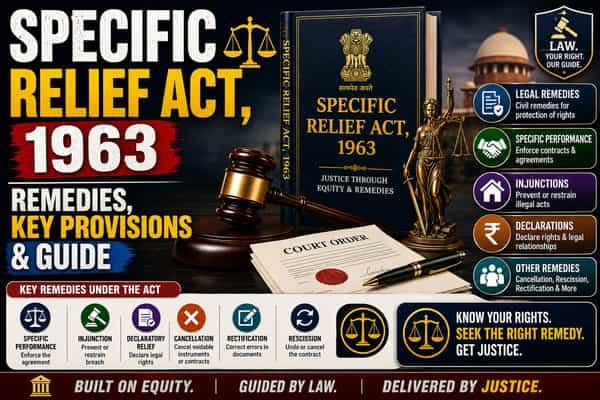
In legal disputes, financial compensation is not always enough to resolve the problem. Imagine purchasing a unique piece of land, signing a business contract for a custom-made machine, or entering into an agreement where the promised performance is more valuable than money. In such cases, simply paying damages may not provide complete justice. This is where the Specific Relief Act, 1963 becomes important.
The Specific Relief Act empowers courts to grant remedies that require parties to perform their contractual obligations or prevent them from doing certain acts, instead of merely awarding monetary compensation. It plays a crucial role in contract enforcement, property disputes, commercial agreements, and civil litigation. Understanding this law is valuable for business owners, property buyers, contractors, lawyers, students, and anyone entering into legally binding agreements.
Specific Relief Act, 1963: Overview
| Particular | Details |
|---|---|
| Full Name | Specific Relief Act, 1963 |
| Enacted | 1963 |
| Objective | Provide specific civil remedies for enforcing legal and contractual rights |
| Applicable To | Civil disputes involving contracts and other legal rights covered under the Act |
| Governing Authority | Civil Courts and other competent courts |
| Covers | Specific performance, injunctions, declaratory relief, recovery of possession, and rectification of instruments |
| Major Amendment | Specific Relief (Amendment) Act, 2018 |
| Importance | Strengthens enforcement of contractual obligations and civil rights |
What is the Specific Relief Act, 1963?
The Specific Relief Act, 1963 is a central legislation that enables courts to grant specific legal remedies in civil matters where monetary compensation alone may not provide adequate relief.
Instead of merely awarding damages, courts may direct a party to perform contractual obligations, restrain unlawful actions, declare legal rights, or grant other equitable remedies provided under the Act.
The legislation works alongside the Indian Contract Act, 1872 and other civil laws, helping ensure that contractual and legal obligations are effectively enforced.
Why Was the Specific Relief Act Introduced?
Many civil disputes involve situations where financial compensation cannot adequately remedy the loss suffered by a party.
The Act was introduced to:
- Enforce lawful contractual obligations.
- Protect civil and property rights.
- Provide equitable remedies.
- Prevent breach of contractual duties.
- Reduce unnecessary litigation.
- Promote certainty in commercial transactions.
- Strengthen confidence in legal agreements.
The law helps ensure fairness where damages alone would be insufficient.
When Does the Specific Relief Act Apply?
The Act applies in various civil matters, including:
- Contract disputes.
- Property disputes.
- Commercial agreements.
- Business transactions.
- Recovery of possession.
- Declaration of legal rights.
- Rectification or cancellation of legal instruments.
Its applicability depends on the facts of each case and the provisions of the law.
Key Remedies Under the Specific Relief Act
1. Specific Performance of Contracts
Specific performance is one of the most important remedies under the Act.
Instead of awarding damages, the court may direct a party to perform its contractual obligations where the legal requirements are satisfied.
This remedy is particularly useful when:
- The subject matter is unique.
- Monetary compensation is inadequate.
- Performance of the contract is still possible.
The 2018 amendment strengthened the framework for granting specific performance in appropriate cases.
2. Injunctions
An injunction is a court order directing a person to do or refrain from doing a particular act.
The Act recognizes different forms of injunctions.
Temporary Injunction
Granted during the pendency of legal proceedings to preserve the status quo until the dispute is decided.
Perpetual Injunction
Granted by the court after the final hearing to permanently restrain unlawful acts where justified.
Injunctions are commonly used in property disputes, intellectual property matters, and contractual disagreements.
3. Declaratory Relief
The court may declare the legal rights or legal status of a person without necessarily granting additional relief.
For example, a person may seek a declaration regarding ownership of property or legal entitlement under a contract.
Declaratory relief helps remove uncertainty regarding legal rights.
4. Recovery of Possession
The Act provides remedies for recovering possession of immovable or movable property in appropriate circumstances.
A person who has been unlawfully deprived of possession may seek relief through the competent court.
5. Rectification of Instruments
Where a written document does not accurately reflect the true intention of the parties due to fraud or mutual mistake, the court may order rectification.
This ensures that the document correctly records the agreement between the parties.
6. Cancellation of Instruments
The court may cancel certain legal instruments if their continued existence is likely to cause serious legal injury and the conditions prescribed by the Act are satisfied.
Examples may include documents affected by fraud, mistake, or other legally recognized grounds.
Major Changes Under the 2018 Amendment
The Specific Relief (Amendment) Act, 2018 introduced significant reforms.
Some important changes include:
- Greater emphasis on specific performance as a remedy.
- Reduced discretionary refusal of specific performance in many cases.
- Provision for substituted performance in specified circumstances.
- Promotion of timely contract enforcement.
- Improved confidence among investors and businesses.
The amendment was intended to improve the ease of doing business in India.
Importance of the Specific Relief Act
The Act plays a vital role in India’s civil justice system.
Its significance includes:
- Strengthening contract enforcement.
- Protecting legal rights.
- Promoting business confidence.
- Supporting commercial certainty.
- Preventing unnecessary breaches of contract.
- Encouraging fair legal remedies.
It provides practical solutions where damages alone would not adequately protect a person’s rights.
Practical Situations Where the Act is Useful
The Act is commonly invoked in cases involving:
- Sale of immovable property.
- Construction agreements.
- Business contracts.
- Partnership disputes.
- Property ownership claims.
- Commercial transactions.
- Recovery of possession.
- Contract enforcement.
It is particularly valuable where the promised performance itself is of primary importance.
Practical Tips Before Entering into Contracts
To reduce the risk of disputes:
- Prepare clear written agreements.
- Define rights and obligations precisely.
- Preserve signed documents.
- Include dispute resolution clauses.
- Understand termination conditions.
- Seek legal advice for high-value transactions.
Proper documentation often prevents future litigation.
Frequently Asked Questions (FAQs)
1. What is specific performance under the Specific Relief Act?
Specific performance is a court-ordered remedy directing a party to fulfil its contractual obligations instead of merely paying monetary compensation, where the legal conditions are satisfied.
2. Can a court grant an injunction under the Specific Relief Act?
Yes. The Act empowers courts to grant temporary or perpetual injunctions in appropriate cases to prevent unlawful acts or protect legal rights.
3. Does the Act apply only to contract disputes?
No. In addition to contract enforcement, the Act also covers declaratory relief, recovery of possession, rectification and cancellation of instruments, and other civil remedies provided under the law.
4. What changed after the 2018 amendment?
The 2018 amendment strengthened contract enforcement by placing greater emphasis on specific performance, introducing provisions for substituted performance, and promoting timely resolution of contractual disputes.
Disclaimer: This article is intended for general informational and educational purposes only. It provides a simplified overview of the Specific Relief Act, 1963 and should not be considered legal advice. The application of the Act depends on the specific facts of each case, applicable amendments, judicial interpretation, and related civil laws. Individuals and businesses should consult a qualified legal professional for advice regarding contract enforcement, property disputes, or any matter involving specific legal remedies.