Many people in India use the terms lawyer and advocate interchangeably, assuming they mean the same thing. However, there is an important legal distinction between these two terms. If you are planning to file a court case, seek legal advice, pursue a career in law, or simply want to understand India’s legal system better, knowing the difference can help you make informed decisions. Choosing the right legal professional at the right stage can save both time and money.
For example, someone may provide legal consultation, draft agreements, or explain your legal rights, while another person may also have the authority to represent you before a court of law. Understanding this difference is especially useful for clients, law students, and anyone dealing with legal matters. In this article, we’ll explain the difference between a lawyer and an advocate in simple English with practical examples.
Lawyer vs Advocate: Overview
| Particular | Lawyer | Advocate |
|---|---|---|
| Meaning | A person who has studied law | A lawyer enrolled with a State Bar Council and eligible to practice in courts |
| Law Degree Required | Yes | Yes |
| Bar Council Enrollment | Not mandatory | Mandatory |
| Can Appear in Court | Not always | Yes |
| Can Give Legal Advice | Yes | Yes |
| Can Draft Legal Documents | Yes | Yes |
| Governed By | General legal principles | Advocates Act, 1961 and Bar Council of India Rules |
| Eligible to Represent Clients in Court | Only if enrolled as an advocate | Yes |
Who Is a Lawyer?
A lawyer is a person who has completed a law degree such as LL.B. or an equivalent legal qualification from a recognized institution.
A lawyer has knowledge of Indian laws and can:
- Provide legal advice.
- Explain legal rights and obligations.
- Draft legal documents and agreements.
- Assist in legal research.
- Work in companies, banks, government departments, or legal firms.
However, simply holding a law degree does not automatically allow a person to represent clients before courts. Additional legal requirements must be fulfilled.
Who Is an Advocate?
An advocate is a lawyer who has fulfilled the legal requirements to practice before Indian courts.
To become an advocate, a person must:
- Obtain a recognized law degree.
- Enroll with a State Bar Council.
- Qualify under the applicable rules prescribed by the Bar Council of India, including the All India Bar Examination (AIBE), where applicable for obtaining a Certificate of Practice.
- Receive authorization to practice law before courts.
Once enrolled, an advocate can legally represent clients before various courts and tribunals across India, subject to applicable rules.
Key Difference Between a Lawyer and an Advocate
The primary difference is simple:
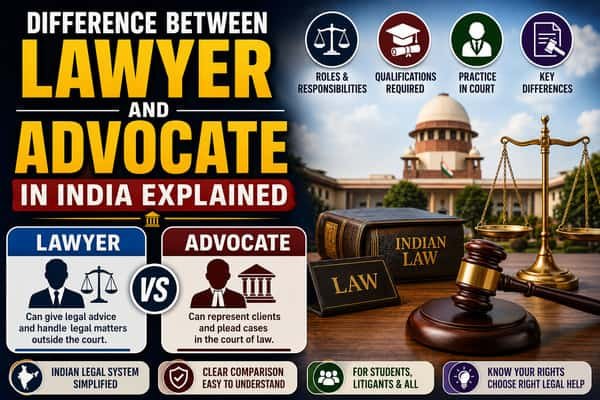
A lawyer has studied law, while an advocate is a lawyer who is legally authorized to practice before courts after enrollment with the State Bar Council.
Every advocate is a lawyer, but not every lawyer is an advocate.
Lawyer vs Advocate: Detailed Comparison
1. Educational Qualification
Both lawyers and advocates must complete a law degree.
Common law degrees include:
- LL.B.
- Integrated BA LL.B.
- BBA LL.B.
- B.Com LL.B.
The educational qualification is the same for both.
2. Right to Practice in Court
This is the biggest difference.
A lawyer who has not completed the required enrollment process cannot independently represent clients before courts.
An advocate has the legal authority to:
- Appear before courts.
- Present arguments.
- File cases.
- Represent clients during hearings.
3. Bar Council Registration
Lawyers are not automatically enrolled with the State Bar Council after completing their law degree.
To become an advocate, enrollment with the appropriate State Bar Council is mandatory. Compliance with Bar Council of India requirements, including obtaining a valid Certificate of Practice where applicable, is also necessary.
4. Nature of Work
A lawyer may work in various legal roles such as:
- Corporate legal departments.
- Legal consultancy.
- Government organizations.
- Banks.
- Insurance companies.
- Compliance departments.
- Legal research.
An advocate generally performs additional responsibilities, including:
- Representing clients before courts.
- Drafting petitions.
- Conducting arguments.
- Filing appeals.
- Appearing before tribunals and judicial authorities.
5. Court Representation
Only advocates are authorized to represent clients before courts in India.
This is why most people hire an advocate when they need assistance in litigation.
Can Every Lawyer Become an Advocate?
Yes.
After completing a law degree, a lawyer can become an advocate by fulfilling the legal requirements prescribed under the Advocates Act, 1961 and the rules of the Bar Council of India, including enrollment with a State Bar Council and meeting the applicable certification requirements.
When Should You Consult a Lawyer?
A lawyer may be suitable when you need:
- Legal advice.
- Contract drafting.
- Property documentation.
- Business agreements.
- Legal opinions.
- Compliance guidance.
Many businesses employ lawyers without requiring them to appear before courts.
When Should You Hire an Advocate?
You should hire an advocate if you need:
- Representation before a court.
- Filing of a civil or criminal case.
- Bail applications.
- Divorce proceedings.
- Property disputes.
- Consumer complaints.
- High Court or Supreme Court litigation.
- Appeals before judicial authorities.
An advocate can handle both legal advice and court representation.
Is an Advocate Better Than a Lawyer?
Not necessarily.
The answer depends on your legal requirement.
If you only need legal advice, documentation, or contract drafting, a lawyer may be sufficient.
If your matter involves court proceedings, you should engage an advocate who is legally entitled to represent you before the court.
Career Opportunities
Both lawyers and advocates have excellent career prospects.
They can work as:
- Corporate legal professionals.
- Independent practitioners.
- Legal consultants.
- Government law officers.
- Public prosecutors (subject to eligibility).
- Judicial officers (through competitive examinations).
- Legal advisors.
- In-house counsel.
Advocates who gain courtroom experience may also specialize in areas such as criminal law, civil law, constitutional law, taxation, family law, or intellectual property law.
Frequently Asked Questions (FAQs)
1. Is every lawyer an advocate in India?
No. Every advocate is a lawyer, but not every lawyer is an advocate. A lawyer becomes an advocate only after enrolling with a State Bar Council and fulfilling the applicable legal requirements to practice before courts.
2. Can a lawyer appear in court without Bar Council registration?
No. A person must be enrolled as an advocate and meet the applicable practice requirements before representing clients before Indian courts.
3. Who should I hire for a court case?
If your matter involves litigation or court proceedings, you should hire an advocate because advocates are authorized to represent clients before courts.
4. Can an advocate also provide legal advice?
Yes. Advocates can provide legal advice, draft legal documents, negotiate settlements, and represent clients before courts.
Disclaimer: This article is provided for general educational and informational purposes only. It explains the legal distinction between a lawyer and an advocate under the Indian legal system. It should not be treated as legal advice or a substitute for professional consultation. Laws, Bar Council regulations, and eligibility requirements may change over time. For advice relating to a specific legal issue, consult a qualified advocate or legal professional.