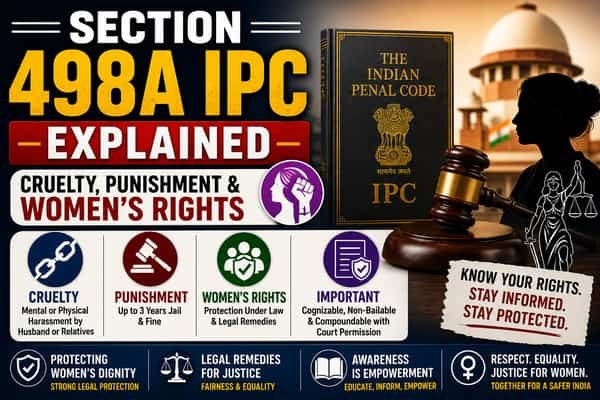
Marriage is built on trust, respect, and mutual support. Unfortunately, not every marriage remains peaceful. In some cases, women face physical violence, mental harassment, emotional abuse, or continuous demands for dowry from their husband or in-laws. Such acts not only affect a woman’s dignity and well-being but can also threaten her life. To protect married women from cruelty within the matrimonial home, the Indian Penal Code (IPC), 1860 introduced Section 498A.
Section 498A became one of the most significant criminal law provisions relating to the protection of married women. It criminalized cruelty by a husband or his relatives and provided legal remedies to victims facing domestic abuse and dowry-related harassment. Although the Indian Penal Code, 1860 has been replaced by the Bharatiya Nyaya Sanhita (BNS), 2023 from 1 July 2024, Section 498A continues to be relevant for cases registered under the IPC and for understanding the evolution of criminal law in India. It remains an important topic for law students, competitive exam aspirants, legal professionals, and the general public.
Section 498A IPC: Overview
| Particular | Details |
|---|---|
| Act | Indian Penal Code, 1860 |
| Section | Section 498A |
| Subject | Cruelty by husband or relatives of husband |
| Introduced | Criminal Law (Second Amendment) Act, 1983 |
| Punishment | Imprisonment up to 3 years and fine |
| Nature of Offence | Cognizable, non-bailable, and non-compoundable (subject to High Court powers under law) |
| Current Status | IPC replaced by Bharatiya Nyaya Sanhita (BNS), 2023 from 1 July 2024 |
What is Section 498A IPC?
Section 498A made it a criminal offence if a husband or his relatives subjected a married woman to cruelty.
The provision was introduced to address increasing cases of:
- Dowry harassment.
- Physical abuse.
- Mental cruelty.
- Harassment likely to drive a woman to suicide.
- Serious abuse causing grave injury or danger to life, limb, or health.
The objective was to provide legal protection to married women facing cruelty within the matrimonial relationship.
Meaning of “Cruelty” Under Section 498A
The law broadly recognized two categories of cruelty.
1. Wilful Conduct
Any deliberate conduct that is likely to:
- Drive a woman to commit suicide.
- Cause grave injury.
- Endanger her life.
- Seriously affect her physical or mental health.
Mental cruelty may also fall within this category depending on the facts of the case.
2. Dowry-Related Harassment
Harassment with a view to coercing the woman or her relatives to meet an unlawful demand for:
- Dowry.
- Property.
- Valuable security.
Continuous pressure for money, gifts, or valuable property connected with marriage may amount to cruelty if the legal requirements are satisfied.
Why Was Section 498A Introduced?
Before this provision, many women facing cruelty within marriage found it difficult to obtain effective criminal protection.
Section 498A was enacted to:
- Protect married women from abuse.
- Curb dowry-related harassment.
- Prevent domestic violence.
- Punish offenders.
- Provide legal support to victims.
- Promote gender justice.
It reflected the legislature’s concern over increasing incidents of cruelty against married women.
Punishment Under Section 498A
A person found guilty under Section 498A could be punished with:
- Imprisonment for a term which may extend to three years; and
- Fine.
The exact sentence depends on the facts, evidence, and judicial findings in each case.
Nature of the Offence
Under the IPC, Section 498A was generally classified as:
- Cognizable – the police could register and investigate the offence in accordance with the law.
- Non-bailable – bail was not available as a matter of right and was subject to the discretion of the competent court.
- Non-compoundable – the offence could not ordinarily be withdrawn by compromise before the trial court, although the High Courts may exercise inherent powers in appropriate cases to quash proceedings after settlement, depending on the facts and applicable legal principles.
Legal Procedure in a Section 498A Case
A typical case generally involves the following stages:
1. Filing of Complaint
The aggrieved woman or another eligible person may approach the police and lodge a complaint.
2. Registration of FIR
If the allegations disclose a cognizable offence, the police may register a First Information Report (FIR) in accordance with the law.
3. Investigation
The police collect evidence, record statements, and conduct the investigation.
4. Filing of Charge Sheet
If sufficient evidence is found, a charge sheet may be filed before the competent court.
5. Trial
The court examines the evidence and decides whether the accused is guilty beyond reasonable doubt.
Judicial Safeguards Against Misuse
The Supreme Court has recognized that while Section 498A serves an important protective purpose, allegations of misuse have also been raised in certain cases.
Accordingly, courts have emphasized:
- Fair investigation.
- Careful scrutiny of allegations.
- Compliance with arrest guidelines.
- Protection of the rights of both the complainant and the accused.
- Avoidance of unnecessary arrests.
Each case must be decided on its own facts and evidence.
Position Under the Bharatiya Nyaya Sanhita, 2023
From 1 July 2024, the Indian Penal Code has been replaced by the Bharatiya Nyaya Sanhita (BNS), 2023.
The offence relating to cruelty by the husband or his relatives has been substantially retained under the BNS, though the provision has been renumbered and incorporated into the new criminal law framework.
Cases registered before the implementation of the BNS may continue to be governed by the IPC, depending on the applicable legal principles.
Rights of an Aggrieved Woman
A woman alleging cruelty may also have rights under other applicable laws, depending on the facts of the case.
These may include:
- Protection under the Protection of Women from Domestic Violence Act, 2005.
- Right to seek maintenance under applicable laws.
- Right to legal representation.
- Right to approach the court for appropriate relief.
- Right to protection from further harassment.
The availability of these remedies depends on the circumstances of each case.
Practical Tips
If a person is involved in a dispute relating to Section 498A:
- Preserve relevant documents and communications.
- Avoid destroying evidence.
- Cooperate with lawful investigation.
- Seek advice from a qualified advocate.
- Do not rely on social media or unofficial legal advice.
- Understand that each case depends on its own facts and evidence.
Timely legal guidance can help protect the rights of all parties.
Frequently Asked Questions (FAQs)
1. What is Section 498A of the IPC?
Section 498A made cruelty by a husband or his relatives towards a married woman a criminal offence, particularly where such cruelty involved serious abuse or dowry-related harassment.
2. What is the punishment under Section 498A IPC?
A person convicted under Section 498A may be punished with imprisonment of up to three years and may also be liable to pay a fine.
3. Is Section 498A still applicable after the Bharatiya Nyaya Sanhita, 2023?
The IPC has been replaced by the Bharatiya Nyaya Sanhita (BNS), 2023 from 1 July 2024. However, cases registered under the IPC before that date continue to be governed by the applicable law, and the offence relating to cruelty has been substantially retained under the BNS.
4. Can a woman file a complaint only for physical violence?
No. Depending on the facts, Section 498A also covered mental cruelty and dowry-related harassment in addition to physical abuse.
Disclaimer: This article is intended for general informational and educational purposes only. It provides a simplified overview of Section 498A of the Indian Penal Code, 1860, which has been replaced by the Bharatiya Nyaya Sanhita (BNS), 2023 with effect from 1 July 2024. The applicability of the law depends on the facts of each case, statutory provisions, judicial precedents, and the stage of the proceedings. This article should not be treated as legal advice. If you are involved in a matrimonial dispute or criminal case, consult a qualified legal professional for advice specific to your situation.