
India’s criminal justice system plays a vital role in maintaining law and order, protecting citizens, and ensuring justice for victims. For more than 160 years, criminal offences in India were primarily governed by the Indian Penal Code (IPC), 1860. However, with changing social conditions, technological advancements, cybercrime, organized crime, and new forms of criminal activity, there was a growing need to modernize criminal laws. To address these evolving challenges, Parliament enacted the Bharatiya Nyaya Sanhita (BNS), 2023, replacing the IPC.
The Bharatiya Nyaya Sanhita is one of India’s most significant legal reforms in recent decades. It introduces updated provisions relating to offences, punishments, organized crime, terrorism, crimes against women and children, electronic offences, and community service while aiming to make criminal law more contemporary and citizen-centric. Understanding the BNS is important for students, legal professionals, law enforcement agencies, businesses, and every citizen because it forms the foundation of India’s criminal law framework.
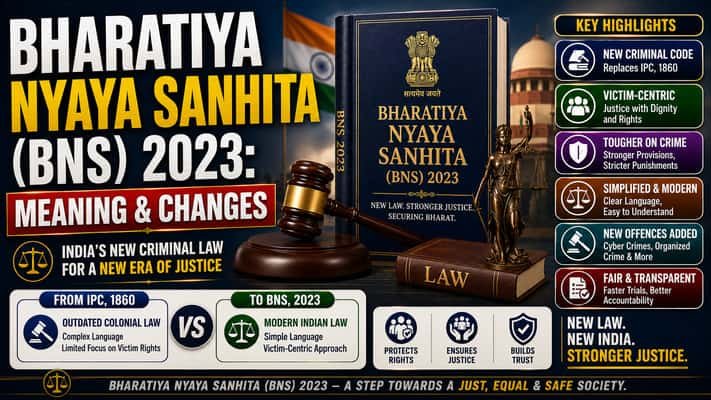
Bharatiya Nyaya Sanhita, 2023: Overview
| Particular | Details |
|---|---|
| Full Name | Bharatiya Nyaya Sanhita, 2023 |
| Common Name | BNS, 2023 |
| Enacted | 2023 |
| Came Into Force | 1 July 2024 |
| Replaces | Indian Penal Code (IPC), 1860 |
| Objective | Modernize India’s criminal law and strengthen the justice system |
| Covers | Criminal offences, punishments, organized crime, terrorism, offences against women and children, and public order |
| Importance | Forms the primary substantive criminal law in India |
What is the Bharatiya Nyaya Sanhita, 2023?
The Bharatiya Nyaya Sanhita (BNS), 2023 is India’s principal criminal law that defines offences and prescribes punishments. It replaces the Indian Penal Code, 1860, and forms part of a broader reform of India’s criminal justice system.
The BNS has been designed to address modern forms of crime while simplifying certain legal provisions. It works alongside the Bharatiya Nagarik Suraksha Sanhita (BNSS), 2023, which governs criminal procedure, and the Bharatiya Sakshya Adhiniyam, 2023, which regulates the law of evidence.
Why Was the Bharatiya Nyaya Sanhita Introduced?
The IPC served India for over a century but was drafted during the colonial era. Over time, legal experts and policymakers felt that criminal law required modernization to reflect present-day realities.
The BNS was introduced to:
- Modernize criminal law.
- Address organized crime and terrorism.
- Strengthen protection for women and children.
- Recognize technology-related offences.
- Simplify criminal provisions.
- Improve efficiency in the justice system.
- Replace outdated colonial-era provisions.
The legislation aims to create a more contemporary criminal law framework suited to present-day India.
Key Features of the Bharatiya Nyaya Sanhita
1. Replacement of the Indian Penal Code
One of the most significant changes is the replacement of the Indian Penal Code, 1860.
While many core criminal offences remain, the BNS reorganizes and updates several provisions to improve clarity and address modern criminal activities.
2. Stronger Provisions Against Organized Crime
The BNS introduces provisions dealing with organized crime and activities carried out by criminal groups, subject to the conditions specified in the law.
These provisions aim to strengthen action against serious criminal networks.
3. Recognition of Terrorism-Related Offences
The BNS includes provisions relating to terrorist acts and offences affecting national security, complementing other applicable special laws where relevant.
These measures reflect the growing importance of addressing security-related offences.
4. Community Service as a Punishment
One notable reform under the BNS is the introduction of community service as a punishment for certain minor offences, where prescribed.
This promotes corrective justice while reducing reliance solely on imprisonment or fines for specified offences.
Important Categories of Offences
The BNS covers a wide range of criminal offences.
Major categories include:
- Offences against the human body.
- Offences against women and children.
- Property offences.
- Financial offences.
- Public order offences.
- Organized crime.
- Terrorism-related offences.
- Cyber-related offences covered under applicable laws.
- Offences affecting public servants and public administration.
Each offence carries penalties prescribed under the legislation.
Protection of Women and Children
The Bharatiya Nyaya Sanhita places significant emphasis on protecting vulnerable groups.
The law contains provisions relating to:
- Sexual offences.
- Violence against women.
- Child protection.
- Human trafficking.
- Exploitation.
The objective is to strengthen legal safeguards while ensuring effective investigation and prosecution.
Changes in Punishments
The BNS updates punishments for various offences.
Depending on the offence, penalties may include:
- Imprisonment.
- Fine.
- Community service for specified offences.
- Life imprisonment.
- Other punishments prescribed by law.
The applicable punishment depends on the nature and seriousness of the offence.
Relationship with Other Criminal Laws
The Bharatiya Nyaya Sanhita is one part of India’s new criminal law framework.
It works together with:
- Bharatiya Nagarik Suraksha Sanhita (BNSS), 2023 – governing criminal procedure.
- Bharatiya Sakshya Adhiniyam, 2023 – governing the law of evidence.
Together, these three legislations replaced the colonial-era criminal law framework.
Importance of the Bharatiya Nyaya Sanhita
The BNS represents one of the most significant reforms in India’s criminal justice system.
Its importance includes:
- Modernizing criminal law.
- Addressing contemporary crimes.
- Improving legal clarity.
- Protecting victims.
- Strengthening national security.
- Promoting efficient criminal justice.
- Supporting technological adaptation in law enforcement.
The Act reflects India’s effort to align criminal law with present-day social and technological developments.
Rights of Citizens
While the BNS defines offences and punishments, individuals continue to enjoy constitutional and legal protections.
These include:
- Right to a fair trial.
- Presumption of innocence until proven guilty.
- Legal representation.
- Protection against unlawful procedures.
- Judicial oversight.
The implementation of the BNS remains subject to the Constitution of India and judicial review.
Practical Tips for Citizens
To remain compliant with criminal law:
- Follow applicable laws and regulations.
- Report criminal activities to the police.
- Preserve evidence if you are a victim of an offence.
- Avoid sharing illegal or harmful content online.
- Cooperate with lawful investigations.
- Seek legal advice if involved in criminal proceedings.
Legal awareness helps individuals protect both their rights and responsibilities.
Frequently Asked Questions (FAQs)
1. What is the Bharatiya Nyaya Sanhita, 2023?
The Bharatiya Nyaya Sanhita, 2023 is India’s principal criminal law that defines criminal offences and punishments. It replaced the Indian Penal Code, 1860, with effect from 1 July 2024.
2. Does the Bharatiya Nyaya Sanhita completely replace the IPC?
Yes. The Bharatiya Nyaya Sanhita has replaced the Indian Penal Code, 1860, as India’s primary substantive criminal law from 1 July 2024.
3. What is one of the major new features of the BNS?
One notable feature is the introduction of community service as a punishment for certain specified offences, along with provisions addressing organized crime and modern forms of criminal activity.
4. Is the BNS the only new criminal law introduced in India?
No. The BNS is part of a broader criminal law reform that also includes the Bharatiya Nagarik Suraksha Sanhita (BNSS), 2023 and the Bharatiya Sakshya Adhiniyam, 2023.
Disclaimer: This article is intended for general informational and educational purposes only. It provides a simplified overview of the Bharatiya Nyaya Sanhita (BNS), 2023 and should not be considered legal advice. The application of the law depends on the facts of each case, applicable government notifications, judicial interpretation, and related legislation. Individuals involved in criminal proceedings or seeking legal guidance should consult a qualified legal professional for advice specific to their circumstances.