For every worker, fair wages are more than just a paycheck—they provide financial security, support families, and ensure a basic standard of living. Whether someone works in construction, manufacturing, agriculture, retail, hospitality, or any other sector, receiving at least the legally prescribed minimum wage is a fundamental labour protection. Without wage regulations, workers could be vulnerable to exploitation through unfairly low pay. To address this issue, India enacted the Minimum Wages Act, 1948, which laid the foundation for minimum wage protection across various employments.
Although the Code on Wages, 2019 has been enacted to consolidate several labour laws, including the Minimum Wages Act, the 1948 Act remains historically significant and continues to be widely studied in competitive examinations, legal education, and discussions on labour law reforms. Understanding this legislation helps employers, employees, HR professionals, students, and business owners appreciate the evolution of wage protection laws in India.
Minimum Wages Act, 1948: Overview
| Particular | Details |
|---|---|
| Full Name | Minimum Wages Act, 1948 |
| Enacted | 1948 |
| Objective | Ensure payment of minimum wages to workers in scheduled employments |
| Applicable To | Scheduled employments notified under the Act (prior to consolidation under the Code on Wages, 2019) |
| Administered By | Central and State Governments |
| Covers | Minimum wage fixation, revision, payment, working hours, overtime, and inspections |
| Current Status | Subsumed under the Code on Wages, 2019, subject to its enforcement framework |
| Importance | Landmark legislation for protecting workers from unfair wages |
What is the Minimum Wages Act, 1948?
The Minimum Wages Act, 1948 was enacted to ensure that workers employed in specified sectors received wages not below the minimum rates fixed by the appropriate government.
Before this law, there was no uniform mechanism to prevent employers from paying extremely low wages, particularly in unorganized and labour-intensive sectors. The Act empowered the Central and State Governments to fix and revise minimum wage rates for scheduled employments while considering factors such as the nature of work, skill level, and local economic conditions.
Although wage regulation is now governed primarily by the Code on Wages, 2019, the Minimum Wages Act remains an important milestone in India’s labour law history.
Why Was the Minimum Wages Act Introduced?
The legislation was introduced to protect workers from exploitation and ensure that they received fair compensation for their labour.
Its major objectives included:
- Prevent payment of extremely low wages.
- Protect vulnerable workers.
- Promote social justice.
- Improve living standards.
- Reduce wage exploitation.
- Encourage fair employment practices.
- Support industrial peace.
The Act played a significant role in improving labour welfare across various industries.
Who Was Covered Under the Act?
The Act primarily applied to workers employed in scheduled employments notified by the appropriate government.
These sectors included various industries such as:
- Construction.
- Agriculture.
- Manufacturing.
- Mining.
- Textile industries.
- Shops and commercial establishments in certain cases.
- Transport.
- Other notified employments.
The list of scheduled employments varied based on government notifications.
Key Features of the Minimum Wages Act
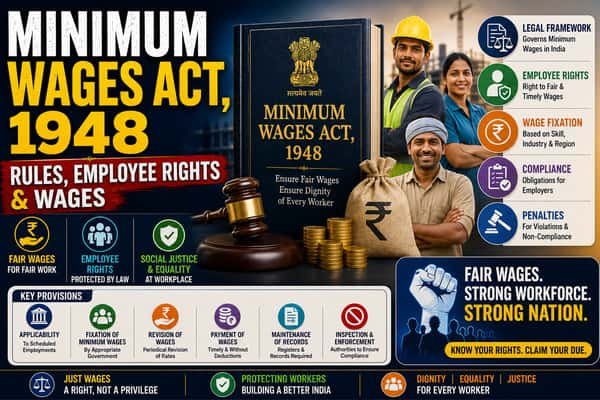
1. Fixation of Minimum Wages
The Act empowered the appropriate government to fix minimum wage rates for workers employed in scheduled employments.
The wage rates could vary depending on factors such as:
- Skill level.
- Nature of work.
- Location.
- Type of employment.
This ensured greater flexibility while addressing regional economic conditions.
2. Periodic Revision of Wages
Minimum wages were not intended to remain static.
The Act required governments to review and revise wage rates periodically to reflect changing economic conditions, inflation, and cost of living.
This helped maintain the real value of workers’ earnings.
3. Different Categories of Wages
The Act permitted different wage rates based on:
- Skilled workers.
- Semi-skilled workers.
- Unskilled workers.
- Highly skilled workers.
- Adults.
- Adolescents where applicable under labour laws.
This classification recognized differences in job responsibilities and expertise.
4. Working Hours and Overtime
The Act also addressed matters relating to:
- Normal working hours.
- Weekly rest.
- Overtime wages where applicable.
- Payment for work performed beyond prescribed hours.
Workers performing overtime were generally entitled to overtime wages in accordance with the applicable legal provisions.
Responsibilities of Employers
Employers covered under the Act were expected to:
- Pay at least the prescribed minimum wage.
- Maintain wage records.
- Pay wages within the prescribed time.
- Comply with working hour regulations.
- Permit inspections by authorized authorities.
- Avoid unlawful deductions.
Compliance with wage laws helped create fair and lawful workplaces.
Rights of Employees
Workers enjoyed several protections under the Act.
These included:
- Right to receive minimum wages.
- Protection against underpayment.
- Right to overtime wages where applicable.
- Access to legal remedies in case of violations.
- Protection from unlawful wage deductions.
- Right to approach competent authorities for wage-related disputes.
These safeguards strengthened the bargaining position of workers.
Inspections and Enforcement
To ensure compliance, the Act authorized inspectors to:
- Visit workplaces.
- Examine wage records.
- Verify payment registers.
- Investigate complaints.
- Ensure compliance with legal requirements.
These enforcement measures helped discourage wage violations.
Penalties for Non-Compliance
Employers who failed to comply with the Act could face legal consequences.
Depending on the nature of the violation, penalties could include:
- Monetary fines.
- Prosecution.
- Payment of wage differences.
- Other legal action as provided under the Act.
The applicable authority determined the consequences based on the facts of each case.
Transition to the Code on Wages, 2019
The Minimum Wages Act, 1948 has been subsumed under the Code on Wages, 2019, which consolidates several labour laws relating to wages.
The Code seeks to:
- Simplify wage laws.
- Extend wage protection to a wider range of employees.
- Introduce the concept of a floor wage.
- Promote uniformity across labour regulations.
- Improve ease of compliance.
The transition represents a significant reform in India’s labour law framework.
Importance of the Minimum Wages Act
The Act remains one of India’s most influential labour welfare legislations.
Its significance includes:
- Protecting workers from exploitation.
- Promoting fair wages.
- Improving living standards.
- Supporting labour welfare.
- Encouraging responsible employment practices.
- Laying the foundation for modern wage reforms.
Its principles continue to influence current labour legislation.
Practical Tips for Employees
Employees should:
- Know the applicable wage rates for their employment.
- Keep salary slips and employment records.
- Verify wage payments regularly.
- Report genuine wage violations to the appropriate authorities.
- Understand their rights under current labour laws.
Awareness of legal rights helps workers protect their interests.
Frequently Asked Questions (FAQs)
1. Is the Minimum Wages Act, 1948 still in force?
The Act has largely been subsumed by the Code on Wages, 2019, subject to its implementation. However, it remains historically important and is frequently studied in labour law and competitive examinations.
2. Who fixed minimum wages under the Act?
The appropriate Central or State Government fixed and periodically revised minimum wages for scheduled employments covered by the Act.
3. Could employers pay less than the prescribed minimum wage?
No. Employers covered by the Act were generally required to pay at least the minimum wage prescribed for the relevant employment.
4. What is the difference between the Minimum Wages Act and the Code on Wages?
The Minimum Wages Act focused primarily on scheduled employments, whereas the Code on Wages, 2019 consolidates multiple wage-related laws and seeks to provide a more comprehensive and uniform framework for wage regulation.
Disclaimer: This article is intended for general informational and educational purposes only. It provides a simplified overview of the Minimum Wages Act, 1948. Readers should note that this Act has been subsumed under the Code on Wages, 2019, subject to its implementation and applicable legal provisions. The information provided should not be treated as legal advice. For guidance on specific employment or wage-related matters, consult the relevant labour authorities or a qualified legal professional.