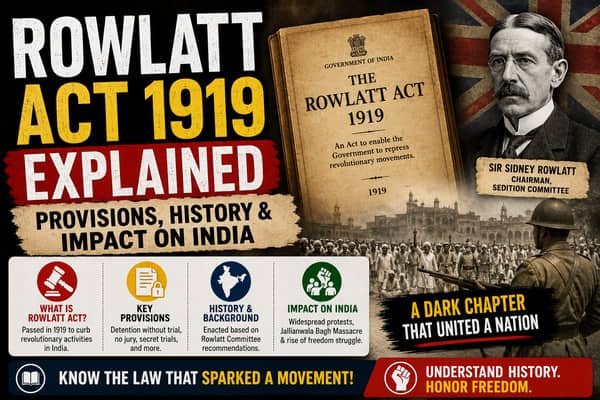
In India’s struggle for independence, several laws introduced during British rule became symbols of oppression rather than justice. Among them, the Rowlatt Act, 1919 stands out as one of the most controversial legislations. It granted the British Government extraordinary powers to arrest and detain individuals without trial, severely restricting civil liberties and freedom of expression. The widespread opposition to this Act united people across India and marked a turning point in the country’s freedom movement.
Understanding the Rowlatt Act is important not only for students preparing for competitive examinations but also for anyone interested in Indian history, constitutional development, and the evolution of civil rights. The Act demonstrates how laws can affect individual freedoms and why democratic societies place great importance on the rule of law and protection of fundamental rights.
Rowlatt Act, 1919: Overview
| Particular | Details |
|---|---|
| Full Name | Anarchical and Revolutionary Crimes Act, 1919 |
| Common Name | Rowlatt Act, 1919 |
| Enacted By | British Imperial Legislative Council |
| Year | 1919 |
| Named After | Justice Sir Sidney Rowlatt |
| Main Purpose | To curb revolutionary activities and political movements against British rule |
| Major Powers | Preventive detention, arrest without warrant, restrictions on trials and public freedoms |
| Public Response | Nationwide protests and the Rowlatt Satyagraha |
| Historical Significance | Became a major catalyst for India’s freedom movement |
What Was the Rowlatt Act?
The Rowlatt Act, officially known as the Anarchical and Revolutionary Crimes Act, 1919, was enacted by the British colonial government following the recommendations of the Rowlatt Committee, headed by Justice Sir Sidney Rowlatt.
The British administration claimed that revolutionary activities and political unrest after the First World War posed a threat to public order. To address these concerns, the Act extended several emergency powers that had been used during the war, even though the war had already ended.
The law was widely criticized because it significantly reduced civil liberties and allowed the government to exercise sweeping powers with limited judicial oversight.
Why Was the Rowlatt Act Introduced?
The British Government argued that revolutionary groups were becoming increasingly active and that stronger legal measures were necessary to maintain law and order.
The objectives behind the Act included:
- Suppress revolutionary movements.
- Prevent anti-British political activities.
- Control nationalist organizations.
- Strengthen the government’s policing powers.
- Prevent public unrest.
However, many Indian leaders believed that the Act was intended to suppress peaceful political dissent rather than address genuine security concerns.
Key Provisions of the Rowlatt Act
The Act introduced several extraordinary legal powers.
1. Preventive Detention
Authorities could detain individuals suspected of revolutionary activities for extended periods without following the ordinary criminal trial process.
2. Arrest Without Warrant
Police were empowered to arrest certain individuals without obtaining prior judicial authorization in situations covered by the Act.
3. Restrictions on Trials
The Act permitted special procedures for certain offences, limiting many of the safeguards normally available in criminal proceedings.
In some cases:
- Jury trials could be dispensed with.
- Proceedings could be conducted before special tribunals.
- Appeals were significantly restricted under the applicable provisions.
4. Restrictions on Freedom
The Act enabled the government to impose restrictions affecting:
- Public meetings
- Political gatherings
- Publications
- Freedom of expression
- Movement of suspected individuals
These powers were viewed as severe limitations on civil liberties.
Why Was the Rowlatt Act So Controversial?
The Act became highly unpopular because many Indians believed it violated the basic principles of justice and fairness.
The major criticisms included:
- Detention without ordinary judicial safeguards.
- Wide discretionary powers for the executive.
- Limited opportunities to challenge government action.
- Restrictions on political expression.
- Suppression of civil liberties.
Many Indian leaders described the legislation as unjust because it gave extraordinary powers to the colonial government while offering limited legal protections to individuals.
Opposition to the Rowlatt Act
The Act faced widespread opposition across India.
Prominent leaders, lawyers, students, traders, and ordinary citizens participated in protests against the legislation.
One of the strongest critics was Mahatma Gandhi, who believed the Act violated the principles of justice and individual freedom.
He launched the Rowlatt Satyagraha, calling upon people to resist the law through peaceful, non-violent means.
The movement marked one of Gandhi’s first nationwide mass political campaigns in India.
Connection with the Jallianwala Bagh Massacre
The protests against the Rowlatt Act eventually led to one of the darkest chapters in Indian history.
On 13 April 1919, thousands of people gathered at Jallianwala Bagh in Amritsar, Punjab.
The gathering included:
- Peaceful protesters
- Local residents
- Families attending the Baisakhi festival
British troops under Brigadier General Reginald Dyer opened fire on the unarmed crowd without warning, resulting in a large number of deaths and injuries.
The massacre shocked the nation and intensified public anger against British rule.
It also strengthened India’s independence movement and further reduced public confidence in the colonial administration.
Impact of the Rowlatt Act on India’s Freedom Movement
Although the Act was intended to suppress political opposition, it had the opposite effect.
Its impact included:
- Increased public participation in the freedom movement.
- Greater unity among Indians across regions.
- Rise of non-cooperation movements.
- Strengthening of Gandhian leadership.
- Growing demand for self-rule.
- International criticism of British policies in India.
The Act became a symbol of colonial repression and encouraged many Indians to actively participate in the struggle for independence.
Why Is the Rowlatt Act Important Today?
The Rowlatt Act is no longer in force, but it continues to hold great historical significance.
It serves as a reminder of:
- The importance of civil liberties.
- The need for fair legal procedures.
- Judicial oversight in criminal justice.
- Protection against arbitrary state action.
- Democratic accountability.
Modern India’s constitutional framework places significant emphasis on protecting individual rights, ensuring due process, and maintaining the rule of law—principles that stand in sharp contrast to the extraordinary powers granted under the Rowlatt Act.
Historical Legacy of the Rowlatt Act
The Rowlatt Act occupies an important place in Indian history because it changed the course of the freedom struggle.
Its legacy includes:
- Inspiring nationwide political awakening.
- Demonstrating the power of peaceful public resistance.
- Strengthening demands for independence.
- Highlighting the importance of constitutional rights.
- Influencing future democratic values in independent India.
Today, the Act is studied as an example of how excessive governmental powers can affect civil liberties and public trust.
Frequently Asked Questions (FAQs)
1. Why was the Rowlatt Act called the “Black Act”?
Many Indians referred to it as the Black Act because they believed it gave the British Government excessive powers that curtailed civil liberties and denied individuals important legal protections.
2. Who introduced the Rowlatt Act?
The Act was enacted by the British Government in India in 1919 based on the recommendations of the Rowlatt Committee chaired by Justice Sir Sidney Rowlatt.
3. What was the connection between the Rowlatt Act and the Jallianwala Bagh Massacre?
The widespread protests against the Rowlatt Act created the backdrop for the gathering at Jallianwala Bagh in Amritsar on 13 April 1919, where British troops fired on an unarmed crowd, making the incident one of the most significant events of India’s freedom movement.
4. Is the Rowlatt Act still applicable in India?
No. The Rowlatt Act is no longer in force. It is studied today as an important historical law that influenced India’s struggle for independence and highlighted the importance of protecting civil liberties.
Disclaimer: This article is intended for general educational and informational purposes only. It presents a simplified overview of the Rowlatt (Anarchical and Revolutionary Crimes) Act, 1919 based on historical records. The content should not be interpreted as legal advice or a comprehensive historical analysis. Readers seeking detailed academic or legal information should consult authoritative historical sources or qualified experts.