Discovering that someone has occupied your house, plot, shop, or other property without permission can be alarming. But even when ownership documents are clearly in your name, physically removing the occupant yourself may create a bigger legal dispute.
Indian law provides civil remedies for recovering possession of immovable property. The correct route depends on an important question: how did the person enter or remain in possession? A stranger who allegedly entered without permission, a tenant refusing to leave, a relative occupying family property, and a person claiming ownership may all require different legal approaches.
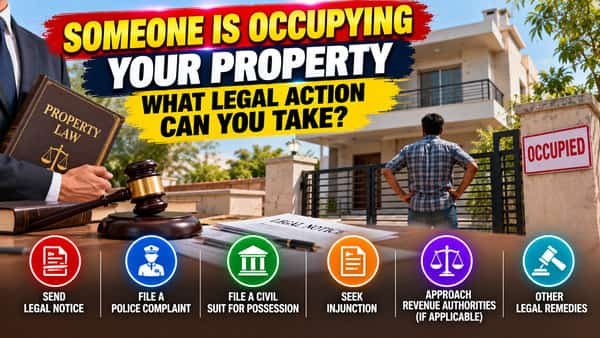
Property Occupation: Quick Legal Overview
| Situation | Possible Legal Step |
|---|---|
| Recently dispossessed without consent | Consider remedy under Section 6 of Specific Relief Act |
| Owner seeking possession on title | Suit for recovery of possession |
| Occupant threatening further interference | Injunction may be sought |
| Tenant refusing to vacate | Eviction proceedings under applicable tenancy/property law |
| Forged documents or alleged fraud | Civil action and, where facts disclose an offence, criminal complaint |
| Ownership itself is disputed | Declaration/title and possession proceedings may be necessary |
1. Do Not Try to Remove the Occupant by Force
One of the biggest mistakes a property owner can make is attempting immediate physical eviction without following legal procedure.
Changing locks, removing someone’s belongings, threatening occupants, or using force can create additional disputes.
Indian law recognises remedies against dispossession otherwise than through due course of law. Section 6 of the Specific Relief Act, 1963, for example, permits a person dispossessed without consent and otherwise than in due course of law to sue to recover possession, subject to its requirements.
Therefore, ownership and the right to physically remove someone are not always the same question.
Use the legal process to establish and enforce your right to possession.
2. Collect Your Property Documents
Before starting proceedings, establish your documentary position.
Depending on the property, useful records can include:
- Registered sale deed
- Conveyance deed
- Gift deed
- Will and succession documents
- Partition documents
- Lease or rent agreement
- Possession documents
- Property-tax records
- Electricity or utility records
- Mutation/revenue records
- Previous correspondence with the occupant
- Photographs and other evidence concerning possession
A single document does not necessarily decide every ownership dispute. Your advocate may need to examine the entire chain of title and the circumstances in which the other person obtained possession.
3. Find Out How the Occupant Entered the Property
This is critical because not every person remaining in a property is legally in the same position.
Complete Stranger
If someone allegedly entered property without permission, the owner may need possession and injunction remedies and, depending on the facts, may also need to approach the appropriate authorities.
Tenant
A tenant who entered under a valid tenancy cannot simply be treated as a stranger who trespassed onto the property.
Termination and eviction may be governed by the lease, the Transfer of Property Act, applicable state rent-control legislation, or other relevant law.
Relative or Family Member
Family-property disputes can involve questions of ownership, inheritance, partition, licences, joint possession, or other rights.
Before calling a relative an illegal occupant, the person’s claimed legal interest in the property should be examined.
Person Claiming Ownership
If both sides claim ownership, a simple demand to vacate may not resolve the matter. The court may need to determine title and possession based on the pleadings and evidence.
4. Send a Legal Notice Where Appropriate
Depending on the case, an advocate may first send a legal notice requiring the occupant to vacate or address the dispute.
A notice can identify:
- The property
- Your claimed ownership or right to possession
- How the other person came into possession
- Why their continued occupation is disputed
- The demand to vacate
- A reasonable or legally applicable deadline
- Proposed legal action if the dispute is not resolved
A notice does not itself physically evict someone.
Its usefulness is that it formally communicates your position and may create an opportunity to resolve the matter before litigation.
5. File a Suit for Recovery of Possession
The Specific Relief Act provides important remedies concerning possession of immovable property.
Under Section 5, a person entitled to possession of specific immovable property may recover it in the manner provided by the Code of Civil Procedure.
A title-based possession case can require the claimant to establish their legal right to the property.
Evidence can therefore become crucial.
The Supreme Court’s own case categorisation recognises civil proceedings involving the Transfer of Property Act and Specific Relief Act concerning declaration, injunction, possession and cancellation of deeds or documents.
6. Recently Dispossessed? Section 6 Can Be Important
Section 6 of the Specific Relief Act provides a special remedy where someone has been dispossessed from immovable property without consent and otherwise than in due course of law.
An important feature is the time limit.
A Section 6 suit must be brought within six months from the date of dispossession. The section also states that such a suit cannot be brought against the Government.
The Supreme Court dealt with this remedy in a 2024 decision involving a suit filed within six months of alleged illegal dispossession and upheld the findings concerning restoration of possession.
Section 6 is therefore particularly important when the dispute concerns recent forcible or otherwise unlawful dispossession.
It should not be confused with an ordinary title-based possession suit.
7. Consider an Injunction
Recovering possession may not be the only concern.
Suppose the occupant starts:
- Altering the property
- Creating third-party interests
- Claiming rights over it
- Interfering with your lawful possession
- Threatening a transfer
Depending on the circumstances, an advocate may advise seeking temporary or permanent injunctive relief.
An injunction is essentially a court remedy intended to require or restrain particular conduct, depending on the nature of the order.
Interim relief can be particularly important when something may happen before the main property dispute is finally decided. The Supreme Court’s procedural classifications expressly recognise applications for interim injunction and injunction relief.
Whether an injunction should be requested depends on the facts and the relief claimed in the case.
8. What If Fake Property Documents Are Being Used?
A possession dispute becomes more serious when the occupant relies on a document that the owner alleges is forged or fraudulently created.
Do not destroy, alter, or seize documents yourself.
Preserve copies and obtain legal advice.
Depending on the facts, the dispute may require civil remedies concerning declaration, cancellation of documents, injunction, and possession. If the facts also disclose a criminal offence, a separate complaint to the appropriate authority may be considered.
The civil and criminal aspects should not be confused: a dispute does not automatically become criminal simply because one party says the other’s documents are incorrect.
9. Do Not Delay Taking Legal Advice
Property disputes can be subject to limitation periods.
The applicable period depends on the type of proceeding and the facts. For example, the Limitation Act separately deals with claims concerning possession and claims for compensation for trespass; Article 87 provides a three-year period for compensation for trespass upon immovable property from the date of trespass.
This should not be confused with the separate six-month period for the summary remedy under Section 6 of the Specific Relief Act.
Because different remedies can carry different limitation rules, waiting for years before obtaining advice can complicate a property dispute.
10. Police Complaint or Civil Case?
This depends on what actually happened.
A dispute about title or entitlement to possession is commonly dealt with through civil proceedings.
But if the facts involve alleged criminal conduct—such as document forgery or other independently punishable acts—the circumstances may also justify approaching the police.
A police complaint should not be treated as a substitute for a civil possession suit where the real dispute is over ownership or possession.
An advocate can examine the facts and determine which remedies can legitimately proceed.
What Should a Property Owner Do First?
A practical sequence is:
- Preserve evidence of your ownership and possession.
- Identify the occupant and understand how possession began.
- Do not attempt forcible eviction.
- Record when you discovered the occupation or were dispossessed.
- Have the title documents examined by a property lawyer.
- Send an appropriate legal notice where advisable.
- Seek possession, declaration, injunction, eviction, or other appropriate relief depending on the facts.
- Act quickly where recent dispossession makes Section 6 relevant.
The most important point is that “someone is occupying my property” does not describe one single legal problem. The relationship between the parties and the history of possession determine which remedy is appropriate.
FAQs
Q1. Can I forcibly remove someone occupying my property?
A. You should use the lawful process for recovering possession rather than attempting forcible self-help. Indian law specifically provides remedies concerning recovery of possession and dispossession otherwise than through due course of law.
Q2. Can I file a case to recover possession of my property?
A. Yes, where the legal requirements are satisfied. Section 5 of the Specific Relief Act provides for recovery of specific immovable property by a person entitled to possession through the procedure provided by the Code of Civil Procedure.
Q3. What if someone recently took possession of my property without permission?
A. Section 6 of the Specific Relief Act may be relevant where a person has been dispossessed without consent and otherwise than in due course of law. A suit under this section must generally be filed within six months of dispossession.
Q4. Can an illegal occupant become the owner just by staying on the property for years?
A. Mere long occupation should not automatically be treated as ownership. Questions involving limitation and adverse possession have specific legal requirements and are highly fact-dependent. Owners facing long-standing occupation should have the title and possession history examined promptly rather than assuming either side automatically owns the property.
Q5. Can I seek an injunction against a property occupant?
A. Depending on the circumstances, injunction relief may be sought to prevent particular interference, alteration, transfer, or creation of third-party interests while the underlying rights are determined. The exact relief depends on the facts and the nature of the property dispute.