India’s next large consumer opportunity is not limited to Mumbai, Delhi, Bengaluru or other major metros. Cities such as Indore, Jaipur, Lucknow, Nagpur, Coimbatore, Surat, Bhubaneswar and many smaller urban centres are seeing stronger digital adoption, organised retail and demand for convenient services.
This creates a different opportunity for entrepreneurs. Instead of introducing an entirely new category, a business can often succeed by providing a product or service that already works in metropolitan India—but adapting its pricing, delivery and customer experience to the local market.
The shift is visible in online commerce. Tier-2 and Tier-3 cities are expected to generate nearly 66% of new D2C orders in FY26, and around 65% of new online shoppers in 2025 came from Tier-2 and smaller cities.
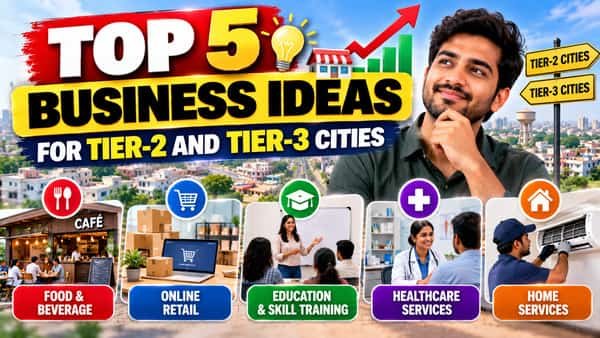
Here are five business models worth considering.
Business Ideas at a Glance
| Business Idea | Investment | Revenue Opportunity |
|---|---|---|
| Local digital marketing agency | Low | Monthly retainers |
| Cloud kitchen/takeaway food | Medium | Repeat orders |
| Local D2C brand | Low–Medium | Product margins |
| Home maintenance services | Medium | Service fees/packages |
| Skill training centre | Low–Medium | Course fees |
1. Digital Marketing Agency for Local Businesses
Many businesses in smaller cities have already established themselves offline but have not developed an equally strong digital presence.
Restaurants, clinics, coaching centres, hotels, property businesses, retailers and professional-service firms may need help with websites, local search visibility and social media.
A small agency can provide:
- Website development
- Local SEO
- Google Business Profile management
- Social-media management
- Content creation
- Online advertising
- E-commerce setup
- Basic analytics and reporting
The advantage is recurring revenue.
Instead of charging only for building a website, the agency can provide monthly SEO, website maintenance or digital-marketing packages.
A local agency can also have an advantage over a remote provider because it understands the city’s language, neighbourhoods, customer behaviour and competition.
India’s MSME initiatives are also encouraging smaller enterprises to participate in digital commerce. The MSE TEAM initiative under RAMP, for example, specifically prioritises outreach in Tier-2 and Tier-3 cities while helping micro and small enterprises adopt digital and e-commerce tools.
Best for: Web developers, SEO specialists, designers and digital marketers.
2. Cloud Kitchen and Takeaway Food Business
A full-service restaurant requires a good location, interiors, furniture and front-of-house employees. A delivery-focused kitchen can operate differently.
It concentrates primarily on preparing food for takeaway and delivery.
The menu can be built around local demand, such as:
- Regional meals
- Office lunch boxes
- Healthy meals
- Snacks
- Biryani
- Bakery products
- Family meal packages
The biggest advantage is the possibility of beginning with a smaller physical footprint than a conventional dine-in restaurant.
However, a cloud kitchen is not automatically profitable. Food costs, packaging, delivery-related expenses, marketing and wastage all affect margins.
A better approach is to start with a focused menu rather than trying to offer dozens of dishes.
Food businesses must also comply with applicable food-safety requirements. Registration or licensing requirements should be checked through the official FSSAI system before starting commercial operations.
Best for: Food entrepreneurs who understand local tastes and kitchen operations.
3. Build a Local D2C Brand
A business located in a smaller city no longer has to depend entirely on local customers.
E-commerce allows locally produced products to be sold across India.
This creates opportunities around products such as:
- Regional foods
- Handicrafts
- Home décor
- Textiles
- Personalised gifts
- Local speciality products
- Selected lifestyle products
The numbers show why this model deserves attention. Tier-2 and Tier-3 cities are expected to contribute around 66% of new D2C orders in FY26. India’s annual online transacting population has also expanded substantially, with smaller cities becoming major contributors to new customer acquisition.
There are two sides to the opportunity.
Entrepreneurs can sell to consumers in Tier-2 and Tier-3 cities, or build brands from these cities and sell nationally.
The second model can be particularly interesting where the city or surrounding region has a distinctive product.
A startup should begin with a limited product range, professional packaging and clear positioning rather than launching dozens of products immediately.
Best for: Entrepreneurs with access to distinctive local products or manufacturing capabilities.
4. Organised Home Maintenance Services
Finding a plumber, electrician, appliance technician, cleaner or carpenter is possible in most cities. The bigger problem can be finding someone who arrives on time, provides transparent pricing and offers dependable after-service support.
That gap creates an opportunity for an organised local service business.
Services could include:
- Plumbing
- Electrical work
- Appliance servicing
- AC servicing
- Home cleaning
- Carpentry
- Painting
- Pest-management coordination through appropriately qualified providers
The company does not necessarily need to employ a large team from the beginning.
It could start with a small group of verified technicians, centralised bookings and standardised service charges.
WhatsApp, a website and a simple booking system may be enough initially.
The real product is reliability.
Customers should know approximately when the technician will arrive, what the service will cost and whom to contact if there is a problem afterward.
As Tier-2 and Tier-3 cities expand, rising housing and consumer demand can create room for more organised local services. India’s real-estate services sector is also seeing growing demand in these cities.
Best for: Entrepreneurs who are good at managing people and local operations.
5. Skill Training and Career Education Centre
Tier-2 and Tier-3 cities contain large populations of students and young professionals seeking employment-oriented skills.
A training business can focus on practical subjects such as:
- Coding
- Web development
- Graphic design
- Digital marketing
- Accounting software
- Excel
- Spoken English
- Interview preparation
- E-commerce
- AI productivity tools
The key is avoiding the traditional model of teaching outdated material simply to issue certificates.
Courses should be designed around skills that students can actually demonstrate.
For example, a web-development programme could require every student to build a functioning website. A digital-marketing course could include keyword research, campaign planning and analytics exercises.
The business can combine offline classes with recorded lessons and live online support.
This hybrid model allows an institute to serve local students while gradually expanding beyond one city.
Best for: Teachers, experienced professionals and entrepreneurs with expertise in employability-focused skills.
Why Tier-2 and Tier-3 Cities Offer Business Opportunities
The biggest attraction is not simply that operating expenses may be lower than in some metros.
Consumer behaviour is changing.
India’s fastest consumer growth is coming from Tier-2 and Tier-3 cities, which are expected to add nearly 100 million consumers to branded and organised retail by 2030.
Online commerce has accelerated this transition. Two-tier cities and smaller towns already account for around 60% of online orders, according to IBEF’s 2026 e-commerce industry analysis.
That creates room for businesses combining local knowledge with standards customers increasingly experience online: transparent pricing, digital payments, convenient ordering, professional branding and dependable after-sales service.
How to Choose the Right City and Business
Do not assume that every Tier-2 or Tier-3 city has the same opportunity.
Study the specific city before investing.
A strong manufacturing city may create opportunities for B2B services. A university city may support student housing, education and affordable food businesses. A tourism-focused city may have opportunities in accommodation and local experiences, while a rapidly developing residential city may need organised home services.
Look at:
- Population and customer profile
- Local industries
- College and student population
- Residential development
- Existing competition
- Commercial rents
- Digital adoption
- Purchasing power
- Availability of skilled workers
Most importantly, identify something residents currently obtain inconveniently, inconsistently or from another city. That gap can provide a much stronger business opportunity than simply copying a popular startup from a metro.
FAQs
Q1. Which business is best for Tier-2 cities in India?
A. Digital services, organised home services, food businesses, skill training and D2C brands can be promising, but the best opportunity depends on the city’s economy, population and existing competition.
Q2. Are Tier-3 cities suitable for online businesses?
A. Yes. Tier-2 and smaller cities are becoming increasingly important to Indian e-commerce, accounting for a substantial share of new online shoppers and orders.
Q3. Which business can be started with low investment?
A. Digital marketing, website services, online training and certain locally sourced D2C businesses can have relatively low initial costs compared with businesses requiring large premises or machinery.
Q4. Should I open a franchise in a Tier-2 or Tier-3 city?
A. A franchise can work where the brand has local demand and the economics make sense. Evaluate franchise fees, rent, royalties, required investment, competition and realistic sales before committing.
Q5. What is the biggest advantage of starting in a smaller city?
A. Entrepreneurs can sometimes benefit from lower operating costs and underserved customer needs while still reaching national customers through digital channels. The opportunity varies considerably from one city to another, so local market research remains essential.