Starting a business alone creates an unusual decision for an entrepreneur. You may be the only founder today, but the legal structure you choose must also support where the business could go tomorrow. In India, two corporate structures that often enter this discussion are a One Person Company (OPC) and a Private Limited Company.
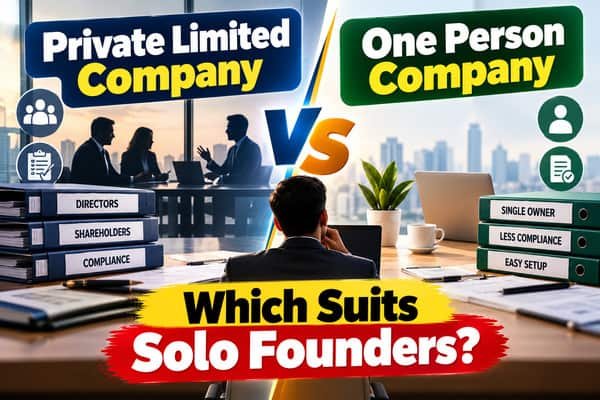
An OPC is specifically designed to allow a single eligible person to operate through a company structure with limited liability. A private limited company, on the other hand, requires at least two members and two directors, although the same individuals can generally act as both shareholders and directors where legally eligible.
For a genuinely solo entrepreneur, an OPC can provide a practical starting structure. But if the business is likely to add co-founders, issue shares or raise equity investment, a private limited company may provide greater flexibility.
What Is a One Person Company?
A One Person Company is a company that has only one person as its member. It allows an individual entrepreneur to establish a separate corporate entity without finding another shareholder simply to meet a minimum membership requirement.
An OPC can be useful for consultants, technology entrepreneurs, online businesses, small service providers and other founders who want complete ownership while operating through a company.
One distinctive requirement is the nomination of another person. The nominee can become the member of the OPC in circumstances prescribed under company law, such as the death or incapacity of the existing member.
An OPC therefore combines single ownership with a corporate legal structure.
What Is a Private Limited Company?
A private limited company is a privately held company incorporated under the Companies Act, 2013. Unlike an OPC, it cannot operate with only one member.
A private company generally requires:
- At least two members
- At least two directors
- A registered office
- Compliance with applicable company law requirements
A private limited structure is widely used by businesses that have multiple founders or intend to introduce additional shareholders.
For startups planning to raise equity capital, build a larger ownership structure or offer shares to investors, a private limited company can be more suitable from the beginning.
Private Limited Vs OPC: Key Differences
Since solo founders often evaluate these two structures side by side, a comparison helps clarify their practical differences.
| Factor | One Person Company | Private Limited Company |
|---|---|---|
| Minimum members | 1 | 2 |
| Minimum directors | 1 | 2 |
| Suitable for single owner | Yes | Not as a single-member structure |
| Nominee requirement | Yes | No OPC-style nominee requirement |
| Adding shareholders | Requires structural change/conversion as applicable | More straightforward within legal limits |
| Equity fundraising | Less suitable in existing single-member form | Generally more suitable |
| Ownership structure | Single member | Multiple members permitted |
| Compliance | Corporate compliance applies, with certain OPC-specific relaxations | Regular private company compliance applies |
| Best suited for | Genuine solo entrepreneurs | Multi-founder and growth-oriented businesses |
Why Can an OPC Be Attractive to a Solo Founder?
The strongest reason to choose an OPC is simple: you can remain the sole member of the company.
A founder does not need to bring in another shareholder merely to satisfy the minimum membership requirement of a private company.
This can be useful when the entrepreneur wants:
- Full ownership and control
- A separate corporate identity
- Limited liability protection, subject to law
- Greater business formality than an individual proprietorship
- Continuity through the nominee mechanism
- A structure designed specifically for a single member
An OPC may therefore fit businesses where the founder expects to remain the sole owner for a meaningful period.
Where Can an OPC Become Restrictive?
The same single-member characteristic that makes an OPC attractive can eventually become its limitation.
Suppose a founder launches a software business as an OPC and later wants to bring in a co-founder in exchange for shares. The existing OPC structure cannot simply continue as a one-person company with multiple members.
Similarly, an investor expecting equity ownership cannot become an additional shareholder while the entity remains an OPC.
The company would need to take the appropriate legal steps to move to a structure that permits multiple members.
Therefore, founders should think beyond their current position. Being solo today does not necessarily mean the business will remain single-owner.
Why Do Growth-Focused Startups Often Prefer Private Limited Companies?
A private limited company provides a more natural structure for businesses built around multiple shareholders.
For example, suppose two founders want to own 60% and 40% of a startup. A private company can accommodate that ownership arrangement directly.
If investors later participate, shares can potentially be issued or transferred according to applicable company law, the company’s constitutional documents, shareholder arrangements and regulatory requirements.
This makes a private limited company particularly relevant for businesses planning to:
- Add co-founders
- Raise equity funding
- Introduce strategic investors
- Create a more complex shareholding structure
- Scale operations substantially
- Consider employee equity incentives
The structure does not guarantee investment, but it generally provides a more suitable corporate framework for equity participation.
What About Compliance Costs?
Both OPCs and private limited companies are incorporated companies, so neither should be chosen with the assumption that corporate compliance disappears.
Depending on the company’s circumstances, obligations may involve maintaining statutory records, financial statements, income-tax filings, Registrar of Companies filings and other applicable requirements.
OPCs receive certain compliance-related exemptions or simplified requirements under company law. However, this does not make an OPC a compliance-free entity.
A founder should therefore compare the actual annual compliance burden and professional costs rather than choosing solely on the basis of registration expenses.
OPC Vs Private Limited Company for Raising Investment
This is one of the most important considerations for an ambitious solo founder.
An OPC has one member by definition. Therefore, bringing an equity investor into the existing ownership structure conflicts with its fundamental single-member nature.
A private limited company, by contrast, is designed to accommodate multiple shareholders.
If your business model depends on angel investment, venture capital or another form of equity fundraising, starting with a private limited structure may avoid an additional restructuring step later.
However, a freelancer, consultant or closely controlled business that intends to grow mainly through revenue rather than external equity may find an OPC sufficient.
Can an OPC Later Become a Private Limited Company?
Yes. An OPC can be converted into another type of company by following the applicable legal process and meeting the required conditions.
This gives solo founders flexibility.
A founder can begin with an OPC while the business remains individually owned and later move to a private company when additional shareholders are required.
However, conversion involves legal documentation, corporate approvals and regulatory filings. If you already know that a co-founder or equity investor is likely to join soon, starting with an appropriate private company structure may be more efficient.
Which Structure Suits a Solo Founder Better?
The answer depends less on the number of founders today and more on the expected ownership structure tomorrow.
An OPC may suit you when you genuinely want to remain the only shareholder, want a corporate identity and do not expect equity investors or co-founders in the near future.
A private limited company may be more suitable when the business is being built for multiple owners, external equity investment or a rapidly evolving shareholding structure.
For a small solo business, choosing a private limited company merely because it appears more prestigious can create unnecessary complexity. At the same time, choosing an OPC solely because you are currently alone may lead to restructuring if your growth plan already involves additional shareholders.
The legal structure should therefore follow the business plan rather than the other way around.
FAQs
Q1. Can one person start a private limited company in India?
A. A private limited company requires a minimum of two members and two directors. A single eligible entrepreneur who wants to be the sole member can consider a One Person Company instead. If another genuine shareholder is involved, a private limited company may become an option.
Q2. Is an OPC better than a private limited company for a startup?
A. An OPC can work well for a startup that will remain under one person’s ownership. A private limited company is generally more suitable when multiple founders or equity investors are expected because it can accommodate multiple shareholders.
Q3. Can an OPC have two shareholders?
A. No. The defining feature of a One Person Company is that it has only one member. If another person needs to become a shareholder, the company would need to adopt an appropriate structure in accordance with the applicable legal requirements.
Q4. Should a solo founder choose OPC if they plan to raise funding later?
A. It depends on how soon equity fundraising is expected. If external investors or co-founders are already part of the near-term plan, a private limited company may be more practical. If the business will remain wholly owned for the foreseeable future, an OPC can provide a suitable starting structure.