
Opening a food business in India no longer automatically means renting a high-street property, creating a dining area and hiring a full front-of-house team. Delivery platforms and changing ordering habits have made the cloud kitchen a practical alternative to the traditional restaurant model.
A cloud kitchen primarily prepares food for delivery or takeaway and usually does not maintain a conventional dine-in space. A traditional restaurant combines the kitchen with customer seating, service staff and a physical dining experience.
Because a cloud kitchen can operate from a smaller, less prominent property with fewer customer-facing expenses, it will generally cost less to start. But lower setup costs do not automatically mean higher profits. Delivery commissions, packaging, digital advertising and intense online competition can significantly affect the economics of a cloud kitchen.
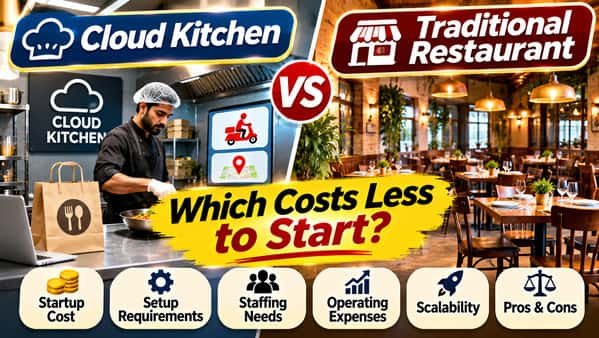
What Is a Cloud Kitchen?
A cloud kitchen is a food preparation facility built primarily around delivery orders rather than dine-in customers. It is also commonly called a ghost kitchen, virtual kitchen or delivery-only kitchen.
Customers usually discover the brand through food-delivery apps, social media, search or the business’s own ordering channels.
Since customers do not normally sit and eat at the premises, the owner can focus investment on the kitchen rather than expensive dining infrastructure.
Typical startup expenses include:
- Kitchen rent and deposit
- Cooking equipment
- Refrigeration
- Exhaust and ventilation
- Food preparation equipment
- Storage
- Packaging
- Licences and registrations
- Staff
- Branding and menu photography
- Technology and ordering systems
- Initial marketing
The absence of a full dining room can substantially reduce the initial investment.
What Does a Traditional Restaurant Require?
A traditional restaurant must provide both food production and a customer experience.
In addition to a commercial kitchen, the entrepreneur may need to spend on:
- Dining furniture
- Interior design
- Lighting
- Air conditioning
- Customer washrooms
- Signage
- Billing systems
- Crockery and cutlery
- Service counters
- Front-of-house staff
- Housekeeping
- Customer-facing décor
Location also becomes more important.
A dine-in restaurant generally benefits from visibility, accessibility, parking or strong foot traffic. Properties offering these advantages can command much higher rents than less prominent spaces suitable for delivery-only kitchens.
Cloud Kitchen Vs Restaurant: Startup Cost Differences
A comparison table is appropriate because the two models require very different categories of initial expenditure.
| Cost Factor | Cloud Kitchen | Traditional Restaurant |
|---|---|---|
| Space requirement | Generally smaller | Usually larger |
| Prime location | Less important | Often important |
| Interior expenditure | Minimal to moderate | Can be substantial |
| Dining furniture | Not normally required | Required |
| Kitchen equipment | Required | Required |
| Front-of-house staff | Minimal/not required | Required |
| Packaging | Major recurring requirement | Lower for dine-in orders |
| Initial investment | Generally lower | Generally higher |
| Delivery dependence | High | Varies |
| Customer experience investment | Mainly digital/food quality | Physical and digital |
Actual costs vary significantly by city, cuisine, size and business positioning, so there is no reliable single startup figure applicable to every food business.
Why Does a Cloud Kitchen Usually Cost Less?
The largest saving comes from real estate and interiors.
Consider a restaurant that needs 1,500 square feet to accommodate a kitchen, dining tables, reception, storage and customer facilities. A delivery-focused operation producing a similar menu might operate from substantially less space.
The cloud kitchen can also consider locations away from expensive high streets, provided the site remains suitable for delivery coverage, staff access and legal operation.
The second major saving comes from interiors.
Customers visiting a restaurant notice the walls, furniture, lighting, air conditioning and overall atmosphere. A cloud-kitchen customer never sees most of the premises.
That allows the entrepreneur to direct more of the startup budget towards food production rather than decoration.
Staff Costs Can Also Be Lower
A traditional restaurant requires people to serve customers, clear tables, manage reservations or queues, handle the dining floor and maintain customer areas.
Depending on the format, employees may include:
- Waiters
- Hosts
- Cashiers
- Floor managers
- Bartenders
- Housekeeping staff
A cloud kitchen can operate with a more production-focused team consisting mainly of cooks, kitchen assistants, packers and management staff.
This does not mean labour costs are insignificant. A high-volume delivery kitchen still needs enough people to prepare and pack orders quickly, particularly during peak periods.
But eliminating much of the front-of-house operation can reduce payroll requirements.
Where Cloud Kitchens Can Become Expensive
Lower setup costs can hide substantial recurring expenses.
A cloud kitchen often depends heavily on online food-delivery platforms to generate orders. Platform-related costs can affect margins significantly, depending on the commercial arrangement.
Other recurring expenses can include:
- Packaging
- Promotional discounts
- Sponsored visibility
- Digital advertising
- Food photography
- Customer acquisition
- Refunds and order issues
- Delivery-related operational costs
Packaging is particularly important.
A dine-in restaurant can serve food on reusable plates. A delivery kitchen needs containers, bags, seals, labels and sometimes specialised packaging to prevent leakage or loss of food quality.
These costs apply repeatedly to every order.
Traditional Restaurants Have an Advantage Cloud Kitchens Lack
A restaurant is not selling only food. It can also sell an experience.
Customers may choose a restaurant for birthdays, dates, family dinners, business meetings or celebrations. Ambience, hospitality and location can influence what customers are willing to pay.
A successful restaurant can also generate both dine-in and delivery revenue.
A cloud kitchen has fewer opportunities to create this physical customer relationship. Its food arrives in a package, making brand differentiation more dependent on taste, consistency, presentation, reviews and digital visibility.
This can make online competition intense.
Which Model Reaches Break-Even Faster?
A cloud kitchen has the potential to reach break-even with lower sales because its initial investment and fixed overheads can be lower.
However, that is not guaranteed.
Suppose a cloud kitchen has low rent but spends heavily on advertising and platform promotions while earning a thin contribution margin per order. It may still take considerable time to recover its investment.
A restaurant may have much higher fixed costs but generate a larger average bill through beverages, starters, desserts and group dining.
Before launching either model, calculate:
Average order value – food cost – packaging – platform/delivery costs – variable labour and other variable expenses = contribution per order
Then compare the contribution with monthly fixed expenses.
This provides a much more realistic picture than simply comparing rent.
Which Is Better for a First-Time Food Entrepreneur?
A cloud kitchen can provide a lower-risk way to test a food concept because the entrepreneur does not need to commit as much money to customer-facing infrastructure.
For example, someone developing a specialised biryani, healthy-meal or dessert brand could test demand through delivery before investing in a large restaurant.
Cloud kitchens can also make it easier to experiment with multiple virtual brands from one production facility, provided operations and applicable registrations support the arrangement.
A traditional restaurant may be preferable when the concept depends heavily on ambience, hospitality or customer experience.
A premium café, fine-dining restaurant or family dining concept cannot necessarily reproduce its core value through delivery alone.
Which Costs Less to Start?
In most comparable situations, a cloud kitchen costs less to start than a traditional restaurant because it requires less space, fewer interiors, limited customer-facing infrastructure and generally fewer front-of-house employees.
But entrepreneurs should not choose the model based only on startup costs.
A cloud kitchen needs strong unit economics, efficient packaging and reliable digital customer acquisition. A traditional restaurant needs enough revenue to support higher rent, interiors and staffing.
Before investing, estimate the cost per order, expected order volume, food margin, monthly fixed expenses and break-even point. The cheaper business to open is not necessarily the easier business to make profitable.
FAQs
Q1. Is a cloud kitchen cheaper than opening a restaurant?
A. Generally, yes. A cloud kitchen can operate from a smaller and less prominent property and does not normally require expensive dining interiors, furniture or a large front-of-house team. Actual costs depend on the city, cuisine and scale.
Q2. Can I start a cloud kitchen from home in India?
A. A home-based food business may be possible in some circumstances, but the operator must comply with applicable food-safety, local, residential, municipal and other regulatory requirements. Do not assume that every residential property can legally be used as a commercial kitchen.
Q3. Are cloud kitchens more profitable than restaurants?
A. Not necessarily. Cloud kitchens have lower infrastructure costs but may face significant packaging, platform, promotional and customer-acquisition expenses. Profitability depends on order volume, food costs, pricing and operational efficiency.
Q4. Should a first-time entrepreneur choose a cloud kitchen?
A. A cloud kitchen can be an effective way to test a delivery-friendly food concept with lower initial investment. However, a traditional restaurant may be more appropriate when ambience, location and in-person service are central to the business idea.