Hiring employees is not the only way to build a business. For many first-time entrepreneurs, staying small can actually be an advantage. There is no payroll to manage, fewer fixed expenses, and the owner can change services or pricing quickly when the market changes.
Technology has made this model much more practical. Payments, invoicing, websites, customer communication, scheduling and parts of marketing can now be handled digitally. India’s small businesses are already highly digital: 89% of surveyed small businesses generated more than 10% of their revenue through digital payments in 2025, while 74% generated more than 10% through e-commerce channels.
The important distinction is that “no employees” does not mean “no work.” These businesses are suitable for a solo owner precisely because the workload can be controlled, automated or kept within a specialised niche.
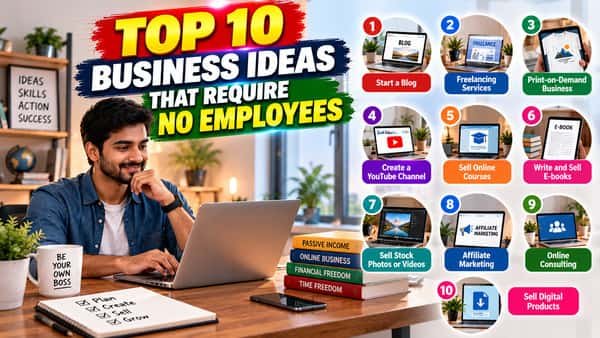
No-Employee Business Ideas at a Glance
| Business Idea | Startup Cost | Main Revenue Model |
|---|---|---|
| Freelance consulting | Low | Project/retainer |
| Website development | Low | Projects + maintenance |
| Digital products | Low | Product sales |
| Online tutoring | Low | Class/course fees |
| Content creation | Low | Advertising/partnerships/products |
| Graphic design | Low | Project/retainer |
| SEO services | Low | Monthly retainer |
| Blogging/niche website | Low | Ads/affiliate/products |
| Photography | Medium | Project fees |
| Micro-SaaS | Medium | Subscription |
1. Freelance Consulting
Consulting is one of the simplest businesses to operate alone because your expertise is the main product.
A professional can provide consulting in areas such as:
- Marketing
- Human resources
- Business operations
- Technology
- E-commerce
- Branding
- SEO
- Data analysis
Specialisation is usually better than describing yourself simply as a “business consultant.”
For example, helping small manufacturers improve their online presence communicates a clearer service than offering general business advice.
A solo consultant can work with a small number of clients and charge per project or through monthly retainers.
Best for: Experienced professionals with a specialised skill.
2. Website Development and Maintenance
A website-development business can be operated by one skilled person with relatively little physical infrastructure.
Services can include:
- WordPress websites
- Shopify stores
- Landing pages
- Website redesign
- Speed optimisation
- Bug fixes
- Backups
- Website maintenance
The recurring opportunity is particularly attractive.
After completing a website, the developer can offer an optional monthly maintenance plan covering agreed updates, monitoring, backups and technical support.
A solo developer does not need dozens of projects simultaneously. A combination of occasional development projects and manageable maintenance clients can create a more predictable workload.
Best for: WordPress, Shopify and web developers.
3. Sell Digital Products
Physical products need manufacturing, storage, packaging and shipping. Digital products remove many of these requirements.
Examples include:
- Templates
- Printable worksheets
- E-books
- Design assets
- Business spreadsheets
- Checklists
- Website templates
- Educational resources
A digital product is created once and can potentially be sold repeatedly.
That does not make the business passive. The owner still needs to attract visitors, answer customer questions, update products and handle marketing.
The strongest digital products generally solve a narrow problem. A spreadsheet specifically designed to track inventory for small retailers, for example, has a clearer target customer than a generic spreadsheet bundle.
Best for: Designers, educators, developers and professionals with specialised knowledge.
4. Online Tutoring
Teaching can be converted into a one-person online business without renting a classroom or employing other teachers.
Possible subjects include academic topics as well as practical skills such as:
- Coding
- Excel
- Graphic design
- Web development
- Spoken English
- Digital marketing
- Accounting software
An instructor can begin with live individual or group sessions.
Later, frequently repeated lessons can be turned into original recorded courses, worksheets or other educational products.
This combination allows one person to earn through both live teaching and reusable educational resources.
Best for: Teachers and skilled professionals who enjoy explaining concepts.
5. Content Creation Business
A creator can operate as a one-person media business by producing useful or entertaining content for a defined audience.
The Indian creator economy is becoming increasingly significant. India has roughly 2–2.5 million digital creators influencing substantial consumer spending, although only a relatively small share currently monetise effectively.
Revenue can eventually come from multiple legitimate sources, including advertising, brand collaborations, subscriptions and the creator’s own products or services.
The most important decision is choosing a clear subject.
A focused channel covering WordPress tutorials for beginners, for example, gives viewers a clearer reason to follow than a channel covering unrelated topics every week.
Building an audience usually takes time, so this should not be treated as guaranteed quick income.
Best for: People with strong knowledge, communication or creative skills.
6. Freelance Graphic Design
Graphic design can operate as a completely solo service business.
A designer might create:
- Logos
- Social-media graphics
- Advertisements
- Website banners
- Presentations
- Brochures
- Packaging designs
- Business stationery
Instead of accepting every type of project, designers can specialise.
For example, one designer might create social-media graphics for restaurants, while another focuses on presentations for businesses.
AI-powered design tools can speed up certain repetitive tasks, but clients still pay for design judgement, brand consistency, communication and reliable delivery.
Best for: Designers familiar with professional design software and visual communication.
7. SEO Services
Search engine optimisation is particularly suitable for a solo business because much of the work can be scheduled and delivered remotely.
Services can include:
- Keyword research
- Technical SEO reviews
- On-page optimisation
- Local SEO
- Content planning
- Internal linking
- Search-performance reporting
The recurring model is important here as well.
Businesses generally need ongoing monitoring and optimisation rather than a website being “SEO completed” permanently.
A solo consultant can deliberately limit the number of monthly clients so service quality remains manageable.
Best for: SEO specialists, website managers and digital marketers.
8. Blogging and Niche Websites
A niche website is a digital publishing business centred on a particular subject.
Revenue can potentially come from advertising, legitimate affiliate partnerships, digital products or services.
Possible website categories include education, technology tutorials, travel information, careers, home improvement and specialised professional topics.
India’s digital content economy continues to expand. Digital media became the country’s largest media and entertainment segment in 2025, with revenues exceeding ₹1 trillion, according to figures highlighted by IBEF.
However, blogging is rarely immediate income.
A successful niche website requires genuinely useful content, search visibility, regular updates and a clear audience. Publishing hundreds of low-quality automated pages is not a substitute for providing useful information.
Best for: Writers, SEO professionals and subject-matter specialists.
9. Photography Business
Photography is one of the few businesses on this list that requires meaningful equipment, but it can still operate without permanent employees.
A photographer can specialise in:
- Product photography
- Food photography
- Property photography
- Corporate photography
- Portraits
- Small events
Specialisation makes equipment purchases and marketing easier.
For example, a product photographer can create a small home studio and work mainly with e-commerce businesses.
During unusually large projects, a business owner may use legitimate independent professional services where appropriate rather than maintaining a permanent workforce, but the normal operation can remain solo.
Best for: Skilled photographers comfortable handling both creative work and customers.
10. Micro-SaaS Business
Micro-SaaS is a small software business designed to solve one narrow customer problem.
Examples might include software that helps businesses:
- Schedule appointments
- Generate routine reports
- Organise customer enquiries
- Track recurring tasks
- Manage website content
- Analyse customer feedback
The advantage is scalability.
A consultant must usually perform additional work for each new client. Software can potentially serve many customers through the same underlying product.
For example, 100 customers paying ₹500 per month would represent ₹50,000 in monthly recurring revenue before expenses. That is only an illustration—reaching 100 paying customers is not guaranteed.
AI and cloud services can also reduce the amount of infrastructure a small software founder needs to build independently.
Best for: Developers seeking a scalable solo business.
What Makes a Business Suitable for One Person?
The ideal solo business has three characteristics.
First, workload can be controlled. You should be able to stop accepting new customers temporarily when capacity is full.
Second, fixed costs are limited. A business with a large office, significant inventory or complicated physical operations becomes difficult for one person to manage.
Third, technology can handle repetitive administration. Scheduling, invoices, payments, backups and routine customer communication can often be streamlined without immediately adding staff.
India’s expanding service and gig economy also makes skill-based independent work increasingly significant. The number of gig workers increased from 77 lakh in FY21 to about 1.2 crore in FY25.
Do Solo Businesses Need Registration?
Having no employees does not automatically exempt a business from registration, taxation or other legal requirements.
The requirements depend on the business structure, turnover, activity and location.
Eligible micro, small and medium enterprises can use India’s official Udyam system. The Government states that Udyam registration is online, paperless, based on self-declaration and free of charge.
Official Udyam Registration Portal
GST, professional licences and sector-specific requirements may separately apply depending on the activity.
FAQs
Q1. Which business is easiest to run without employees?
A. Freelance consulting, website development, graphic design, SEO and online tutoring are among the simpler options because one person can control the number of clients and projects accepted.
Q2. Can one person run a profitable business?
A. Yes. A solo business can generate revenue without employees, particularly when it sells specialised services, digital products or software. Profitability depends on pricing, demand, expenses and the owner’s capacity.
Q3. Which no-employee business can generate recurring revenue?
A. Website maintenance, SEO retainers, digital subscriptions and micro-SaaS products can use recurring-revenue models.
Q4. Can I start a solo business from home?
A. Many digital businesses can operate from home. Local rules, rental agreements and sector-specific requirements should still be checked if customers, inventory, manufacturing or commercial activities are involved.
Q5. Should I avoid hiring employees permanently?
A. Not necessarily. Remaining solo can keep costs and management simple during the early stage. If customer demand eventually exceeds one person’s capacity, hiring or building a team may become a sensible next stage rather than turning customers away.