
Lending money to a friend, relative, business associate, or another person can become a serious problem when the agreed repayment date passes and the borrower stops responding. The situation becomes even more difficult when the loan was based largely on trust rather than a detailed written agreement.
In India, however, the absence of repayment does not necessarily mean the money is lost. Depending on the evidence, terms of the loan, limitation period and circumstances, the lender may consider a written demand, legal notice, settlement, mediation, or a civil money-recovery proceeding.
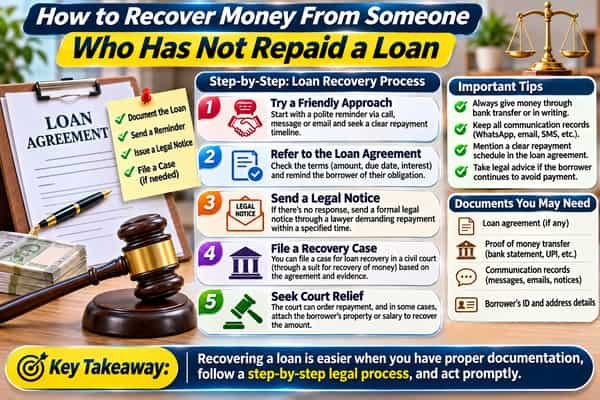
The first priority should be to preserve evidence and act within the applicable limitation period.
Money Recovery: Quick Overview
| Situation | Possible Step |
|---|---|
| Repayment date recently passed | Send a written reminder |
| Borrower keeps delaying | Make a formal written demand |
| Borrower refuses payment | Consider an advocate’s legal notice |
| Written debt/document available | Civil recovery remedies may be available |
| Both sides are willing to settle | Negotiate, mediate or consider Lok Adalat |
| Limitation period is approaching | Obtain legal advice immediately |
| Borrower disputes receiving money | Preserve bank transfers, messages and other evidence |
1. Collect Evidence of the Loan
Before demanding repayment, collect everything that can establish the transaction.
Useful evidence may include:
- Written loan agreement
- Promissory note
- Bank transfer record
- UPI transaction record
- Cheque details
- Receipt
- Emails
- Messages discussing the loan
- Written acknowledgement of debt
- Repayment promises
- Records of partial repayments
Cash transactions can be more difficult to prove when there is no receipt or written acknowledgement.
If money was transferred electronically, preserve the complete transaction details rather than only a cropped screenshot.
The objective is to establish basic facts: how much was lent, when it was lent, why it was transferred, and when repayment became due.
2. Ask for Repayment in Writing
If previous discussions were verbal, make a clear written demand.
Mention:
- Amount lent
- Date of the loan
- Agreed repayment date
- Amount already repaid, if any
- Balance outstanding
- Reasonable date by which payment is requested
Keep the communication professional.
Avoid threats, abusive messages or public accusations.
Written communication can also help establish what each side says about the transaction.
3. Consider a Legal Notice
If ordinary reminders fail, a legal notice through an advocate may be appropriate.
A money-recovery notice generally records the transaction and formally demands repayment.
Depending on the circumstances, it may include:
- Lender and borrower details
- Original loan amount
- Date money was advanced
- Agreed repayment terms
- Payments already received
- Outstanding balance
- Previous demands
- Time provided for payment
- Proposed legal action if payment is not made
A legal notice is not the same as a court order.
The borrower may pay, dispute the debt, propose instalments, seek settlement, or simply refuse to respond.
If the dispute continues, further proceedings may need to be considered.
4. Can You Recover Money Without a Written Loan Agreement?
Potentially, yes—but evidence becomes particularly important.
People often lend money to relatives or friends without preparing a formal agreement.
Other evidence may help establish the transaction, such as:
Bank records: showing that money moved from you to the borrower.
Messages: where the borrower acknowledges receiving the loan or promises repayment.
Emails: discussing repayment dates or outstanding amounts.
Partial repayment: which may be relevant to establishing the existence of a financial transaction.
But a bank transfer by itself does not always establish that the money was a loan. The recipient could claim it represented payment for something else.
The surrounding evidence therefore matters.
5. File a Civil Suit for Recovery of Money
If the borrower refuses to repay despite demands, a civil recovery proceeding may be considered.
The correct court and procedure depend on matters such as:
- Amount involved
- Place where the parties reside or conduct business
- Place where the transaction occurred
- Terms of any written agreement
- Nature of the evidence
- Applicable territorial and pecuniary jurisdiction
A successful claim may result in a decree directing payment according to the court’s decision.
The Code of Civil Procedure contains the procedural framework for civil suits and enforcement of civil decrees.
Because jurisdiction and court fees can differ, it is sensible to have the documents examined before filing.
6. When Can a Summary Suit Be Considered?
In certain cases involving clear written financial obligations, Order XXXVII of the Code of Civil Procedure provides a special summary procedure.
It can apply to specified categories of claims based on instruments or written contracts covered by that Order. It should not be assumed that every informal personal loan automatically qualifies.
The purpose of the procedure is different from an ordinary civil trial, and the defendant’s right to defend is governed by the requirements of Order XXXVII.
Whether your loan qualifies depends heavily on the documents forming the basis of the claim.
7. Do Not Miss the Limitation Period
Waiting indefinitely is one of the biggest mistakes in a money-recovery dispute.
The Limitation Act, 1963 contains different limitation rules for different types of claims. Its schedule generally prescribes a three-year period for several common categories of money-lending and debt claims, but the point from which that period begins can differ depending on the transaction.
For example, a loan payable on demand can raise a different limitation calculation from money lent under an agreement requiring repayment on a particular date.
Sections 18 and 19 of the Limitation Act also deal with the effect of written acknowledgement and certain payments made before expiry of the prescribed limitation period.
Do not assume that repeatedly asking the borrower for money automatically extends limitation.
If the loan is old or the three-year mark may be approaching, obtain legal advice promptly.
8. Can You Settle Instead of Going to Court?
Yes.
If the borrower accepts the debt but cannot pay everything immediately, settlement may be more practical than prolonged litigation.
The parties might agree on:
- Full payment by a specified date
- Instalments
- A revised repayment schedule
- Settlement of an agreed amount
Put any settlement in writing.
It should clearly identify the outstanding amount, payment dates and consequences if the borrower defaults again.
9. Consider Lok Adalat for Settlement
Money disputes can also be appropriate for consensual resolution through Lok Adalat.
NALSA explains that Lok Adalats can deal with disputes that are already before a court as well as eligible disputes at the pre-litigation stage. A State or District Legal Services Authority can refer an appropriate pre-litigation matter for amicable settlement.
There is no court fee for a matter filed in Lok Adalat. When the parties reach a settlement, the award is treated as a decree of a civil court and is final and binding.
National Legal Services Authority – Lok Adalats
However, an ordinary Lok Adalat is fundamentally a settlement forum. It cannot force the parties into a compromise.
10. Is Non-Repayment Automatically a Criminal Case?
No.
A simple failure to repay a loan should not automatically be described as cheating or another criminal offence.
There is an important distinction between:
a genuine loan or contractual debt that later remains unpaid, and
conduct that independently satisfies the ingredients of a criminal offence.
The existence of a money dispute does not by itself prove criminal wrongdoing.
Where fraud or another offence is alleged, the facts at the time of the transaction become important. A lawyer can assess whether the matter is essentially civil or whether the evidence raises a separate criminal issue.
Using a criminal complaint merely as pressure for recovery should not substitute for the appropriate civil remedy.
What Should You Do First?
If someone has not repaid your money, follow a practical sequence:
- Collect all evidence of the loan.
- Calculate the exact outstanding amount.
- Check the agreed repayment date.
- Demand repayment in writing.
- Preserve any acknowledgement or repayment promise.
- Consider a legal notice if reminders fail.
- Explore settlement or Lok Adalat where appropriate.
- Consider civil recovery proceedings if necessary.
- Check limitation immediately, especially for an older loan.
The strength of a money-recovery claim often depends less on how many times repayment was requested and more on whether the lender can prove the transaction and has taken action within the applicable legal time limit.
FAQs
Q1. Can I recover a personal loan given to a friend?
A. Potentially, yes. Evidence such as a loan agreement, bank transfer, messages acknowledging the debt, repayment promises and partial payments can be important. The appropriate recovery process depends on the facts and limitation period.
Q2. Can I recover money if there was no written agreement?
A. The absence of a formal agreement does not automatically prevent recovery, but proving that the transfer was actually a loan may become more difficult. Bank records, messages, emails, receipts and acknowledgements can be important evidence.
Q3. How long do I have to file a money-recovery case?
A. The Limitation Act generally provides three-year limitation periods for several common categories of loan and debt claims, but the starting point varies according to the nature and repayment terms of the transaction.
Q4. Can a money dispute be settled through Lok Adalat?
A. Yes, appropriate civil money disputes can be considered for Lok Adalat settlement, including at the pre-litigation stage. A settlement award is treated as a civil court decree and is binding on the parties.
Q5. Is failure to repay borrowed money automatically cheating?
A. No. Non-payment of a debt can be a civil dispute. Whether the facts also constitute a criminal offence depends on whether the legal ingredients of that offence are independently established.


