
A new business can have a profitable idea and still struggle because too much money was committed to premises before the business had proven itself. This is especially relevant in India, where purchasing a commercial shop in a strong retail location can require a substantial upfront investment.
Owning a shop gives the entrepreneur control over the premises and creates a long-term property asset. Renting, on the other hand, preserves capital and makes it easier to change locations if customer response, competition or business requirements change.
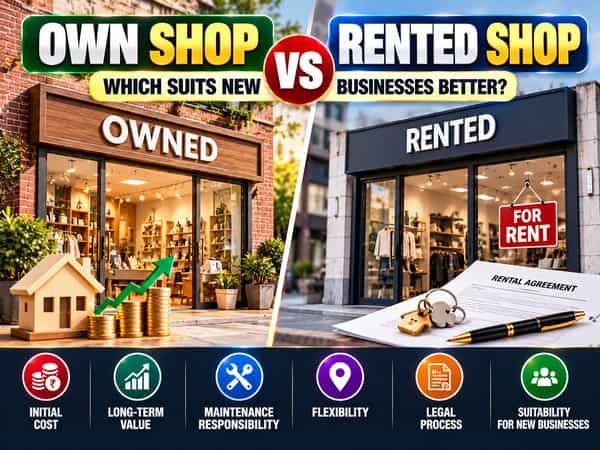
For most first-time businesses, the question should not be “Is owning better than renting?” It should be: “Where will my limited capital generate the highest return right now—inside the business or inside the property?”
What Changes When You Own the Shop?
When an entrepreneur purchases commercial premises, the business gains much greater control over its location.
There is no landlord deciding whether to renew the tenancy, and the owner does not face periodic rent negotiations in the same way as a tenant.
Owning can be particularly attractive for established businesses that know:
- Which location works for them
- How much space they require
- Their long-term customer base
- Their expected cash flow
- Whether they intend to operate there for many years
The property itself may also become a valuable business or personal asset over time.
However, buying requires capital that could otherwise be used for operations and expansion.
Why Do New Businesses Often Rent?
Renting lowers the amount of capital required to establish a physical presence.
Instead of spending a large amount purchasing commercial property, the entrepreneur may initially need to arrange expenses such as:
- Security deposit
- Advance rent
- Interiors
- Furniture
- Signage
- Equipment
- Licences and registrations
- Opening inventory
This can leave substantially more capital available for actually running the business.
For a new venture whose sales are still uncertain, that flexibility can be extremely valuable.
Own Shop Vs Rented Shop: Key Differences
| Factor | Own Shop | Rented Shop |
|---|---|---|
| Initial capital | High | Comparatively lower |
| Monthly rent | No | Yes |
| Property ownership | Yes | No |
| Location flexibility | Low | High |
| Renovation freedom | Greater | Subject to lease/landlord terms |
| Risk of rent increase | No | Yes |
| Risk of non-renewal | No landlord risk | Possible |
| Property appreciation potential | Yes | No |
| Capital available for business | Can be reduced significantly | Generally better preserved |
| Relocation | More difficult | Comparatively easier |
| Best suited for | Established, location-dependent businesses | New or evolving businesses |
Capital Is the Biggest Issue for a New Business
Suppose an entrepreneur has ₹50 lakh available.
One option is to spend ₹35 lakh purchasing a commercial shop, leaving ₹15 lakh for inventory, employees, marketing and working capital.
Another option is to rent suitable premises and retain a much larger portion of the ₹50 lakh for the business.
Which option is better depends on the business.
A property purchase may save rent and create an asset. But if insufficient working capital prevents the business from maintaining inventory or marketing effectively, owning the premises will not compensate for weak operations.
Cash available today can be more valuable to an early-stage business than property value that may increase over many years.
Renting Makes It Easier to Test a Location
Location can determine the success of many physical businesses.
This is particularly true for:
- Restaurants
- Salons
- Clothing stores
- Cafés
- Clinics
- Grocery stores
- Electronics shops
- Coaching centres
Entrepreneurs can estimate footfall before opening, but actual customer behaviour becomes clear only after operating.
A rented shop allows the business to test whether the location works.
If sales remain weak because of poor visibility, parking problems, low footfall or unsuitable customers, relocating may be possible after satisfying the lease conditions.
A business that purchased the shop has far less flexibility.
Ownership Protects Against Rent Increases
Rent is a recurring operating expense.
A shop that appears affordable today may become considerably more expensive over a long period as rent increases.
Lease agreements can provide for periodic escalation.
For a business that remains in the same location for 10, 15 or 20 years, total rent paid can become substantial.
Ownership eliminates commercial rent on the owned property, although expenses such as maintenance, property-related charges, repairs and financing costs can continue.
For an established business with predictable long-term occupancy, buying can therefore become financially attractive.
Buying With a Commercial Property Loan Changes the Calculation
Entrepreneurs do not necessarily need to pay the full property price in cash.
Commercial property can potentially be financed, subject to lender eligibility and terms.
However, replacing rent with a loan EMI does not automatically make buying better.
The business must consider:
- Down payment
- Interest
- EMI
- Registration-related expenses
- Applicable stamp duty
- Maintenance
- Property taxes and charges
- Opportunity cost of the down payment
A ₹70,000 EMI should not automatically be considered superior to ₹50,000 rent merely because the EMI contributes towards ownership.
The additional ₹20,000 monthly commitment and large upfront investment still affect business cash flow.
Opportunity Cost Is Often Ignored
Imagine an entrepreneur spends ₹40 lakh purchasing a shop.
The question is not only whether the property will appreciate.
The entrepreneur should also ask:
What could ₹40 lakh earn if invested in the business instead?
That capital might finance:
- Additional inventory
- A second outlet
- Digital marketing
- Machinery
- Employees
- Technology
- Delivery infrastructure
If ₹40 lakh invested in the operating business can generate substantially more value than the savings on rent and expected property appreciation, renting may be economically superior.
The opposite can also be true for a mature business with limited need for additional growth capital.
Ownership Provides Greater Control
Tenants operate within the restrictions of their lease agreements.
Significant structural changes may require landlord approval.
There may also be limitations involving:
- Signage
- Renovation
- Subletting
- Alterations
- Use of premises
- Operating activities
An owner generally has more freedom, subject to applicable building, municipal, zoning, society and other legal restrictions.
This can matter greatly for businesses requiring specialised premises.
For example, a manufacturer, restaurant or medical facility may spend heavily customising a location. Repeating that investment after a lease ends can be expensive.
A Rented Shop Has Lease-Related Risks
Renting preserves capital, but tenants face their own risks.
These can include:
- Rent escalation
- Lease expiry
- Landlord disputes
- Restrictions on modifications
- Security-deposit issues
- Requirement to vacate
- Business interruption during relocation
A successful shop can become heavily associated with its location.
If a retailer spends years building local customer traffic and later has to relocate, some of that goodwill may be lost.
This makes the quality of the lease agreement particularly important for location-dependent businesses.
Property Ownership Can Create a Second Source of Wealth
If a business eventually relocates, an owned shop does not necessarily become useless.
Depending on the property and market, the owner may be able to:
- Sell it
- Rent it to another business
- Use it for another venture
- Hold it as a long-term property asset
This is one reason established business owners sometimes prefer commercial-property ownership.
However, property appreciation should never be assumed. Commercial real estate can experience long periods of weak demand, vacancy or stagnant prices.
Which Businesses Benefit More From Owning?
Ownership becomes more attractive when the business has a strong reason to remain at the same location for many years.
Examples can include:
- Established neighbourhood retailers
- Clinics with a stable patient base
- Long-running restaurants
- Workshops
- Warehouses
- Manufacturing units
- Businesses requiring expensive customised interiors
If moving would cause major disruption or destroy location-specific goodwill, ownership can provide valuable stability.
Which Businesses Benefit More From Renting?
Renting can suit businesses that are still discovering their ideal size, market or location.
This may include:
- First-time entrepreneurs
- New retail brands
- Startups
- Experimental restaurant concepts
- Businesses expanding into a new city
- Seasonal businesses
- Businesses expecting rapid growth
A company that needs 500 sq. ft. today might require 2,000 sq. ft. three years later.
Owning a small shop too early can turn the property itself into a constraint.
Should a Business Buy Just Because Rent Feels “Wasted”?
The statement that “rent is wasted money” oversimplifies the economics.
Rent purchases something valuable: the right to use a commercial location without buying the property.
That flexibility has financial value.
Similarly, a property EMI is not entirely an investment. Part of the payment represents interest, while ownership also comes with transaction costs and other expenses.
A fair comparison should consider total costs rather than treating every rupee of rent as a loss and every rupee of EMI as wealth creation.
Which Suits New Businesses Better?
For many new businesses, renting is the more flexible starting point because it preserves capital, allows the location to be tested and makes future relocation easier.
Buying becomes more compelling when the business has stable cash flow, adequate working capital and confidence that the premises will remain suitable for many years.
A practical rule is to avoid allowing property ownership to starve the actual business of capital.
If buying the shop would leave the company short of money for inventory, salaries, marketing or emergencies, renting may be the safer choice.
If the business is already financially stable, expects to remain in the same location for the long term and can purchase without creating cash-flow stress, ownership can provide both operational stability and a valuable asset.
FAQs
Q1. Is buying a shop better than paying rent every month?
A. Not automatically. Buying creates property ownership and removes future rent, but it requires substantial capital. Renting can be financially better when the retained capital can generate higher returns inside the business or when location flexibility is important.
Q2. How long should a business operate before buying commercial property?
A. There is no fixed period. The decision should depend on stable profitability, adequate emergency and working capital, confidence in the location and the expected period of occupancy rather than simply the age of the business.
Q3. What should I check before renting a shop for a new business?
A. Review the permitted use of the premises, lease duration, rent escalation, security deposit, maintenance obligations, renewal terms, notice period, signage and modification rights, and other important conditions. Also verify that the location is legally suitable for the intended business activity.
Q4. Should I take a loan to buy a shop instead of renting?
A. It can make sense for an established business with predictable cash flow and long-term location requirements. For a new business, compare the down payment, EMI, interest and property costs with rent and consider whether the loan would reduce the working capital needed to operate and grow the business.