
Buying a house with a loan creates two separate financial risks. First, the property itself can suffer damage from events such as fire, storms or other insured perils. Second, the borrower may die before the home loan is fully repaid, leaving a substantial debt behind.
These risks require different types of protection. Home insurance primarily protects the property and, depending on the policy, its contents. Home loan insurance is designed around the outstanding housing-loan liability, typically providing protection if the insured borrower dies during the covered period.
Because both are connected with the same house, borrowers sometimes assume one can replace the other. It generally cannot. Understanding exactly what each policy protects is particularly important when purchasing a home through a long-term loan.
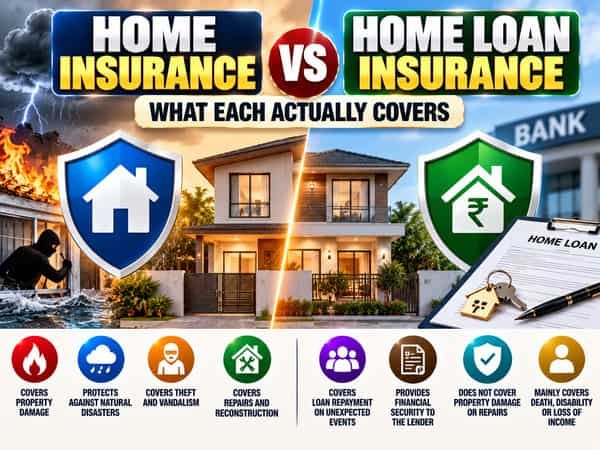
What Does Home Insurance Cover?
Home insurance is property insurance.
Depending on the policy selected, it may cover the residential building, household contents or both against specified risks.
Building insurance generally relates to the physical structure and eligible components of the home. Depending on policy wording, coverage can respond to insured events involving elements such as:
- Walls
- Roof
- Floors
- Permanent fixtures
- Built-in structures
- Other insured parts of the building
Contents insurance can provide separate protection for eligible belongings inside the home.
The exact scope, exclusions, limits and claim conditions vary between policies.
What Is Home Loan Insurance?
Home loan insurance generally refers to insurance intended to address the outstanding home-loan liability if a covered event occurs, most importantly the death of the insured borrower under many such arrangements.
Suppose a borrower takes a ₹60 lakh home loan for 20 years.
If the borrower dies while a substantial amount remains outstanding, the family could otherwise face the burden of continuing the EMIs or arranging repayment.
A suitable loan-protection policy can provide a benefit according to its terms that helps settle the covered outstanding liability.
The purpose is therefore very different from insuring the building itself.
Home Insurance Vs Home Loan Insurance: Key Differences
| Factor | Home Insurance | Home Loan Insurance |
|---|---|---|
| Primary protection | House/property | Home-loan liability |
| Fire/property damage | Can be covered | Generally no |
| Natural calamity-related property damage | Can be covered for specified perils | Generally no |
| Theft of household contents | Possible with suitable contents cover | No |
| Borrower’s death | Does not normally repay loan merely because borrower dies | Common core protection |
| Beneficiary/claim purpose | Repair/replacement for insured property loss | Address covered loan liability |
| Linked to outstanding loan | Not necessarily | Usually |
| Useful without a home loan | Yes | Generally not relevant |
| Protects physical house | Yes, according to cover selected | No |
| Protects family from loan burden | Not its primary purpose | Yes, according to policy terms |
Example: A Fire Damages the House
Suppose a family owns a home financed through a housing loan. A serious fire causes extensive damage to the building.
The borrower is alive and continues earning.
In this situation, home loan insurance generally does not solve the property-damage problem simply because a loan exists.
A suitable home insurance policy may respond to the covered fire damage, subject to the sum insured, deductibles, exclusions and claim conditions.
The loan itself does not disappear because the house has been damaged.
This illustrates why protecting the property can remain important throughout the loan period.
Example: The Borrower Dies During the Loan
Consider a different situation.
The house is completely undamaged, but the primary earning member who took the home loan dies while ₹35 lakh remains outstanding.
Home insurance generally does not repay the housing loan merely because the owner has died.
A suitable home-loan protection policy may provide a benefit for the covered outstanding liability according to its structure.
This protects against the debt risk, not physical damage to the house.
The two examples show why these products should not be treated as substitutes.
Does Home Insurance Cover Household Belongings?
It can, but only if the selected policy includes appropriate contents protection.
Building insurance and contents insurance should be distinguished.
A building policy focuses on the insured structure. Contents coverage may protect eligible household belongings against specified insured events.
Depending on the product, these could include items such as:
- Furniture
- Appliances
- Electronics
- Clothing
- Other household contents
Certain high-value items may require specific declarations, limits or additional coverage.
Homeowners should therefore check whether their policy is building-only, contents-only or a combined policy.
Does Home Insurance Cover Every Type of Damage?
No.
Home insurance is not a maintenance contract.
It generally does not mean the insurer will pay whenever something in the house deteriorates or stops working.
Claims can be affected by exclusions involving matters such as:
- Normal wear and tear
- Gradual deterioration
- Certain construction defects
- Uninsured events
- Intentional damage
- Other policy-specific exclusions
The exact wording matters.
A leaking old pipe caused by gradual deterioration, for example, should not automatically be treated in the same way as sudden damage arising from a specifically insured event.
Does Home Loan Insurance Remain Constant?
Not always.
Some loan-protection products are structured so that the insurance benefit broadly follows the reducing outstanding home-loan balance.
As EMIs are paid, the loan outstanding declines. The associated cover may also decline according to the policy structure.
Other insurance arrangements can operate differently.
This is one reason borrowers should understand whether they are buying:
- Reducing cover
- Level cover
- Single-premium protection
- Regular-premium protection
A lower premium does not automatically make one structure better. The question is how much protection remains when the family might actually need it.
Home Loan Insurance Vs Regular Term Insurance
Borrowers should also compare home-loan protection with a regular term life insurance policy.
A term insurance policy generally provides a life cover amount according to the contract rather than existing solely to match one housing loan.
For example, if a person has:
- A home loan
- Children’s education responsibilities
- Household expenses
- Other debts
protecting only the home loan may not be enough.
A sufficiently sized term plan can potentially provide the family with broader financial protection, from which outstanding debts may also be addressed.
Home-loan insurance can still be useful in suitable circumstances, but borrowers should compare its flexibility, cover pattern and cost with regular term insurance rather than purchasing automatically.
What Happens When You Transfer the Home Loan?
Borrowers sometimes move their loan to another lender to obtain better interest rates or repayment terms.
This can create an important question if insurance was linked closely to the original loan.
The borrower should check whether the existing loan-protection policy:
- Continues independently
- Can accommodate the transfer
- Needs modification
- Has restrictions linked to the original lender
Never assume that transferring a housing loan automatically transfers every insurance arrangement associated with it.
This should be checked before completing the balance transfer.
Is Home Insurance Required Only While a Loan Exists?
No.
The financial need to protect a building continues even after the housing loan has been repaid.
Imagine a homeowner finishes paying a 20-year mortgage and then allows the property insurance to lapse.
The house may be debt-free, but it can still suffer severe damage.
Home insurance protects the value represented by the property itself, so its usefulness is not dependent on whether a bank has a financial interest in the house.
Should Homeowners Have Both?
For many financed homeowners, having appropriate protection for both risks can make sense.
Consider a family with a ₹70 lakh property and ₹45 lakh outstanding housing loan.
They face at least two separate questions:
What happens financially if the house is badly damaged?
Home insurance addresses this type of property risk according to the policy.
What happens if the earning borrower dies while ₹45 lakh is still owed?
Suitable life or loan-protection insurance addresses this financial risk.
Protecting only one leaves the other exposure unresolved.
Which Cover Should You Prioritise?
The decision should not necessarily be framed as choosing one instead of the other.
Home insurance protects a major physical asset.
Life or home-loan protection addresses the possibility that debt remains after the borrower’s death.
For someone buying a home with a substantial loan, a sensible insurance review can therefore consider:
- Building insurance
- Contents protection where needed
- Existing term life cover
- Outstanding housing loan
- Family income dependence
- Other financial obligations
If the borrower already has sufficient term life insurance to cover the housing debt along with the family’s other financial needs, additional home-loan-specific insurance may not always be necessary.
But term insurance does not replace property insurance.
FAQs
Q1. Does home insurance pay off my home loan if I die?
A. Home insurance primarily protects the insured property and/or contents against specified risks. It does not normally repay a housing loan simply because the borrower dies. That risk requires suitable life or home-loan protection coverage.
Q2. Does home loan insurance cover damage to my house?
A. Generally, no. Home-loan insurance is designed around the borrower’s loan liability rather than physical property damage. A suitable home insurance policy is required for covered risks such as fire or specified natural events.
Q3. Do I need home loan insurance if I already have term insurance?
A. Not necessarily. If your existing term insurance is sufficient to cover the outstanding home loan as well as your family’s other financial needs, separate loan protection may be unnecessary. Compare the amount, duration and structure of your existing life cover with your liabilities.
Q4. Should I continue home insurance after repaying my home loan?
A. Yes, it can still be valuable because the property remains exposed to insured risks even after it becomes debt-free. Home insurance protects the house as an asset, not merely the bank’s outstanding loan.