A social media post is removed after a government order, a peaceful public meeting is stopped without a clear reason, or a qualified professional is prevented from carrying on a lawful occupation. These situations may look different, but each raises an important question: how far can the government restrict a citizen’s freedom?
Article 19 of the Indian Constitution protects six essential freedoms that allow citizens to express opinions, organise peacefully, travel, settle and earn a livelihood. These rights make democratic participation possible in everyday life. However, they are not unlimited. The government may impose reasonable restrictions for specific constitutional purposes, such as public order, national security, morality and the protection of the general public.
Article 19 of the Indian Constitution: Overview
| Particular | Important information |
|---|---|
| Constitutional provision | Article 19 |
| Located in | Part III—Fundamental Rights |
| Protection available to | Citizens of India |
| Number of current freedoms | Six |
| Main freedoms | Speech, assembly, association, movement, residence and profession |
| Are these rights absolute? | No, reasonable restrictions are permitted |
| Property right under Article 19 | Removed through the 44th Constitutional Amendment |
| Internet-related protection | Speech and lawful business through the internet are constitutionally protected |
| Main remedies | High Court under Article 226 and Supreme Court under Article 32 |
| Main purpose | Protecting individual freedom and democratic participation |
What Does Article 19 Protect?
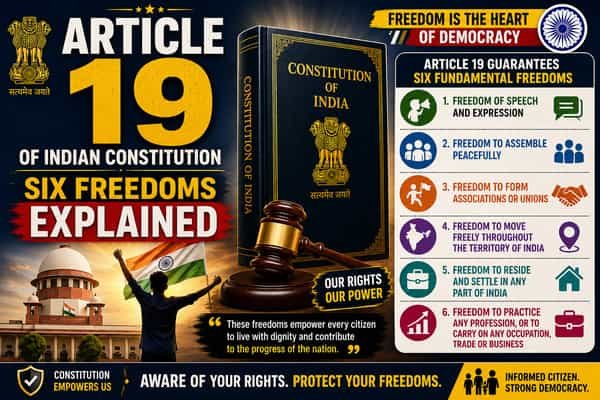
Article 19(1) provides six freedoms to Indian citizens:
- Freedom of speech and expression
- Freedom to assemble peacefully and without arms
- Freedom to form associations, unions or cooperative societies
- Freedom to move freely throughout India
- Freedom to reside and settle in any part of India
- Freedom to practise a profession or carry on an occupation, trade or business
These freedoms are closely connected. A citizen may express an opinion, form an organisation with like-minded people, conduct a peaceful meeting and travel to another city to participate in it.
Article 19 directly protects citizens. Foreign nationals cannot ordinarily claim these particular freedoms, although they may receive protection under other constitutional provisions, including Articles 14 and 21.
Freedom of Speech and Expression
Article 19(1)(a) allows citizens to communicate ideas through speech, writing, art, films, publications, peaceful symbolic acts and digital platforms.
It protects not only popular opinions but also criticism of government policies and public authorities. Democracy cannot function effectively when citizens are afraid to question those exercising power.
The freedom includes several related protections, such as:
- Freedom of the press
- Right to receive and communicate information
- Political and artistic expression
- Peaceful criticism and public discussion
- Expression through online platforms
- The choice not to make certain statements
Freedom of the press is not separately mentioned in Article 19, but it is recognised as part of freedom of speech and expression.
The Constitution also permits restrictions in the interests of India’s sovereignty and integrity, State security, friendly relations with foreign countries, public order, decency, morality, contempt of court, defamation and prevention of incitement to an offence.
A restriction cannot be imposed merely because an opinion is uncomfortable, unpopular or strongly critical.
Freedom of Peaceful Assembly
Article 19(1)(b) protects the right to gather peacefully and without weapons. Public meetings, demonstrations, marches and peaceful protests may fall within this protection.
However, citizens do not have an unrestricted right to occupy every road or public place indefinitely. Authorities may regulate the location, timing, route, sound levels and safety arrangements of an assembly.
Restrictions may be imposed in the interests of India’s sovereignty and integrity or public order. Police permission requirements may be lawful when they are used to manage traffic and safety. They become questionable when permission is rejected arbitrarily or solely to prevent lawful criticism.
Violent gatherings and assemblies involving weapons do not receive the same constitutional protection.
Freedom to Form Associations and Unions
Article 19(1)(c) allows citizens to form associations, trade unions and cooperative societies. Political parties, resident welfare associations, professional bodies, cultural groups and workers’ unions depend on this freedom.
It protects the decision to join with others for a common lawful purpose. It may also protect a person against being forced to remain in an association against their choice.
The government may impose reasonable restrictions for sovereignty and integrity, public order or morality. An organisation created for violence, unlawful activities or threats to national security can be regulated or prohibited through valid law.
The right to form an association does not automatically guarantee government recognition, financial assistance or success in achieving every objective.
Freedom of Movement Across India
Article 19(1)(d) gives citizens the freedom to move throughout the territory of India. A person can generally travel from one state to another without requiring special permission merely because they belong to another region.
Reasonable restrictions may be imposed in the interests of the general public or to protect the interests of Scheduled Tribes. For example, entry into environmentally sensitive, border or protected tribal areas may be regulated through permits.
Movement may also be temporarily restricted during serious public-order situations, disasters or health emergencies, provided the action has legal authority and is not excessive.
The freedom does not create a right to enter private property, military installations or every restricted government facility.
Freedom to Reside and Settle Anywhere
Article 19(1)(e) allows citizens to reside and settle in any part of India. It supports national unity by enabling people to move for education, employment, business or family reasons.
A state cannot normally prevent an Indian citizen from settling there merely because the person comes from another state, speaks another language or follows a different culture.
Restrictions may still be imposed for the protection of the general public or the interests of Scheduled Tribes. Special land and settlement protections in certain tribal, border or constitutionally protected areas may therefore remain valid.
The freedom to settle does not automatically give a person ownership rights over land. Property purchases must comply with applicable land, tenancy, environmental and local laws.
Freedom of Profession, Occupation, Trade or Business
Article 19(1)(g) protects the right to choose and carry on a lawful profession, occupation, trade or business.
It covers salaried professionals, shopkeepers, traders, freelancers, manufacturers and service providers. However, businesses can be regulated through licensing, taxation, health standards, labour laws and consumer-protection requirements.
The State may prescribe professional or technical qualifications. A person cannot demand the right to practise medicine, law or another regulated profession without the required education and registration.
The government may also establish a complete or partial monopoly in a particular trade or service. Activities that are inherently unlawful or seriously harmful do not receive ordinary business protection merely because someone earns money from them.
Article 19 and the Internet
The internet has become an important medium for communication, journalism, education and business. Freedom of speech through the internet is protected under Article 19(1)(a), while lawful trade and business conducted through it receive protection under Article 19(1)(g).
This does not mean that every form of internet access has been declared an independent and unlimited Fundamental Right. Online activities remain subject to valid restrictions, cyber laws, criminal laws and platform rules.
Government-ordered internet restrictions must have legal authority, follow the prescribed procedure and remain proportionate to the situation. Indefinite or unexplained restrictions can face constitutional challenge.
Removal of content by a private social media platform is not automatically identical to government censorship. The platform’s terms, statutory duties and the government’s involvement must be examined.
What Makes a Restriction Reasonable?
Calling a restriction “reasonable” does not automatically make it constitutional. Courts may examine:
- Whether the restriction is imposed through valid law
- Whether it falls within a ground mentioned in Article 19
- Whether there is a genuine connection with the stated objective
- Whether the measure is excessive or broader than necessary
- Whether procedural safeguards are available
- Whether less restrictive alternatives were considered
An authority cannot add new grounds for restricting free speech beyond those recognised by the Constitution.
How Can a Citizen Challenge an Article 19 Violation?
The affected citizen should obtain the written order, licence condition, notification or reason for the restriction. Screenshots, correspondence, permission applications and evidence of unequal treatment should be preserved.
A written representation or statutory appeal may resolve an administrative dispute. Where State action violates a Fundamental Right, the citizen may approach the relevant High Court under Article 226. The Supreme Court can be approached under Article 32 for enforcement of Fundamental Rights.
The court may cancel an unlawful order, direct the authority to reconsider the matter or grant another appropriate constitutional remedy.
Frequently Asked Questions
Does Article 19 allow people to say anything they want?
No. Free speech is subject to constitutionally permitted restrictions relating to matters such as public order, defamation, contempt of court, national security, decency and incitement to offences.
Can the police stop a peaceful protest?
Police may regulate a protest for traffic, security and public-order reasons. However, a peaceful protest cannot be stopped arbitrarily merely because authorities disagree with its message.
Is the right to travel and settle available everywhere in India?
Citizens generally have this freedom, but valid restrictions may apply in protected tribal areas, sensitive border regions, military zones and other legally regulated locations.
Can the government stop a person from running a business?
The government can regulate lawful businesses through licences, qualifications and safety requirements. A restriction may be challenged when it is arbitrary, discriminatory or unrelated to a legitimate public interest.
Disclaimer: This article is intended solely for general information, education and constitutional awareness. It does not constitute legal advice, an official interpretation of Article 19 or a substitute for the Constitution, legislation and judicial decisions. The validity of a restriction depends on the applicable law, facts, purpose and conduct of the authorities involved. Anyone facing censorship, restrictions on protest, movement, association or business should consult a qualified advocate or approach the appropriate legal authority. The author and publisher are not responsible for decisions taken solely on the basis of this article.