Imagine entering the Lok Sabha and finding that women, who make up nearly half of India’s population, occupy only a small share of the seats where national laws are debated. The situation has been similar in many State Legislative Assemblies, where decisions affecting women’s safety, healthcare, education, employment and welfare are often made with limited female participation.
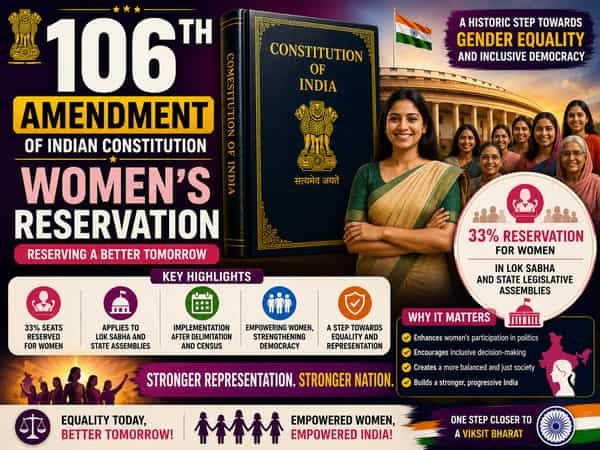
The 106th Amendment of the Indian Constitution was introduced to address this representation gap. Popularly known as the Nari Shakti Vandan Adhiniyam, it provides for approximately one-third reservation for women in the Lok Sabha, State Legislative Assemblies and the Delhi Legislative Assembly. However, the reservation did not begin immediately after the law came into force. Its implementation is linked to the publication of new Census figures and a subsequent delimitation exercise.
106th Constitutional Amendment: Overview
| Particular | Important information |
|---|---|
| Official name | Constitution (One Hundred and Sixth Amendment) Act, 2023 |
| Popular name | Nari Shakti Vandan Adhiniyam |
| Presidential assent | 28 September 2023 |
| Came into force | 16 April 2026 |
| Main purpose | Reservation of approximately one-third of directly elected seats for women |
| Bodies covered | Lok Sabha, State Legislative Assemblies and Delhi Legislative Assembly |
| SC/ST women’s reservation | One-third of SC/ST-reserved seats |
| Implementation condition | Publication of Census figures followed by delimitation |
| Rotation of seats | After each subsequent delimitation |
| Constitutional period | 15 years, subject to extension by Parliament |
| Rajya Sabha coverage | Not covered |
| Current position | Amendment is in force, but reservation is not yet operational |
What Is the 106th Constitutional Amendment?
The 106th Amendment changed the Constitution to provide greater representation for women in major directly elected legislative bodies.
It inserted three important provisions:
- Article 330A for women’s reservation in the Lok Sabha
- Article 332A for women’s reservation in State Legislative Assemblies
- Article 334A dealing with implementation, duration and rotation
It also amended Article 239AA to provide reservation for women in the Legislative Assembly of the National Capital Territory of Delhi.
The amendment aims to increase women’s participation in law-making and public decision-making. It does not reserve government jobs, educational seats or positions in private organisations. Its focus is legislative representation.
How Much Reservation Is Provided?
The amendment provides that, as nearly as possible, one-third of the total seats filled through direct election in the Lok Sabha will be reserved for women.
A similar one-third reservation applies to directly elected seats in State Legislative Assemblies and the Delhi Legislative Assembly.
The expression “as nearly as may be” is used because the number of seats may not always be exactly divisible by three. The final number will depend on the total seats and the allocation made during delimitation.
The reservation will operate at the constituency level. Certain constituencies will be identified as women-reserved seats, and only women candidates will be able to contest those seats during the relevant election.
Women will still be free to contest general, unreserved seats as well.
Reservation for SC and ST Women
The amendment also provides representation for women belonging to Scheduled Castes and Scheduled Tribes.
Approximately one-third of the Lok Sabha and Assembly seats already reserved for SCs and STs must be reserved for women belonging to the respective category.
For example, where a group of constituencies is reserved for Scheduled Castes, approximately one-third of those seats will be allocated to Scheduled Caste women. The same principle applies to Scheduled Tribe-reserved seats.
This is not an additional reservation beyond the overall women’s quota. It operates within the existing reservation for SCs and STs.
Why Was the Amendment Needed?
Women have played major roles in voting, public campaigns, local government and political parties, but their representation in Parliament and many State Assemblies has remained limited.
The amendment seeks to create a more balanced legislature by ensuring that women are not dependent only on political parties voluntarily offering them election tickets.
Supporters expect greater female representation to bring more attention to issues such as:
- Maternal and public healthcare
- Women’s safety and access to justice
- Education of girls
- Workplace participation
- Nutrition and sanitation
- Property and financial rights
- Rural development and social welfare
Reservation does not guarantee that every woman representative will take the same political position. Women elected from different parties, regions and communities may have very different opinions. The main objective is to widen participation and opportunity.
Why Was the Reservation Not Implemented Immediately?
The amendment makes implementation dependent on two major steps.
First, the relevant figures of the first Census taken after the amendment’s commencement must be published. Second, a delimitation exercise must be undertaken using the required constitutional and legal process.
Delimitation involves reviewing and redrawing the boundaries of parliamentary and Assembly constituencies. It may also involve adjusting seat distribution according to the applicable population figures and constitutional rules.
Since the Act came into force on 16 April 2026, the Census conducted after that date becomes significant for implementation. The reservation cannot practically operate until the required Census data is published, delimitation is completed and reserved constituencies are formally identified.
Therefore, the amendment being “in force” and the reservation being “implemented in elections” are two different stages.
What Is the Role of Census and Delimitation?
Census data provides updated information about the population of different states, districts and geographical areas. Delimitation authorities use legally recognised population figures to determine constituency boundaries and representation.
After the relevant Census figures are published, Parliament must provide the necessary framework for the delimitation exercise. The responsible authority will then identify the constituencies to be reserved for women.
This process may involve:
- Reviewing existing constituency boundaries
- Examining population distribution
- Preparing draft proposals
- Conducting public consultations
- Hearing objections and suggestions
- Publishing final delimitation orders
Until these stages are completed, it is not possible to know exactly which Lok Sabha or Assembly constituencies will be reserved for women.
How Will Reserved Seats Rotate?
Article 334A permits women-reserved constituencies to rotate after each subsequent delimitation exercise.
Rotation means the same constituency may not remain reserved permanently. A seat reserved for women during one delimitation cycle may become open in a later cycle, while another constituency may become reserved.
The purpose is to distribute the opportunity across different regions. However, critics argue that frequent rotation may affect the long-term relationship between an elected representative and a constituency.
The exact rotation method must be prescribed through the applicable law and delimitation framework.
How Long Will Women’s Reservation Continue?
The constitutional provision states that the reservation will cease after a period of 15 years from the relevant commencement specified under Article 334A.
However, Parliament has the power to continue the reservation through legislation. Therefore, the 15-year period does not necessarily mean that women’s reservation must permanently end after that point.
The actual operational period will also depend on when delimitation is completed and when the reservation begins to apply in elections.
Which Legislative Bodies Are Not Covered?
The 106th Amendment does not provide reservation for women in the Rajya Sabha because Rajya Sabha members are not directly elected by the public from territorial constituencies.
It also does not directly cover State Legislative Councils. These councils exist only in certain states and use different methods of election.
The amendment should not be confused with women’s reservation in Panchayats and Municipalities. Local-body reservation already exists under Articles 243D and 243T. Many states provide 50% reservation for women in local government, even though the constitutional minimum is one-third.
Separate laws have been used to address women’s reservation in the Legislative Assemblies of Jammu and Kashmir and Puducherry.
Does the Amendment Provide an OBC Women’s Quota?
The amendment specifically provides internal reservation for women in seats reserved for Scheduled Castes and Scheduled Tribes. It does not create a separate sub-quota for women belonging to Other Backward Classes in the Lok Sabha or State Assemblies.
This was one of the major issues discussed during the parliamentary debate. Supporters of an OBC sub-quota argued that women from different social groups do not receive equal access to political opportunities.
The absence of a separate OBC women’s quota does not prevent political parties from selecting OBC women as candidates in reserved or general constituencies.
Frequently Asked Questions
Is 33% women’s reservation already applicable in elections?
No. The amendment is in force, but the reservation will become operational only after the relevant Census figures are published and the required delimitation exercise is completed.
Will women be allowed to contest unreserved seats?
Yes. A woman may contest both a constituency reserved for women, subject to category requirements, and any general seat for which she is eligible.
Does the amendment reserve one-third of Rajya Sabha seats?
No. The 106th Amendment applies to directly elected seats in the Lok Sabha, State Legislative Assemblies and the Delhi Legislative Assembly. It does not apply to the Rajya Sabha.
Will the same constituencies always remain reserved for women?
No. Reserved constituencies may rotate after subsequent delimitation exercises. The precise method will depend on the law and rules governing implementation.
Disclaimer: This article is intended solely for general information, education and constitutional awareness. It does not constitute legal advice, an official interpretation of the 106th Constitutional Amendment or a substitute for the Constitution, delimitation laws and government notifications. The implementation timeline, allocation of reserved constituencies and election procedures may change through legislation, official orders or judicial decisions. Readers requiring information about a specific constituency, election or eligibility issue should consult the Election Commission, the relevant government authority or a qualified legal professional. The author and publisher are not responsible for decisions taken solely on the basis of this article.