For decades, Article 370 appeared regularly in news debates, election speeches and competitive examinations, yet many Indians remained unsure about what it actually did. Did it make Jammu and Kashmir a separate country? Did Indian laws not apply there? Was Article 370 completely removed from the Constitution in 2019? These questions cannot be answered correctly through political slogans alone.
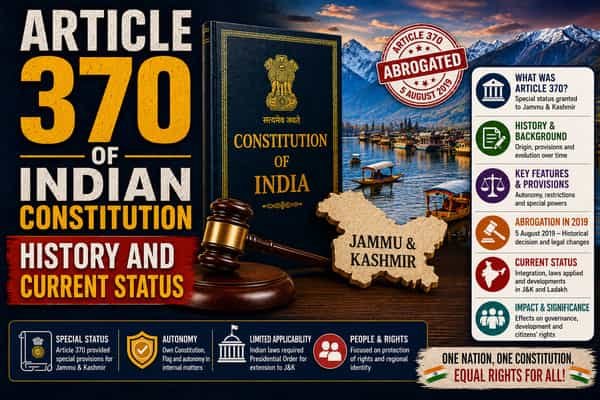
Article 370 created a special constitutional arrangement for Jammu and Kashmir during a complicated historical period. It determined how different provisions of the Indian Constitution and laws made by Parliament would apply to the former state. Major constitutional changes introduced in August 2019 ended this special arrangement and reorganised the region. Understanding these developments is useful for students, citizens and anyone trying to follow India’s constitutional system accurately.
Article 370 Overview
| Particular | Key information |
|---|---|
| Constitutional location | Part XXI of the Constitution of India |
| Part XXI heading | Temporary, Transitional and Special Provisions |
| Related territory | Former State of Jammu and Kashmir |
| Main purpose | Regulated the application of the Indian Constitution to Jammu and Kashmir |
| Effective constitutional changes | 5 and 6 August 2019 |
| Reorganisation date | 31 October 2019 |
| Present administrative units | Union Territory of Jammu and Kashmir and Union Territory of Ladakh |
| Jammu and Kashmir legislature | Union Territory with a Legislative Assembly |
| Ladakh legislature | Union Territory without a Legislative Assembly |
| Supreme Court judgment | 11 December 2023 |
| Current legal position | Special constitutional arrangement is no longer operational |
| Article 35A status | Ceased to operate after the 2019 constitutional changes |
Why Was Article 370 Introduced?
At the time of India’s independence in 1947, princely states were required to decide whether they would join India or Pakistan. The Maharaja of Jammu and Kashmir signed the Instrument of Accession to India in October 1947.
Under the Instrument of Accession, the Dominion of India initially received authority over specified subjects, including defence, external affairs and communications. The political and security circumstances in the region were still developing when the Constitution of India was being drafted.
Article 370 was therefore introduced as a temporary constitutional arrangement. It came into force with the Constitution on 26 January 1950 and provided a mechanism through which other constitutional provisions could gradually be extended to Jammu and Kashmir.
How Did Article 370 Work?
Article 370 did not mean that Jammu and Kashmir was outside India. Article 1 of the Constitution, which describes India as a Union of States, applied to the region.
However, the application of many other constitutional provisions depended on Presidential Orders. Depending on the subject involved, consultation or concurrence with the Jammu and Kashmir government was required.
Parliament’s legislative power over the former state initially operated differently from its power over other states. Through a series of Presidential Orders issued over several decades, a large part of the Indian Constitution and numerous central laws were gradually applied to Jammu and Kashmir.
The state also had its own Constitution, which came into force in 1957. This separate Constitution operated alongside the Constitution of India until the changes made in 2019.
What Was Article 35A?
Article 35A was introduced through the Constitution (Application to Jammu and Kashmir) Order, 1954. It allowed the Jammu and Kashmir legislature to define the state’s permanent residents and provide them with particular rights and privileges.
These benefits could relate to matters such as:
- Ownership of immovable property
- Employment under the state government
- Settlement within the state
- Scholarships and other forms of government assistance
Article 35A did not appear in the main numbered sequence of constitutional articles in the usual manner. It was added through a Presidential Order issued using the authority available under Article 370.
When the 1954 Presidential Order was superseded in August 2019, Article 35A also ceased to operate.
What Happened on 5 August 2019?
On 5 August 2019, the President issued the Constitution (Application to Jammu and Kashmir) Order, 2019, commonly known as Constitutional Order 272.
This Order applied all provisions of the Constitution of India to Jammu and Kashmir. It also modified the interpretation of certain expressions connected with the procedure under Article 370.
At that time, Jammu and Kashmir was under President’s Rule and its legislative powers were being exercised by Parliament. Parliament approved a resolution recommending that the special operation of Article 370 should end.
On 6 August 2019, the President issued Constitutional Order 273. It declared that the clauses of Article 370 would cease to operate, except for a modified provision stating that all provisions of the Constitution of India would apply to Jammu and Kashmir.
Therefore, saying that Article 370 was simply “deleted” is not technically precise. It remains visible in the constitutional text for historical and legal reference, but the earlier special arrangement created through it is no longer operational.
Reorganisation of Jammu and Kashmir
Parliament also passed the Jammu and Kashmir Reorganisation Act, 2019. The law came into effect on 31 October 2019 and divided the former state into two Union Territories:
- Jammu and Kashmir: A Union Territory with a Legislative Assembly
- Ladakh: A Union Territory without a Legislative Assembly
The Union Territory of Jammu and Kashmir includes the territories of the former state other than the Leh and Kargil districts. Those two districts form the Union Territory of Ladakh.
The reorganisation changed the administrative and legislative structure of the region. The Lieutenant Governor became the constitutional administrator of each Union Territory.
Supreme Court Judgment on Article 370
Several petitions challenged the 2019 constitutional changes and reorganisation before the Supreme Court. A five-judge Constitution Bench delivered its judgment on 11 December 2023.
The Court held that Article 370 was a temporary provision and that Jammu and Kashmir did not retain internal sovereignty after joining India. It upheld the Presidential action applying the entire Constitution of India to Jammu and Kashmir.
The Court also held that the President had the power to declare Article 370 inoperative even after the Jammu and Kashmir Constituent Assembly had ceased to exist. It consequently upheld Constitutional Order 273.
However, the Court found that using Article 367 to replace the expression “Constituent Assembly” with “Legislative Assembly” was not a valid method of amending Article 370. This finding did not change the final outcome because the Court independently recognised the President’s power under Article 370(3).
The Court directed that elections to the Jammu and Kashmir Legislative Assembly should be conducted by 30 September 2024. It also stated that the restoration of statehood to Jammu and Kashmir should take place at the earliest possible time.
What Changed After Article 370 Became Inoperative?
After the 2019 changes, the Constitution of India became applicable to Jammu and Kashmir without the earlier special exceptions and modifications.
Central laws now operate in the Union Territory in the same constitutional framework in which they generally apply elsewhere, subject to ordinary legislative arrangements. The separate Constitution of Jammu and Kashmir became inoperative and redundant.
The earlier permanent-resident framework under Article 35A also ended. Matters such as domicile eligibility, public employment and property are now governed by the applicable central and Union Territory laws and rules rather than Article 35A.
The change did not affect Jammu and Kashmir’s status as an integral part of India; it changed the constitutional and administrative arrangement through which the region was governed.
Frequently Asked Questions
Is Article 370 completely removed from the Constitution?
It has not been physically erased from every published constitutional text. However, the earlier special arrangement under Article 370 was declared inoperative through the Presidential declaration issued on 6 August 2019.
Did Article 370 give Jammu and Kashmir its own citizenship?
No. Residents of Jammu and Kashmir were citizens of India. The state had a permanent-resident classification that provided certain local rights, but it did not create a separate national citizenship.
Are Jammu and Kashmir and Ladakh states today?
No. Under the Jammu and Kashmir Reorganisation Act, Jammu and Kashmir is a Union Territory with a legislature, while Ladakh is a Union Territory without a legislature.
Did the Supreme Court cancel the 2019 Article 370 decision?
No. On 11 December 2023, the Supreme Court upheld the main constitutional action that made Article 370 inoperative and applied the complete Constitution of India to Jammu and Kashmir.
Disclaimer: This article is prepared solely for general information, education and constitutional awareness. It should not be considered legal advice, an official interpretation of Article 370 or a substitute for the Constitution, legislation and judicial judgments. Constitutional and administrative matters may be affected by later laws, government notifications or court decisions. Anyone dealing with a specific legal, property, domicile, employment or administrative issue involving Jammu and Kashmir or Ladakh should consult a qualified legal professional or the appropriate government authority. The author and publisher are not responsible for actions taken solely on the basis of this article.