
Imagine living in a country where an Emergency can be declared on a vague ground, important freedoms can be suspended and an elected legislature can continue beyond its normal term. India experienced serious concerns of this nature during the Emergency period of 1975–1977. When the political situation changed, constitutional safeguards were needed to ensure that such extraordinary powers could not be used easily again.
The 44th Amendment of the Indian Constitution was introduced mainly to restore democratic protections, strengthen personal liberty and correct several controversial constitutional changes made during the Emergency. It placed tighter conditions on the declaration of a National Emergency, protected Articles 20 and 21, restored the five-year term of elected legislatures and changed the Right to Property from a Fundamental Right into a constitutional right.
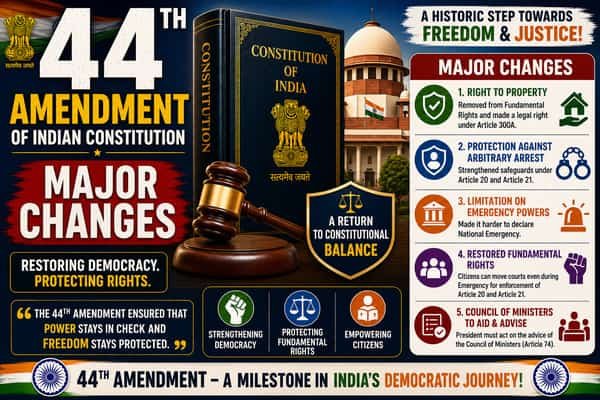
44th Constitutional Amendment: Overview
| Particular | Important information |
|---|---|
| Official name | Constitution (Forty-fourth Amendment) Act, 1978 |
| Presidential assent | 30 April 1979 |
| Main commencement dates | 20 June 1979 and 1 August 1979 |
| Government responsible | Janata Party-led Union Government |
| Prime Minister at the time | Morarji Desai |
| Main purpose | Restoring democratic and civil-liberty safeguards |
| Emergency provision changed | Article 352 |
| Property right changed | Removed from Fundamental Rights and placed under Article 300A |
| Legislative term | Restored from six years to five years |
| Articles protected during Emergency | Articles 20 and 21 |
| President’s power | May return ministerial advice once for reconsideration |
| Wider impact | Strengthened liberty, judicial review and parliamentary control |
Why Was the 44th Amendment Introduced?
The amendment was introduced after the Internal Emergency, which remained in force from June 1975 to March 1977. During that period, civil liberties were restricted, political opponents were detained and the normal democratic system operated under extraordinary constitutional powers.
The 42nd Amendment had also made several changes that increased the power of Parliament and the executive. The 44th Amendment attempted to correct some of these changes and make future use of Emergency powers more difficult.
Its central idea was practical: temporary political majorities should not be able to remove basic democratic protections without strong constitutional checks.
Stronger Safeguards for a National Emergency
One of the most significant changes concerned Article 352, which deals with a National Emergency.
Earlier, an Emergency could be declared because of “internal disturbance,” a broad expression that could cover many situations. The 44th Amendment replaced it with the narrower term “armed rebellion.”
A National Emergency can now be declared only on the grounds of:
- War
- External aggression
- Armed rebellion
This change means that ordinary protests, political instability or internal law-and-order problems cannot by themselves justify a National Emergency under Article 352.
Written Advice of the Union Cabinet
The President cannot declare a National Emergency merely on informal advice or the recommendation of an individual minister.
The decision of the Union Cabinet—which includes the Prime Minister and other Cabinet-rank ministers—must be communicated to the President in writing.
This requirement creates an official record and ensures collective Cabinet responsibility. It reduces the possibility of such an important decision being taken without proper consideration by the senior executive leadership.
Parliamentary Approval and Review
A National Emergency must be approved by both Houses of Parliament within one month. Approval requires a special majority:
- A majority of the total membership of the House
- At least two-thirds of the members present and voting
Once approved, the Emergency continues for six months. Its continuation requires fresh approval from both Houses every six months.
The Lok Sabha can pass a resolution disapproving the Emergency. If at least one-tenth of its total members give the required notice, a special sitting must be held within 14 days to consider the resolution.
These provisions give elected representatives a continuing role instead of allowing an Emergency to remain in operation without regular review.
Protection of Articles 20 and 21
The 44th Amendment created one of India’s most important safeguards for personal liberty.
Even during a National Emergency, the right to approach a court for enforcing Articles 20 and 21 cannot be suspended through a Presidential Order under Article 359.
Article 20 provides protections relating to criminal punishment, including protection against retrospective criminal laws, double punishment for the same offence and forced self-incrimination.
Article 21 states that no person can be deprived of life or personal liberty except according to a lawful procedure.
This means that the State cannot completely remove judicial protection against unlawful deprivation of life or liberty, even during an Emergency.
Limited Suspension of Article 19
Before the 44th Amendment, Article 19 freedoms could automatically remain suspended during any National Emergency.
The amendment limited this rule. Article 19 can now be automatically affected under Article 358 only when the Emergency is declared because of war or external aggression. It is not automatically suspended during an Emergency based on armed rebellion.
Additionally, special Emergency protection is generally available only to laws that clearly state their connection with the Emergency and to executive action taken under such laws.
This makes it more difficult to use an Emergency as a general excuse for unrelated restrictions on citizens’ freedoms.
Right to Property Under Article 300A
The 44th Amendment removed the Right to Property from the list of Fundamental Rights.
Article 19(1)(f), which protected a citizen’s right to acquire, hold and dispose of property, was deleted. Article 31, which dealt with compulsory acquisition of property, was also removed.
A new Article 300A was inserted. It provides that no person shall be deprived of property except by authority of law.
The Right to Property is therefore still constitutionally protected, but it is no longer a Fundamental Right. A person cannot normally approach the Supreme Court directly under Article 32 only for a property-right violation. The person may instead use the appropriate High Court, civil court or statutory remedy.
The government cannot take property merely through an unsupported administrative order. Deprivation must have the backing of valid law and follow the required legal procedure.
Five-Year Term of Legislatures Restored
The 42nd Amendment had increased the normal term of the Lok Sabha and State Legislative Assemblies from five years to six years.
The 44th Amendment restored the original five-year term under Articles 83 and 172.
This change reinforced the principle that elected governments must return to voters at regular intervals. A longer term without a fresh election could reduce public accountability and delay the electorate’s opportunity to change its representatives.
The Constitution still permits limited extension of legislative terms during a National Emergency, subject to specific conditions.
Safeguards Against Extended President’s Rule
The amendment also strengthened the rules concerning President’s Rule under Article 356.
A proclamation generally requires parliamentary approval and must be renewed every six months. Continuing President’s Rule beyond one year is allowed only when:
- A National Emergency is operating in the whole or relevant part of the country or state; and
- The Election Commission certifies that elections cannot be held because of practical difficulties
These conditions are designed to prevent an elected State Government from being replaced by prolonged central administration without strong justification.
President Can Return Advice Once
Article 74 requires the President to act according to the advice of the Council of Ministers.
The 44th Amendment added an important procedural option: the President may ask the Council of Ministers to reconsider its advice once.
After reconsideration, however, the President must accept the advice tendered by the Council. This does not give the President independent executive power, but it allows concerns to be raised before a final decision is taken.
Restoration of Judicial and Democratic Safeguards
The amendment restored the wider wording of the High Courts’ writ jurisdiction under Article 226, allowing writs for Fundamental Rights as well as “for any other purpose.”
It also removed Article 329A, which had created special protection regarding certain election disputes involving high constitutional offices. Election disputes could once again be examined through the ordinary constitutional and judicial process.
Article 361A was added to protect substantially true newspaper and broadcast reports of parliamentary and State Legislative proceedings, unless the publication was malicious or related to a secret sitting.
Reduction of Social and Economic Inequality
The amendment added Article 38(2) to the Directive Principles of State Policy.
It asks the State to minimise inequalities in income, status, facilities and opportunities. It also recognises inequality between groups living in different areas or working in different occupations.
Although Directive Principles are not directly enforceable like Fundamental Rights, they guide legislation and public policy relating to welfare, development and economic justice.
Frequently Asked Questions
Why is the 44th Amendment called a corrective amendment?
It corrected several Emergency-era constitutional changes, restored the five-year legislative term and introduced stronger safeguards for civil liberties, parliamentary control and judicial remedies.
Is the Right to Property still protected in India?
Yes. It is protected as a constitutional right under Article 300A, but it is no longer a Fundamental Right. Property can be taken only under the authority of valid law.
Can the right to life be suspended during a National Emergency?
No. The right to approach courts for enforcement of Article 21 cannot be suspended through Article 359, even during a National Emergency.
What is the main difference between the 42nd and 44th Amendments?
The 42nd Amendment expanded central and parliamentary powers during the Emergency period. The 44th Amendment reversed several controversial changes and strengthened democratic and personal-liberty safeguards.
Disclaimer: This article is intended only for general information, education and constitutional awareness. It does not constitute legal advice, an official interpretation of the 44th Constitutional Amendment or a substitute for the Constitution, legislation and judicial decisions. The application of constitutional provisions may depend on the facts, later amendments and court rulings. Readers dealing with an Emergency-related issue, property dispute or constitutional remedy should consult a qualified advocate or the appropriate legal authority. The author and publisher are not responsible for decisions taken solely on the basis of this article.