In today’s financial world, cheques, promissory notes, and bills of exchange continue to play an important role in business transactions, even with the rise of digital payments. Businesses, traders, professionals, landlords, and individuals often use cheques to make or receive payments. However, when a cheque is dishonoured due to insufficient funds or other valid reasons, it can lead to financial loss and legal disputes. This is where the Negotiable Instruments (NI) Act, 1881 becomes highly relevant.
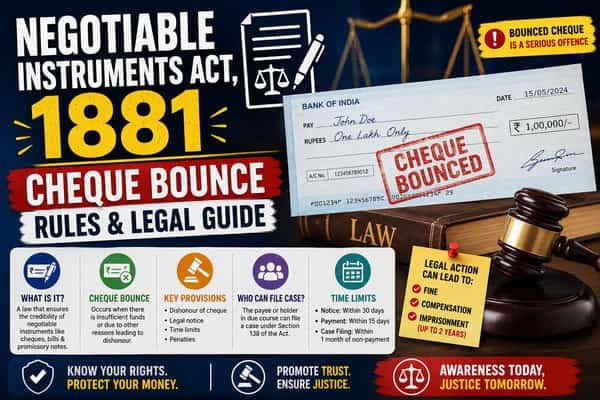
The NI Act provides the legal framework for negotiable instruments in India and lays down specific provisions for cheque dishonour, commonly known as cheque bounce cases. It helps ensure trust in commercial transactions by defining the rights and liabilities of parties involved and prescribing remedies for unpaid cheques. Understanding this law is important for business owners, entrepreneurs, employees, banks, legal professionals, and anyone who deals with financial transactions through negotiable instruments.
Negotiable Instruments (NI) Act, 1881: Overview
| Particular | Details |
|---|---|
| Full Name | Negotiable Instruments Act, 1881 |
| Enacted | 1881 |
| Purpose | Regulate negotiable instruments and provide legal remedies for cheque dishonour |
| Applicable To | Negotiable instruments such as cheques, promissory notes, and bills of exchange |
| Governing Authority | Government of India and courts under applicable laws |
| Important Provision | Section 138 (Cheque Dishonour) |
| Covers | Issuance, transfer, endorsement, payment, and legal enforcement of negotiable instruments |
| Importance | Promotes trust and certainty in commercial and financial transactions |
What is the Negotiable Instruments Act, 1881?
The Negotiable Instruments Act, 1881 is one of India’s oldest commercial laws. It governs the use, transfer, and enforcement of negotiable instruments, ensuring that financial transactions conducted through these instruments remain legally secure and reliable.
The Act defines the legal rights and obligations of parties involved in negotiable instruments and provides remedies when payment obligations are not fulfilled. Over the years, it has been amended to strengthen the legal framework for cheque dishonour and improve the efficiency of commercial transactions.
Objectives of the NI Act
The Act was introduced to create confidence in financial dealings and facilitate trade.
Its primary objectives include:
- Regulate negotiable instruments.
- Ensure smooth commercial transactions.
- Protect the rights of payees and holders.
- Provide legal remedies for dishonoured cheques.
- Promote financial discipline.
- Reduce disputes in business transactions.
- Enhance credibility in banking operations.
These objectives continue to support India’s commercial and banking system.
Types of Negotiable Instruments
The Act primarily recognizes three types of negotiable instruments.
1. Cheque
A cheque is the most commonly used negotiable instrument.
It is a written order directing a bank to pay a specified amount to the person named in the cheque or to the bearer, subject to applicable legal requirements.
Cheques are widely used for:
- Business payments
- Salary payments
- Rent
- Loan repayments
- Security deposits
- Commercial transactions
2. Promissory Note
A promissory note is a written promise made by one person to pay a specified amount to another person either on demand or at a future date.
It is commonly used in:
- Personal loans
- Business borrowings
- Financial agreements
3. Bill of Exchange
A bill of exchange is a written instrument directing one party to pay a specified amount to another party either immediately or on a future date.
It is frequently used in:
- Trade transactions
- International commerce
- Business financing
What is a Cheque Bounce?
A cheque is said to be dishonoured or “bounced” when the bank refuses payment upon presentation.
Common reasons include:
- Insufficient funds
- Signature mismatch
- Closed bank account
- Payment stopped by the drawer
- Alterations on the cheque
- Account restrictions
- Technical defects in the cheque
Not every dishonour automatically results in criminal liability. The legal consequences depend on the facts of each case and the applicable provisions of the Act.
Section 138 of the NI Act
Section 138 is one of the most significant provisions of the Act.
It deals with cheque dishonour for legally enforceable debts or liabilities, subject to the fulfillment of the statutory conditions laid down in the law.
For criminal liability to arise under Section 138, the prescribed legal requirements and timelines must generally be followed, including:
- Presentation of the cheque within its validity period.
- Issuance of the statutory legal notice by the payee after receiving information about the dishonour.
- Failure of the drawer to make payment within the prescribed period after receiving the notice.
- Filing of the complaint within the limitation period provided under the Act.
Compliance with these procedural requirements is essential for initiating legal proceedings.
Legal Remedy for Cheque Bounce
When a cheque is dishonoured and the statutory conditions are satisfied, the payee may initiate legal proceedings under the NI Act.
The process generally includes:
Step 1: Receive the Bank Return Memo
The bank issues a return memo stating the reason for dishonour.
Step 2: Send a Legal Notice
The payee issues a written demand notice to the drawer within the time prescribed under the Act, seeking payment of the cheque amount.
Step 3: Wait for the Prescribed Payment Period
If payment is not made within the statutory period after receipt of the notice, the cause of action for filing a complaint may arise.
Step 4: File a Complaint Before the Competent Court
The complaint must generally be filed within the limitation period prescribed under the NI Act.
Rights of the Payee
The Act provides several legal protections to the holder or payee of a cheque.
These include:
- Right to demand payment.
- Right to issue a statutory legal notice.
- Right to initiate legal proceedings where applicable.
- Right to claim the cheque amount.
- Right to seek compensation or other relief as permitted by law.
These provisions strengthen confidence in cheque-based transactions.
Responsibilities of the Drawer
The person issuing a cheque should:
- Maintain sufficient funds.
- Ensure the cheque is properly signed.
- Avoid issuing cheques without a valid financial arrangement.
- Honour payment obligations.
- Verify all cheque details before issuance.
Responsible financial practices help prevent legal disputes.
Penalties Under the NI Act
If the requirements of Section 138 are established before the court, the drawer may face penalties prescribed under the Act.
Depending on the circumstances and the court’s findings, consequences may include:
- Imprisonment as provided under the law.
- Monetary fine.
- Compensation to the complainant where ordered.
- Additional legal costs in appropriate cases.
The court decides each case based on the evidence presented and the applicable legal provisions.
Importance of the NI Act in Business
The Negotiable Instruments Act plays a vital role in maintaining trust in commercial transactions.
Its significance includes:
- Encouraging secure business payments.
- Protecting creditors.
- Promoting banking discipline.
- Reducing payment defaults.
- Supporting commercial confidence.
- Facilitating smoother financial transactions.
Even in the era of digital payments, cheques remain widely used in business and legal transactions, making the Act highly relevant.
Practical Tips to Avoid Cheque Bounce Disputes
To minimize the risk of legal disputes:
- Keep adequate funds in your bank account before issuing a cheque.
- Verify all cheque details carefully.
- Avoid issuing blank signed cheques unless legally necessary.
- Maintain proper records of transactions.
- Present cheques within their validity period.
- Respond promptly if you receive a legal notice regarding cheque dishonour.
These simple precautions can help prevent unnecessary litigation.
Frequently Asked Questions (FAQs)
1. Does every cheque bounce result in a criminal case?
No. Criminal liability under Section 138 generally arises only when the statutory conditions prescribed under the NI Act are fulfilled, including compliance with the legal notice and limitation requirements.
2. Can a cheque bounce case be settled outside the court?
Yes. In many cases, the parties may resolve the dispute through mutual settlement or other legally permissible methods, subject to the applicable legal process.
3. What should I do if I receive a cheque bounce legal notice?
You should carefully review the notice, understand the allegations, and consider seeking advice from a qualified legal professional before taking further action.
4. Is a digitally signed cheque covered under the NI Act?
Electronic and digitally enabled cheque-related transactions may be governed by the NI Act and other applicable laws, depending on the nature of the instrument and the legal framework in force.
Disclaimer: This article is intended for general informational and educational purposes only. It provides a simplified overview of the Negotiable Instruments Act, 1881 and should not be considered legal advice. The outcome of cheque bounce cases and other matters under the Act depends on the specific facts, applicable legal provisions, and judicial interpretation. Individuals and businesses should consult a qualified legal professional for advice regarding their particular circumstances.