
Education is one of the most powerful tools for building a better future. It not only helps children develop knowledge and skills but also improves their confidence, career opportunities, and overall quality of life. However, many children in India have historically faced barriers such as poverty, lack of access to schools, and social inequality, preventing them from receiving quality education. To ensure that every child gets the opportunity to study, the Government of India enacted the Right of Children to Free and Compulsory Education (RTE) Act, 2009.
The RTE Act gives legal effect to the fundamental right to education guaranteed under Article 21A of the Constitution of India. It makes free and compulsory elementary education a legal entitlement for eligible children and places responsibilities on governments, schools, and local authorities to ensure access to education. Understanding the RTE Act is important for parents, teachers, school administrators, students, and citizens because it promotes equal educational opportunities and strengthens India’s education system.
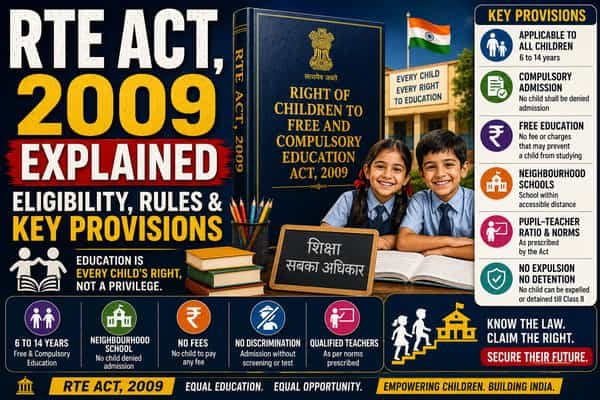
RTE Act, 2009: Overview
| Particular | Details |
|---|---|
| Full Name | Right of Children to Free and Compulsory Education Act, 2009 |
| Common Name | RTE Act, 2009 |
| Enacted | 2009 |
| Effective From | 1 April 2010 |
| Constitutional Basis | Article 21A of the Constitution of India |
| Objective | Provide free and compulsory elementary education to eligible children |
| Age Group Covered | Children aged 6 to 14 years |
| Applicable To | Government schools and specified categories of schools covered under the Act |
| Importance | Promotes universal access to elementary education and educational equality |
What is the RTE Act, 2009?
The Right of Children to Free and Compulsory Education Act, 2009 is a landmark law that guarantees free and compulsory elementary education to every eligible child between 6 and 14 years of age.
The Act places a legal obligation on the appropriate governments and local authorities to ensure that children have access to quality elementary education without being burdened by tuition fees or other charges that could prevent them from completing their schooling. It also lays down norms for school infrastructure, teacher qualifications, pupil-teacher ratios, and admission procedures.
Why Was the RTE Act Introduced?
Before the enactment of the RTE Act, millions of children in India either did not attend school or dropped out due to financial, social, or geographical challenges.
The Act was introduced to:
- Ensure universal elementary education.
- Reduce school dropout rates.
- Promote equality in education.
- Eliminate financial barriers.
- Improve educational quality.
- Strengthen children’s fundamental right to education.
- Encourage inclusive schooling.
The legislation represents an important step toward achieving educational equity across the country.
Who is Eligible Under the RTE Act?
The Act applies to children who:
- Are between 6 and 14 years of age.
- Require elementary education as defined under the Act.
- Meet the eligibility conditions prescribed under the applicable legal framework.
The Act focuses on ensuring access to elementary education without discrimination based on economic or social background.
What Does “Free and Compulsory Education” Mean?
Under the Act:
Free Education
Eligible children should not be required to pay tuition fees or charges that prevent them from completing elementary education in accordance with the provisions of the Act.
Compulsory Education
The responsibility for ensuring that eligible children receive elementary education rests primarily with the appropriate government and local authorities, as specified under the law.
The objective is to ensure that no child is deprived of education due to financial or administrative reasons.
Key Provisions of the RTE Act
1. Right to Elementary Education
The Act guarantees every eligible child the right to receive elementary education in accordance with its provisions.
This right applies until the completion of elementary education within the prescribed age group.
2. Admission Without Discrimination
Schools covered under the Act are expected to follow fair admission practices and provide equal educational opportunities in accordance with applicable legal provisions.
Children should not be denied admission solely because they lack certain documents, subject to the procedures prescribed under the law.
3. Neighbourhood Schools
The Act encourages the establishment of neighbourhood schools so that children have easier access to education close to their homes.
This helps reduce travel difficulties and improve school attendance.
4. School Infrastructure Standards
The Act prescribes norms relating to:
- Classrooms.
- Drinking water.
- Toilets.
- Boundary walls where applicable.
- Teaching facilities.
- Playground requirements, subject to applicable norms.
These standards aim to create a safe learning environment.
5. Teacher Qualifications
The Act emphasizes the appointment of qualified teachers and seeks to maintain appropriate pupil-teacher ratios to improve the quality of education.
Teacher training and professional development are also important aspects of educational improvement.
Reservation Under the RTE Act
One of the significant features of the Act is the provision relating to admission of children from economically weaker sections and disadvantaged groups in certain categories of private schools, subject to the conditions prescribed by the Act and applicable rules.
This provision aims to promote inclusive education and reduce educational inequality.
Responsibilities of Governments
The Act places several responsibilities on governments and local authorities.
These include:
- Establishing schools where required.
- Ensuring access to free elementary education.
- Providing educational infrastructure.
- Recruiting qualified teachers.
- Monitoring school performance.
- Promoting enrolment and attendance.
- Supporting disadvantaged children.
These responsibilities help strengthen the implementation of the Act.
Responsibilities of Schools
Schools covered under the Act are expected to:
- Follow prescribed admission procedures.
- Maintain required infrastructure.
- Employ qualified teachers.
- Provide quality education.
- Maintain prescribed records.
- Comply with applicable educational norms.
Compliance helps create a better learning environment for students.
Importance of the RTE Act
The RTE Act has transformed India’s approach to elementary education.
Its significance includes:
- Increasing school enrolment.
- Improving literacy.
- Promoting equal educational opportunities.
- Supporting children’s constitutional rights.
- Reducing educational disparities.
- Encouraging inclusive education.
The Act also reinforces the principle that education is a right rather than a privilege.
Practical Tips for Parents
Parents can support their children’s education by:
- Enrolling eligible children in school at the appropriate age.
- Encouraging regular attendance.
- Participating in parent-teacher meetings.
- Supporting learning at home.
- Understanding their child’s educational rights.
- Reporting genuine concerns to school authorities where necessary.
Active parental involvement contributes significantly to a child’s academic success.
Frequently Asked Questions (FAQs)
1. Which children are covered under the RTE Act?
The Act generally applies to children between 6 and 14 years of age for elementary education, subject to its provisions and applicable rules.
2. Can a school deny admission because a child does not have all the required documents?
The RTE Act contains provisions intended to ensure that eligible children are not unfairly denied admission due to the absence of certain documents, subject to the applicable procedures and rules.
3. Does the RTE Act apply to private schools?
Yes. Certain categories of private schools are subject to specific obligations under the Act, including provisions relating to admissions, where applicable.
4. Why is the RTE Act important?
The Act guarantees access to free and compulsory elementary education for eligible children, promotes educational equality, reduces barriers to schooling, and supports the constitutional right to education.
Disclaimer: This article is intended for general informational and educational purposes only. It provides a simplified overview of the Right of Children to Free and Compulsory Education (RTE) Act, 2009 and should not be considered legal or educational advice. The implementation of the Act may vary based on applicable Central and State rules, government notifications, and judicial decisions. Parents, schools, and educational institutions should consult the relevant education authorities or qualified legal professionals for guidance on specific matters.