
Business disagreements and contractual disputes are common in today’s fast-paced economy. Whether it is a disagreement between two companies, a construction contract dispute, a partnership issue, or a commercial payment conflict, resolving such matters through traditional court proceedings can often take considerable time and expense. To provide a faster, more efficient, and less formal method of resolving disputes, India enacted the Arbitration and Conciliation Act, 1996.
The Act establishes a legal framework for arbitration, conciliation, and the enforcement of domestic as well as international arbitral awards. It encourages parties to settle disputes outside traditional courts while ensuring fairness, neutrality, and legal certainty. Today, arbitration has become a preferred dispute resolution mechanism for businesses, startups, contractors, multinational companies, and even individuals. Understanding the Arbitration and Conciliation Act is important for entrepreneurs, professionals, students, lawyers, and anyone entering into commercial agreements.
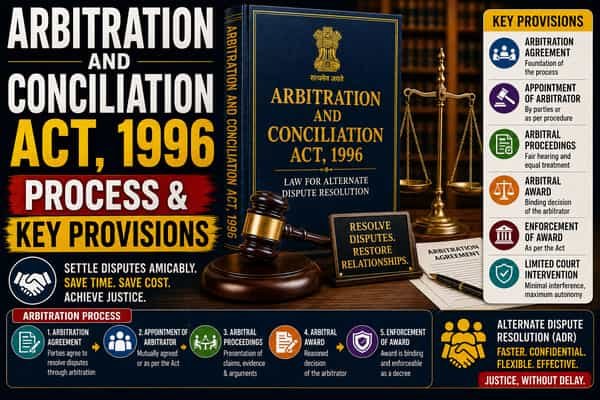
Arbitration and Conciliation Act, 1996: Overview
| Particular | Details |
|---|---|
| Full Name | Arbitration and Conciliation Act, 1996 |
| Enacted | 1996 |
| Objective | Provide a legal framework for arbitration, conciliation, and enforcement of arbitral awards |
| Applicable To | Domestic and international commercial arbitration, conciliation, and related proceedings |
| Governing Principle | Alternative Dispute Resolution (ADR) |
| Covers | Arbitration agreements, appointment of arbitrators, arbitral proceedings, conciliation, and enforcement of awards |
| Importance | Promotes speedy, cost-effective, and efficient dispute resolution |
What is the Arbitration and Conciliation Act, 1996?
The Arbitration and Conciliation Act, 1996 is the principal legislation governing Alternative Dispute Resolution (ADR) through arbitration and conciliation in India.
Instead of resolving disputes through lengthy court trials, parties may choose arbitration or conciliation as an alternative mechanism. Under arbitration, an independent arbitrator hears both sides and delivers a legally binding decision known as an arbitral award. Conciliation, on the other hand, focuses on helping parties reach a mutually acceptable settlement with the assistance of a neutral conciliator.
The Act is based largely on internationally accepted principles and has undergone several amendments to make India a more arbitration-friendly jurisdiction.
Why Was the Arbitration and Conciliation Act Introduced?
Traditional litigation often involves lengthy procedures, increasing legal costs, and delays in resolving commercial disputes.
The Act was introduced to:
- Promote speedy dispute resolution.
- Reduce the burden on courts.
- Encourage commercial certainty.
- Support domestic and international business.
- Provide legally enforceable arbitration awards.
- Promote amicable settlement through conciliation.
The legislation has significantly improved India’s alternative dispute resolution framework.
What is Arbitration?
Arbitration is a legal process in which disputing parties agree to submit their dispute to one or more neutral arbitrators instead of approaching a court.
The arbitrator examines the evidence, hears both parties, and issues an arbitral award that is legally enforceable under the Act, subject to the applicable legal provisions.
Arbitration is commonly used in:
- Business contracts.
- Construction agreements.
- Infrastructure projects.
- Commercial transactions.
- International trade.
- Partnership disputes.
What is Conciliation?
Conciliation is another method of Alternative Dispute Resolution.
Unlike arbitration, the conciliator does not impose a binding decision. Instead, the conciliator assists the parties in negotiating a voluntary settlement that is acceptable to both sides.
Conciliation is often preferred when the parties wish to preserve their business or personal relationship.
Key Features of the Arbitration and Conciliation Act
1. Arbitration Agreement
The arbitration process generally begins with an arbitration agreement between the parties.
This agreement specifies that disputes arising out of the contract will be resolved through arbitration instead of ordinary court proceedings.
An arbitration clause is commonly included in commercial contracts.
2. Appointment of Arbitrators
The parties may mutually agree on the appointment of an arbitrator or arbitral tribunal.
Where they are unable to do so, the appointment may be made in accordance with the provisions of the Act.
The arbitrator is expected to remain impartial and independent throughout the proceedings.
3. Flexibility in Proceedings
Unlike traditional court litigation, arbitration offers procedural flexibility.
The parties may agree on matters such as:
- Place of arbitration.
- Language.
- Applicable procedural rules.
- Number of arbitrators.
- Timelines for proceedings.
This flexibility makes arbitration suitable for commercial disputes.
4. Confidentiality
Arbitration proceedings are generally more private than court proceedings.
Confidentiality helps protect:
- Business information.
- Trade secrets.
- Financial data.
- Commercial reputation.
This is one of the reasons why businesses often prefer arbitration.
Arbitration Process in India
The arbitration process generally follows these stages.
Step 1: Arbitration Agreement
The parties agree that disputes will be resolved through arbitration.
Step 2: Appointment of Arbitrator
An arbitrator or arbitral tribunal is appointed according to the agreement or the provisions of the Act.
Step 3: Submission of Claims
Both parties submit their claims, defences, and supporting documents.
Step 4: Hearing
The arbitrator hears both parties, examines the evidence, and considers the applicable law.
Step 5: Arbitral Award
The arbitrator issues a written arbitral award, which is legally enforceable in accordance with the Act.
Enforcement of Arbitral Awards
One of the major strengths of the Act is that arbitral awards are legally enforceable.
If a party fails to comply voluntarily, the successful party may seek enforcement through the appropriate court in accordance with the provisions of the Act.
The grounds for challenging an arbitral award are limited and specifically provided under the legislation.
Advantages of Arbitration
Arbitration offers several practical benefits.
These include:
- Faster dispute resolution.
- Reduced legal costs in many cases.
- Confidential proceedings.
- Flexible procedures.
- Expert decision-makers.
- Limited court intervention.
- Greater convenience for commercial parties.
These advantages have made arbitration increasingly popular in India and internationally.
Importance of Conciliation
Conciliation focuses on resolving disputes through mutual understanding rather than adversarial proceedings.
Its benefits include:
- Preserving business relationships.
- Reducing litigation.
- Saving time.
- Lower legal expenses.
- Encouraging cooperative solutions.
Where parties are willing to negotiate, conciliation can provide a practical and amicable outcome.
Recent Reforms in Arbitration Law
Over the years, India has introduced several amendments to strengthen its arbitration framework.
The reforms aim to:
- Promote institutional arbitration.
- Reduce unnecessary delays.
- Increase transparency.
- Encourage international investment.
- Improve enforcement of arbitral awards.
- Make India a preferred arbitration destination.
These changes have enhanced confidence among businesses and investors.
Practical Tips Before Signing an Arbitration Clause
Before agreeing to arbitration, parties should:
- Read the arbitration clause carefully.
- Specify the seat and venue of arbitration.
- Decide the number of arbitrators.
- Choose the governing law.
- Consider institutional arbitration where appropriate.
- Seek legal advice for high-value contracts.
A well-drafted arbitration clause can prevent future procedural disputes.
Frequently Asked Questions (FAQs)
1. Is an arbitral award legally binding?
Yes. An arbitral award is generally binding on the parties and is enforceable in accordance with the provisions of the Arbitration and Conciliation Act, 1996, subject to the limited grounds for challenge provided by law.
2. Can parties choose their own arbitrator?
Yes. Parties are generally free to mutually appoint an arbitrator or arbitral tribunal, subject to the provisions of the Act and the terms of their arbitration agreement.
3. What is the difference between arbitration and conciliation?
In arbitration, the arbitrator issues a binding decision after hearing both parties. In conciliation, the conciliator assists the parties in reaching a mutually acceptable settlement without imposing a decision.
4. Is arbitration faster than court litigation?
In many commercial disputes, arbitration is often faster and more flexible than traditional court proceedings, although the duration depends on the complexity of the case and the conduct of the parties.
Disclaimer: This article is intended for general informational and educational purposes only. It provides a simplified overview of the Arbitration and Conciliation Act, 1996 and should not be considered legal advice. The application of the Act depends on the specific facts of each case, contractual terms, applicable amendments, judicial interpretation, and procedural rules. Individuals and businesses should consult a qualified legal professional before initiating arbitration, conciliation, or drafting dispute resolution clauses.