
Access to safe, affordable, and quality healthcare is a basic need for every individual. Whether you visit a private hospital, diagnostic centre, nursing home, clinic, or laboratory, you expect proper medical facilities, qualified healthcare professionals, and transparent services. However, differences in healthcare standards and the operation of unregistered medical facilities have long been concerns in India. To improve healthcare quality and ensure accountability, the Government introduced the Clinical Establishments (Registration and Regulation) Act, 2010.
The Act provides a legal framework for the registration and regulation of clinical establishments across applicable States and Union Territories. It aims to standardize healthcare services, improve patient safety, and ensure that healthcare facilities meet prescribed minimum standards. Understanding this law is important for doctors, hospital owners, healthcare professionals, patients, entrepreneurs planning healthcare facilities, and anyone seeking reliable medical services.
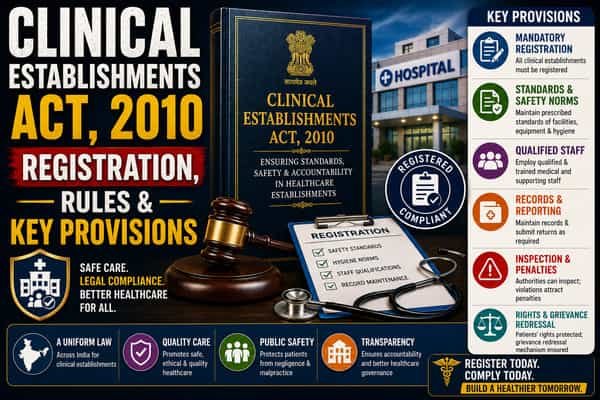
Clinical Establishments (Registration and Regulation) Act, 2010: Overview
| Particular | Details |
|---|---|
| Full Name | Clinical Establishments (Registration and Regulation) Act, 2010 |
| Common Name | Clinical Establishments Act, 2010 |
| Enacted | 2010 |
| Objective | Regulate and register clinical establishments and improve healthcare standards |
| Applicable To | States and Union Territories where the Act has been adopted or notified |
| Covers | Registration, regulation, minimum standards, transparency, and record maintenance |
| Regulated By | Appropriate Central and State Authorities under the Act |
| Importance | Improves healthcare quality, patient safety, and accountability |
What is the Clinical Establishments Act, 2010?
The Clinical Establishments (Registration and Regulation) Act, 2010 is a central legislation designed to regulate clinical establishments by requiring registration and compliance with prescribed standards. It applies to healthcare facilities covered under the Act in States and Union Territories where it is in force.
The legislation seeks to ensure that healthcare providers maintain minimum standards of infrastructure, medical equipment, personnel, and services. It also promotes transparency by requiring registered establishments to display information relating to services and charges where applicable.
Why Was the Clinical Establishments Act Introduced?
Before the enactment of this law, healthcare facilities in different parts of India often operated under varying standards, leading to concerns regarding patient safety and quality of care.
The Act was introduced to:
- Standardize healthcare services.
- Ensure registration of clinical establishments.
- Improve patient safety.
- Promote transparency in healthcare.
- Maintain minimum quality standards.
- Strengthen healthcare regulation.
- Improve public confidence in medical institutions.
The law aims to create a more organized and accountable healthcare system.
What is a Clinical Establishment?
The Act broadly covers various healthcare facilities that provide medical diagnosis, treatment, or care.
Depending on the provisions of the Act, clinical establishments may include:
- Hospitals
- Nursing homes
- Clinics
- Polyclinics
- Diagnostic centres
- Pathology laboratories
- Imaging centres
- Day-care medical facilities
- Other healthcare institutions covered under the legislation
The exact applicability depends on the provisions of the Act and the relevant State or Union Territory.
States Where the Act Applies
The Clinical Establishments Act is not automatically applicable throughout India.
It applies to:
- States and Union Territories that have adopted or implemented the Act.
- Union Territories where the Central Act applies.
- Other jurisdictions that have enacted similar legislation.
Healthcare providers should verify the legal position applicable in their respective State or Union Territory.
Key Provisions of the Clinical Establishments Act
1. Mandatory Registration
One of the most important features of the Act is the requirement for eligible clinical establishments to obtain registration before operating.
Registration helps ensure that healthcare facilities comply with prescribed legal and operational standards.
2. Minimum Standards
The Act prescribes minimum standards relating to:
- Infrastructure.
- Medical equipment.
- Qualified healthcare personnel.
- Patient care.
- Record maintenance.
- Safety measures.
Compliance helps improve the quality of healthcare services.
3. Transparency in Services
Registered establishments may be required to display information relating to:
- Available medical services.
- Charges for services, where applicable.
- Registration details.
- Other information prescribed under the law.
This enables patients to make informed decisions.
4. Record Maintenance
Healthcare facilities covered under the Act are expected to maintain proper medical and administrative records in accordance with applicable legal requirements.
Proper documentation improves continuity of care and regulatory compliance.
Registration Process
The registration process generally involves the following steps.
Step 1: Application
The clinical establishment submits an application to the appropriate authority in the prescribed form.
Step 2: Verification
The authority examines whether the establishment satisfies the applicable legal requirements and prescribed standards.
Step 3: Grant of Registration
If the requirements are fulfilled, registration may be granted in accordance with the provisions of the Act.
Step 4: Continued Compliance
Registered establishments are expected to continue complying with the applicable standards and conditions.
Responsibilities of Clinical Establishments
Healthcare facilities covered under the Act have several responsibilities.
These include:
- Maintaining prescribed standards.
- Employing qualified healthcare professionals.
- Keeping proper patient records.
- Following applicable safety protocols.
- Displaying required information.
- Cooperating with inspections conducted by competent authorities.
Compliance contributes to improved patient care and public trust.
Benefits for Patients
The Act offers several advantages for patients.
These include:
- Better quality healthcare services.
- Greater transparency.
- Improved accountability.
- Safer treatment environments.
- Standardized medical facilities.
- Better access to information regarding services.
Patients are encouraged to seek treatment from appropriately registered healthcare facilities wherever applicable.
Penalties for Non-Compliance
The Act provides for action against establishments that fail to comply with its provisions.
Depending on the nature of the violation, consequences may include:
- Monetary penalties.
- Suspension or cancellation of registration.
- Other regulatory action permitted under the law.
The applicable authority determines the appropriate course of action based on the facts of each case.
Importance of the Clinical Establishments Act
The Act plays an important role in strengthening India’s healthcare system.
Its significance includes:
- Improving healthcare quality.
- Standardizing medical services.
- Protecting patient interests.
- Increasing transparency.
- Promoting ethical healthcare practices.
- Supporting better healthcare governance.
It also encourages continuous improvement in healthcare infrastructure and service delivery.
Practical Tips for Patients
Before choosing a healthcare facility:
- Verify whether the establishment is registered where required.
- Check the qualifications of healthcare professionals.
- Request bills and medical records.
- Understand treatment costs in advance.
- Preserve prescriptions and diagnostic reports.
- Seek clarification regarding treatment options.
Being informed helps patients make better healthcare decisions.
Frequently Asked Questions (FAQs)
1. Does the Clinical Establishments Act apply across all States in India?
No. The Act applies only in States and Union Territories where it has been adopted, notified, or otherwise made applicable. Some States have their own laws regulating clinical establishments.
2. Are private hospitals covered under the Act?
Yes. Depending on the applicability of the Act in the relevant State or Union Territory, private hospitals and other clinical establishments may be required to register and comply with the prescribed standards.
3. Why is registration important under the Act?
Registration helps ensure that healthcare facilities meet minimum standards relating to infrastructure, personnel, equipment, and patient care, thereby promoting quality and accountability.
4. Can authorities inspect registered clinical establishments?
Yes. Competent authorities may inspect registered establishments in accordance with the provisions of the Act to verify compliance with applicable legal requirements.
Disclaimer: This article is intended for general informational and educational purposes only. It provides a simplified overview of the Clinical Establishments (Registration and Regulation) Act, 2010 and should not be considered legal or medical advice. The applicability of the Act varies by State and Union Territory, and healthcare providers should comply with the relevant Central or State laws, rules, and notifications. For specific legal or regulatory guidance, consult the appropriate government authority or a qualified legal professional.