
Evidence is the backbone of every legal case. Whether it is a criminal trial, a civil dispute, or an investigation, courts rely on evidence to determine the truth and deliver justice. In today’s digital world, legal disputes increasingly involve electronic records, emails, CCTV footage, mobile phone data, social media messages, and digital documents. Recognizing the need for a modern law that reflects technological advancements, India enacted the Bharatiya Sakshya Adhiniyam (BSA), 2023, replacing the colonial-era Indian Evidence Act, 1872.
The Bharatiya Sakshya Adhiniyam provides the legal framework for determining what evidence is admissible in courts, how evidence should be presented, and the standards for proving facts during judicial proceedings. It also gives greater recognition to electronic and digital evidence while simplifying several procedural aspects. Understanding this law is important for advocates, law students, police officers, judges, businesses, and citizens because it plays a crucial role in the administration of justice.
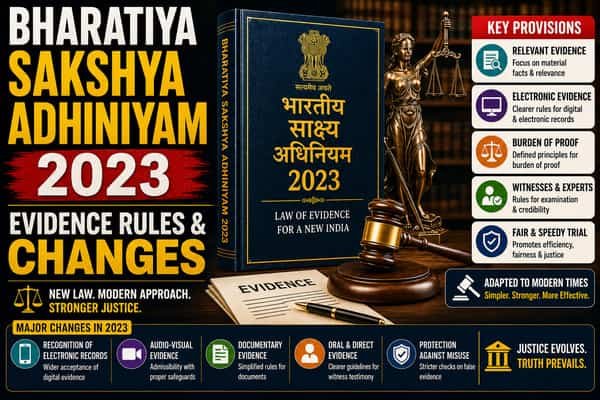
Bharatiya Sakshya Adhiniyam (BSA), 2023: Overview
| Particular | Details |
|---|---|
| Full Name | Bharatiya Sakshya Adhiniyam, 2023 |
| Common Name | BSA, 2023 |
| Enacted | 2023 |
| Came Into Force | 1 July 2024 |
| Replaces | Indian Evidence Act, 1872 |
| Objective | Modernize India’s law of evidence and recognize digital evidence |
| Covers | Admissibility of evidence, electronic records, witness examination, documentary evidence, and proof of facts |
| Importance | Governs the law of evidence in judicial proceedings across India |
What is the Bharatiya Sakshya Adhiniyam, 2023?
The Bharatiya Sakshya Adhiniyam (BSA), 2023 is India’s principal legislation governing the law of evidence. It determines what evidence can be presented before courts, how facts must be proved, and how judges evaluate evidence during legal proceedings.
The BSA replaced the Indian Evidence Act, 1872 from 1 July 2024. It has been updated to reflect technological developments by providing greater recognition to electronic records and digital evidence while retaining many of the fundamental principles of evidence law.
The BSA functions alongside the Bharatiya Nyaya Sanhita (BNS), 2023, which defines criminal offences, and the Bharatiya Nagarik Suraksha Sanhita (BNSS), 2023, which governs criminal procedure.
Why Was the Bharatiya Sakshya Adhiniyam Introduced?
The Indian Evidence Act had served the country for more than 150 years, but the rapid growth of digital communication and electronic transactions created the need for updated legal provisions.
The BSA was introduced to:
- Modernize evidence law.
- Recognize electronic evidence.
- Simplify legal procedures.
- Improve judicial efficiency.
- Strengthen transparency in trials.
- Support digital governance.
- Align evidence law with modern technology.
The Act aims to ensure that courts can effectively deal with evidence generated in today’s digital environment.
Key Features of the Bharatiya Sakshya Adhiniyam
1. Replacement of the Indian Evidence Act
The BSA replaces the Indian Evidence Act, 1872, which governed the law of evidence for over a century.
The new legislation reorganizes provisions while preserving many well-established principles of evidence law.
2. Recognition of Electronic Records
One of the most significant features of the BSA is its greater emphasis on electronic and digital evidence.
Electronic records may include:
- Emails.
- SMS messages.
- Mobile phone records.
- CCTV footage.
- Digital photographs.
- Computer-generated documents.
- Electronic contracts.
- Audio and video recordings.
The admissibility of such evidence is subject to the conditions prescribed under the law.
3. Documentary Evidence
The BSA continues to recognize documentary evidence while expanding its treatment of electronic documents.
Documents may include:
- Written agreements.
- Government records.
- Business records.
- Electronic documents.
- Digital certificates.
- Official records.
Courts assess these documents in accordance with the provisions of the Act.
4. Oral Evidence
Witness testimony remains an important source of evidence.
The Act governs:
- Examination-in-chief.
- Cross-examination.
- Re-examination.
- Competency of witnesses.
The credibility and relevance of oral evidence are evaluated by the court.
Digital Evidence Under the BSA
The increasing use of technology has made digital evidence an essential part of legal proceedings.
Examples include:
- WhatsApp chats.
- Emails.
- CCTV recordings.
- Cloud-based records.
- GPS data.
- Social media posts.
- Electronic financial records.
The BSA recognizes the importance of such evidence while prescribing legal requirements for its admissibility and authenticity.
Admissibility of Evidence
Not every piece of information can automatically be presented in court.
The BSA lays down rules regarding:
- Relevance of facts.
- Admissibility of evidence.
- Documentary proof.
- Electronic evidence.
- Expert opinions.
- Witness testimony.
Only evidence that satisfies the applicable legal requirements may be relied upon by the court.
Witnesses Under the BSA
Witnesses play a crucial role in judicial proceedings.
The Act contains provisions relating to:
- Competency of witnesses.
- Examination of witnesses.
- Cross-examination.
- Leading questions.
- Credibility of witnesses.
These rules help courts evaluate the reliability of testimony.
Expert Evidence
Courts may rely on expert opinions in appropriate cases.
Experts may assist in matters involving:
- Medical science.
- Forensic analysis.
- Digital forensics.
- Handwriting examination.
- Fingerprint analysis.
- Technical subjects.
Expert evidence helps courts understand specialized issues beyond ordinary knowledge.
Major Changes Introduced by the BSA
Some important reforms include:
- Replacement of the Indian Evidence Act.
- Greater recognition of electronic records.
- Modernized treatment of digital evidence.
- Improved legal framework for technological advancements.
- Simplified presentation of evidence in certain areas.
- Better alignment with contemporary criminal justice reforms.
These changes make the law more suitable for today’s digital society.
Importance of the Bharatiya Sakshya Adhiniyam
The BSA plays a central role in India’s justice system.
Its importance includes:
- Modernizing evidence law.
- Supporting digital justice.
- Improving judicial efficiency.
- Strengthening criminal investigations.
- Facilitating fair trials.
- Enhancing confidence in the legal system.
Without reliable evidence, courts cannot effectively determine the truth or administer justice.
Practical Tips for Citizens
When dealing with legal matters:
- Preserve important documents.
- Avoid deleting relevant electronic records.
- Keep original contracts and receipts.
- Store digital evidence securely.
- Report cyber offences promptly.
- Consult a legal professional if evidence preservation becomes necessary.
Proper handling of evidence can significantly affect the outcome of legal proceedings.
Frequently Asked Questions (FAQs)
1. What is the Bharatiya Sakshya Adhiniyam, 2023?
The Bharatiya Sakshya Adhiniyam, 2023 is India’s primary law governing evidence in judicial proceedings. It replaced the Indian Evidence Act, 1872 from 1 July 2024.
2. Does the BSA recognize electronic evidence?
Yes. The BSA provides greater recognition to electronic records and digital evidence, subject to the conditions prescribed under the law.
3. What types of digital evidence may be used in court?
Depending on the facts of the case and the applicable legal provisions, digital evidence may include emails, CCTV footage, WhatsApp messages, electronic documents, computer records, and other electronic records.
4. How is the BSA different from the BNS and BNSS?
The Bharatiya Nyaya Sanhita (BNS) defines criminal offences, the Bharatiya Nagarik Suraksha Sanhita (BNSS) governs criminal procedure, while the Bharatiya Sakshya Adhiniyam (BSA) regulates the admissibility and appreciation of evidence in legal proceedings.
Disclaimer: This article is intended for general informational and educational purposes only. It provides a simplified overview of the Bharatiya Sakshya Adhiniyam (BSA), 2023 and should not be considered legal advice. The application of the law depends on the facts of each case, applicable government notifications, judicial interpretation, and related legislation. Individuals involved in legal proceedings or requiring advice on evidentiary matters should consult a qualified legal professional for guidance specific to their circumstances.