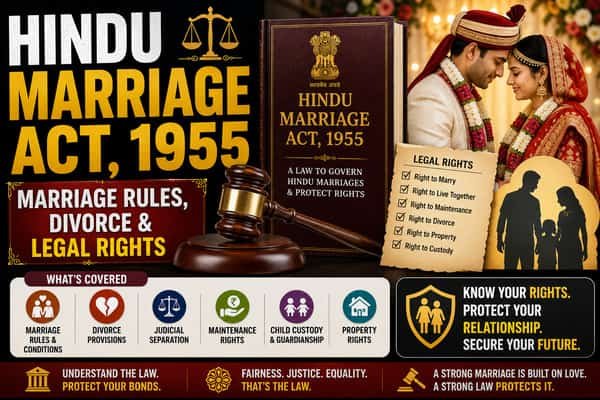
Marriage is one of the most important social and legal institutions in India. It not only brings two individuals together but also creates legal rights and responsibilities relating to family, property, maintenance, children, and inheritance. However, questions often arise regarding the legal validity of marriage, the rights of spouses, divorce procedures, judicial separation, and maintenance. To regulate these matters among Hindus, the Government enacted the Hindu Marriage Act, 1955.
The Hindu Marriage Act is one of the most significant personal laws in India. It lays down the legal conditions for a valid Hindu marriage, provides remedies in matrimonial disputes, recognizes the rights and duties of spouses, and specifies the grounds for divorce, annulment, judicial separation, and restitution of conjugal rights. Understanding this Act is important for couples planning to marry, married individuals, legal professionals, students, and anyone seeking awareness of family laws in India.
Hindu Marriage Act, 1955: Overview
| Particular | Details |
|---|---|
| Full Name | Hindu Marriage Act, 1955 |
| Enacted | 1955 |
| Applicable To | Hindus, Buddhists, Jains, and Sikhs, subject to the Act |
| Objective | Regulate Hindu marriages and provide legal remedies in matrimonial matters |
| Covers | Marriage conditions, divorce, judicial separation, maintenance, legitimacy of children, and matrimonial relief |
| Governing Authority | Family Courts and other competent courts |
| Importance | Protects the legal rights of spouses and promotes fairness in matrimonial matters |
What is the Hindu Marriage Act, 1955?
The Hindu Marriage Act, 1955 is a central legislation that governs marriages among Hindus, Buddhists, Jains, and Sikhs. It establishes the legal requirements for a valid marriage and provides remedies in situations where matrimonial disputes arise.
The Act also deals with issues such as restitution of conjugal rights, judicial separation, divorce, maintenance, legitimacy of children, and remarriage after divorce. Over the years, judicial interpretations and legislative amendments have strengthened the rights of both husbands and wives while promoting gender equality and fairness in matrimonial proceedings.
Why Was the Hindu Marriage Act Introduced?
Before the enactment of this law, Hindu marriage customs and legal practices varied across regions and communities.
The Act was introduced to:
- Standardize Hindu marriage laws.
- Protect the rights of spouses.
- Regulate valid marriages.
- Provide legal grounds for divorce.
- Promote gender justice.
- Resolve matrimonial disputes through legal procedures.
- Modernize Hindu personal law.
The legislation brought greater clarity and consistency to family law in India.
Who Does the Hindu Marriage Act Apply To?
The Act generally applies to:
- Hindus
- Buddhists
- Jains
- Sikhs
It also applies to persons who are governed by Hindu law under the provisions of the Act.
The Act does not ordinarily apply to persons governed by other personal laws unless specifically provided by law.
Essential Conditions for a Valid Hindu Marriage
For a Hindu marriage to be legally valid, certain conditions must generally be fulfilled.
1. Monogamy
At the time of marriage, neither party should have a living spouse.
A second marriage during the subsistence of a valid marriage may attract legal consequences under applicable laws.
2. Mental Capacity
Both parties should be capable of giving valid consent to the marriage and should satisfy the mental capacity requirements prescribed under the Act.
3. Minimum Age
The parties should satisfy the minimum legal age requirements prescribed by law for marriage.
The applicable legal age may be subject to amendments and other relevant legislation.
4. Prohibited Relationships
The parties should not fall within prohibited degrees of relationship unless the applicable custom or usage recognized by law permits such a marriage.
Registration of Marriage
Although the validity of a Hindu marriage depends on compliance with the applicable legal requirements and ceremonies, registration of marriage is highly recommended.
Marriage registration offers several benefits:
- Legal proof of marriage.
- Easier access to government services.
- Assistance in passport and visa applications.
- Simplified property and inheritance matters.
- Better protection of matrimonial rights.
Many States have established procedures for marriage registration.
Rights and Duties of Spouses
The Hindu Marriage Act recognizes various legal rights and obligations of spouses.
These include:
- Mutual respect and support.
- Right to seek matrimonial relief.
- Right to maintenance where legally applicable.
- Rights relating to children.
- Protection through legal remedies provided under the Act.
Both spouses are expected to fulfil their legal and matrimonial responsibilities.
Judicial Separation
Judicial separation allows spouses to live separately without immediately dissolving the marriage.
The court may grant judicial separation on grounds specified under the Act.
This remedy provides an opportunity for reconciliation while suspending certain marital obligations.
Grounds for Divorce
The Hindu Marriage Act provides several legal grounds on which either spouse may seek divorce, subject to the facts of the case.
Common grounds include:
- Cruelty.
- Desertion.
- Conversion to another religion.
- Mental disorder in circumstances recognized by law.
- Certain communicable diseases as applicable under current legal provisions.
- Renunciation of the world.
- Presumption of death after the period specified by law.
The court examines the evidence before granting a decree of divorce.
Divorce by Mutual Consent
The Act also permits divorce by mutual consent where both spouses jointly agree that the marriage has irretrievably broken down and satisfy the legal conditions prescribed by the Act.
This process is generally less adversarial than contested divorce proceedings.
Maintenance and Financial Support
The Act contains provisions enabling the court to grant maintenance in appropriate cases.
Depending on the circumstances, the court may consider factors such as:
- Income of the parties.
- Financial needs.
- Standard of living.
- Other relevant circumstances.
Maintenance may be awarded in accordance with the applicable legal provisions.
Custody of Children
In matrimonial disputes involving children, the court may pass appropriate orders regarding custody, maintenance, education, and welfare.
The welfare of the child remains the primary consideration while deciding custody matters.
Importance of the Hindu Marriage Act
The Act has significantly strengthened family law in India.
Its importance includes:
- Protecting spouses’ legal rights.
- Providing legal remedies in matrimonial disputes.
- Promoting gender equality.
- Standardizing marriage laws.
- Supporting peaceful dispute resolution.
- Safeguarding children’s interests.
The legislation continues to play a central role in governing Hindu marriages and family relationships.
Practical Tips Before Marriage
Couples should consider the following:
- Understand the legal requirements for marriage.
- Register the marriage wherever possible.
- Preserve important marriage documents.
- Discuss financial planning openly.
- Seek legal guidance for complex family matters.
- Understand rights relating to maintenance and property.
Awareness of legal rights helps strengthen marital relationships and prevents future disputes.
Frequently Asked Questions (FAQs)
1. Who is governed by the Hindu Marriage Act, 1955?
The Act generally applies to Hindus, Buddhists, Jains, and Sikhs, as well as other persons covered by its provisions.
2. Is marriage registration compulsory under the Hindu Marriage Act?
The legal position regarding compulsory registration may vary depending on applicable laws and State rules. However, registration is strongly recommended as it serves as valuable legal proof of marriage.
3. Can both husband and wife file for divorce under the Act?
Yes. Subject to the provisions of the Act, either spouse may seek divorce on the legally recognized grounds, and both spouses may jointly file for divorce by mutual consent if they satisfy the applicable conditions.
4. Does the Act provide for maintenance after separation or divorce?
Yes. The court may grant maintenance or financial support in appropriate cases after considering the facts and the provisions of the Hindu Marriage Act and other applicable laws.
Disclaimer: This article is intended for general informational and educational purposes only. It provides a simplified overview of the Hindu Marriage Act, 1955 and should not be considered legal advice. The application of the Act depends on the specific facts of each case, applicable amendments, judicial interpretation, and related family laws. Individuals seeking guidance on marriage, divorce, maintenance, child custody, or other matrimonial matters should consult a qualified legal professional or the appropriate judicial authority.