Imagine being denied admission because of your caste, arrested without proper legal procedure, prevented from expressing a lawful opinion or treated unfairly by a government authority. In such situations, the Constitution of India is not merely a book used by lawyers and judges—it is the foundation that protects the rights, dignity and freedom of every person.
From voting in elections and receiving equal treatment to approaching a court when rights are violated, many parts of everyday life are connected with the Constitution. It explains how the country must be governed, how power is divided and what limits apply to Parliament, state legislatures, governments and public authorities. For Indian citizens, understanding its basic provisions can make dealing with institutions, laws and public services far less confusing.
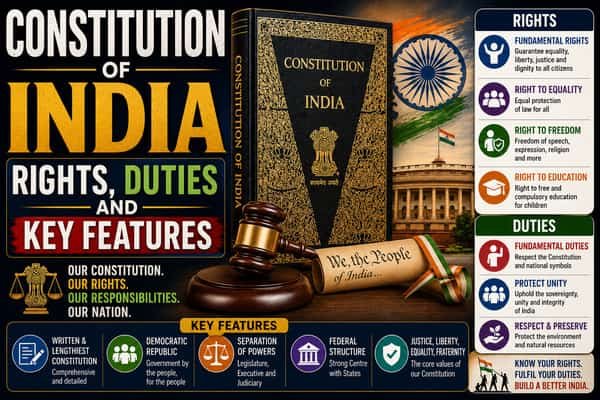
Constitution of India: Quick Overview
| Particular | Important information |
|---|---|
| Adopted on | 26 November 1949 |
| Came into force | 26 January 1950 |
| Drafting Committee Chairman | Dr. B. R. Ambedkar |
| Nature of the country | Sovereign, Socialist, Secular, Democratic Republic |
| Form of government | Parliamentary system |
| Government structure | Federal system with a strong Union |
| Fundamental Rights | Provided mainly under Part III |
| Directive Principles | Provided under Part IV |
| Fundamental Duties | Provided under Part IVA |
| Number of Schedules | 12 |
| Latest incorporated amendment | Constitution (106th Amendment) Act, 2023 |
| Supreme interpreter | Supreme Court of India |
Why India Needed a Written Constitution
When India became independent, the country needed a clear system for governing a large and diverse population. Different regions, languages, communities and social conditions had to be brought under a common democratic framework.
The Constituent Assembly prepared the Constitution after extensive debates and discussions. It established institutions such as Parliament, the Supreme Court, the offices of the President and Prime Minister, state legislatures and constitutional authorities.
More importantly, it made government power subject to legal limits. An elected government cannot simply act according to its preferences. Its laws and decisions must remain within the constitutional framework.
The Preamble and Its Practical Meaning
The Preamble expresses the guiding vision of the Constitution. It declares India to be a Sovereign, Socialist, Secular, Democratic Republic and promises justice, liberty, equality and fraternity.
These words influence how constitutional provisions are understood:
- Sovereign means India can make its own internal and external decisions.
- Socialist reflects the goal of reducing inequality and promoting social welfare.
- Secular means the State does not establish an official religion and must treat religions fairly.
- Democratic means people choose their representatives through elections.
- Republic means the head of the State is not a hereditary monarch.
The Preamble does not independently provide an enforceable legal remedy, but it helps courts understand the Constitution’s objectives.
Fundamental Rights Available in India
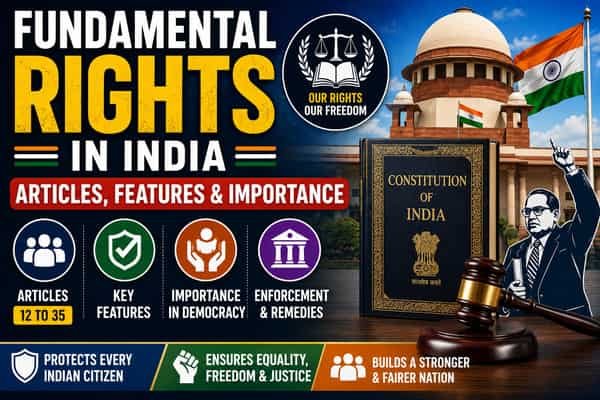
Part III provides Fundamental Rights that protect individuals against arbitrary State action. Some rights are available only to citizens, while others protect every person within India.
Right to Equality
Articles 14 to 18 promote equality before the law and prohibit discrimination on specified grounds. They also address equality of opportunity in public employment, untouchability and State-conferred titles.
Equality does not always require identical treatment. The Constitution permits protective measures and reservations for disadvantaged groups to achieve meaningful equality.
Right to Freedom
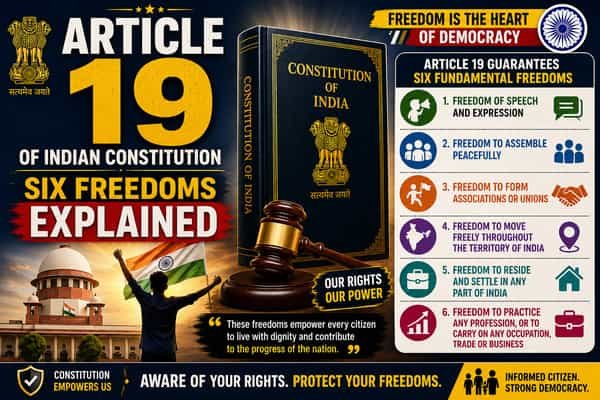
Articles 19 to 22 cover important freedoms and personal protections. Citizens receive freedoms relating to speech, peaceful assembly, association, movement, residence and profession, subject to reasonable legal restrictions.
Article 21 protects life and personal liberty. Courts have interpreted it broadly to include dignity, privacy, fair procedure and several other essential protections.
Right Against Exploitation
Articles 23 and 24 prohibit human trafficking, forced labour and certain forms of child labour. These protections are especially important for vulnerable workers, children and people facing economic exploitation.
Freedom of Religion
Articles 25 to 28 protect freedom of conscience and the right to profess, practise and propagate religion, subject to public order, morality, health and other constitutional provisions.
Cultural and Educational Rights
Articles 29 and 30 protect cultural, linguistic and educational interests, including the rights of minorities to conserve their identity and establish educational institutions.
Right to Constitutional Remedies
Article 32 allows individuals to approach the Supreme Court for enforcement of Fundamental Rights. High Courts can also issue constitutional remedies under Article 226, which covers Fundamental Rights as well as certain other legal rights.
Directive Principles of State Policy
The Directive Principles guide governments while making laws and policies. They encourage social justice, equal pay, public health, education, environmental protection, legal aid and better living conditions.
Unlike Fundamental Rights, Directive Principles are not directly enforceable through courts. A person ordinarily cannot demand that a court implement a particular Directive Principle. However, they remain fundamental to governance and influence legislation, welfare schemes and judicial interpretation.
Fundamental Duties of Citizens
Fundamental Duties appear in Article 51A. They remind citizens that democracy requires responsible public behaviour, not only the enjoyment of rights.
Citizens are expected to respect the Constitution and national symbols, protect India’s unity, promote harmony, preserve the environment, value the country’s heritage, develop scientific temper and safeguard public property.
Parents and guardians also have a duty to provide educational opportunities to children between six and fourteen years of age. Most duties are not independently enforceable unless supported by legislation, but courts may consider them while examining constitutional questions.
How Government Power Is Divided
The Constitution creates a parliamentary system at the Union and state levels. The President is the constitutional head of the Union, while the Council of Ministers headed by the Prime Minister exercises executive authority in practice. At the state level, a similar arrangement operates through the Governor and the Chief Minister-led Council of Ministers.
Legislative responsibilities are divided through the Seventh Schedule:
- The Union List contains matters mainly handled by Parliament.
- The State List contains matters ordinarily handled by state legislatures.
- The Concurrent List allows both Parliament and state legislatures to make laws.
This division helps manage a country where national coordination and regional decision-making are both necessary.
Role of the Judiciary
The Constitution provides for an independent judiciary headed by the Supreme Court. High Courts function at the state or regional level, followed by subordinate courts.
Courts can examine whether laws and government decisions comply with the Constitution. This power is commonly known as judicial review. When a law violates constitutional limits, the court may declare it invalid to the extent of the violation.
The judiciary also protects Fundamental Rights, resolves disputes between governments and interprets constitutional provisions.
How the Constitution Can Be Amended
Article 368 provides the main procedure for constitutional amendments. Some provisions can be changed by a special majority in Parliament, while amendments affecting the federal structure also require ratification by at least half of the state legislatures.
Parliament’s amending power is wide but not unlimited. Under the basic structure doctrine, Parliament cannot destroy essential constitutional features such as democracy, judicial review, secularism, federalism and the rule of law.
The Constitution (106th Amendment) Act, 2023 introduced provisions for reserving approximately one-third of seats for women in the Lok Sabha, state legislative assemblies and the Legislative Assembly of the National Capital Territory of Delhi. Its implementation is linked to a future delimitation exercise following the relevant census.
What Citizens Can Do When Their Rights Are Violated
The suitable remedy depends on the authority involved and the nature of the violation. A person may submit a written representation to the department, use a statutory appeal process, approach a commission or tribunal, seek legal aid or file a case before the appropriate court.
For a serious Fundamental Rights violation, a constitutional petition may be filed before a High Court or the Supreme Court. Important records such as government orders, notices, identification documents, correspondence and complaint acknowledgements should be preserved.
District Legal Services Authorities provide legal assistance to eligible persons, including women, children, members of Scheduled Castes and Scheduled Tribes and people meeting prescribed income conditions.
Frequently Asked Questions
Is the Constitution of India applicable only to citizens?
No. Some constitutional rights, including equality before the law and protection of life and personal liberty, are available to every person. However, certain rights, such as the freedoms under Article 19, are specifically available to citizens.
Can Parliament change Fundamental Rights?
Parliament can amend Fundamental Rights through the constitutional amendment process. However, an amendment cannot damage or destroy the Constitution’s basic structure.
What is the difference between Fundamental Rights and Fundamental Duties?
Fundamental Rights protect individuals and can generally be enforced through courts. Fundamental Duties describe citizens’ responsibilities and are usually not directly enforceable unless a law gives effect to them.
Can a person directly approach the Supreme Court?
A person can approach the Supreme Court under Article 32 for enforcement of a Fundamental Right. In many cases, approaching the relevant High Court may be more practical because High Courts have wider writ jurisdiction and are geographically more accessible.
Disclaimer: This article has been prepared for general awareness and educational purposes only. It provides a simplified overview of the Constitution of India and should not be treated as legal advice, an official legal opinion or a substitute for the complete constitutional text. Constitutional provisions may be affected by amendments, legislation and judgments of the Supreme Court or High Courts. Readers dealing with a specific constitutional, administrative or legal dispute should seek advice from a qualified legal professional or contact the appropriate authority. The publisher and author accept no responsibility for decisions made solely on the basis of this content.