A few words added to a legal document can reshape how an entire country describes itself. A new constitutional duty can influence schoolbooks, court decisions and government policies for generations. The 42nd Amendment of the Indian Constitution did both—and much more.
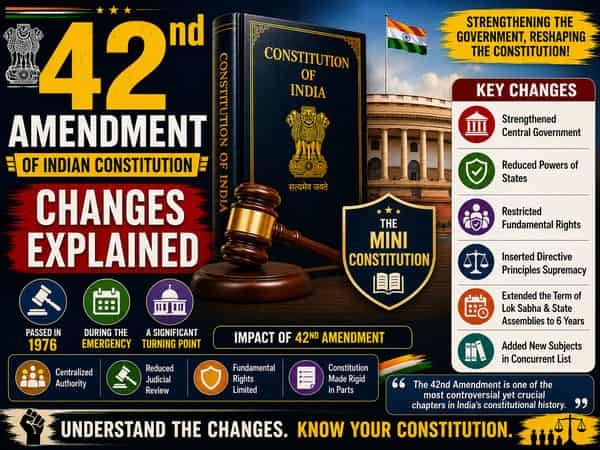
Passed during the Emergency, this amendment changed the Preamble, introduced Fundamental Duties, strengthened Directive Principles, expanded the Central Government’s influence and attempted to restrict the judiciary’s power to review constitutional amendments. Some changes remain visible in everyday constitutional life, while others were later removed or declared invalid. Understanding the 42nd Amendment is therefore important not only for competitive examinations but also for anyone who wants to understand the balance between Parliament, courts, citizens and government power in India.
42nd Constitutional Amendment: Overview
| Particular | Important information |
|---|---|
| Official name | Constitution (Forty-second Amendment) Act, 1976 |
| Common description | Mini-Constitution |
| Presidential assent | 18 December 1976 |
| Implementation | Came into force in stages during 1977 |
| Historical period | Internal Emergency of 1975–1977 |
| Government at the time | Indira Gandhi-led Union Government |
| Major Preamble changes | Added Socialist, Secular and Integrity |
| Fundamental Duties | Added Part IVA and Article 51A |
| New Directive Principles | Articles 39A, 43A and 48A |
| New tribunal provisions | Articles 323A and 323B |
| Legislative term change | Increased from five to six years, later restored |
| Judicial response | Several provisions were later removed or invalidated |
What Was the 42nd Amendment?
The 42nd Amendment was one of the most extensive amendments made to the Constitution of India. It altered the Preamble and made changes across several constitutional Parts, Articles and the Seventh Schedule.
It is popularly called the “Mini-Constitution” because it attempted to reshape several important aspects of governance through a single amendment. Its provisions affected Parliament, state legislatures, the President, courts, Fundamental Rights, Directive Principles, tribunals and Centre–State relations.
The amendment was passed during the Internal Emergency, when civil liberties and political opposition were already under intense pressure. This background remains important when examining the provisions that attempted to reduce judicial control and expand Parliament’s constitutional amending power.
Changes Made to the Preamble
The amendment added three expressions to the Preamble.
The words “Socialist” and “Secular” were inserted between “Sovereign” and “Democratic.” The expression “unity of the Nation” was changed to “unity and integrity of the Nation.”
After the amendment, India was described as a “Sovereign Socialist Secular Democratic Republic.”
In constitutional practice, socialism does not require the State to follow one rigid economic model. It reflects a commitment to social and economic justice, welfare and reduction of inequality.
Secularism requires the State to maintain constitutional neutrality toward religions and protect freedom of religion. Integrity emphasises the preservation of national unity while respecting India’s social, regional and cultural diversity.
These additions remain part of the Preamble today.
Introduction of Fundamental Duties
One of the most lasting contributions of the 42nd Amendment was the addition of Part IVA containing Article 51A.
It originally introduced ten Fundamental Duties for Indian citizens. These include duties to:
- Respect the Constitution, National Flag and National Anthem
- Protect India’s sovereignty, unity and integrity
- Promote harmony and a spirit of common brotherhood
- Preserve the country’s cultural heritage
- Protect the natural environment
- Develop scientific temper and humanism
- Safeguard public property
- Strive for excellence
An eleventh duty concerning educational opportunities for children was added later through the 86th Constitutional Amendment.
Fundamental Duties are generally not directly enforceable in the same way as Fundamental Rights. However, Parliament can make laws supporting these duties, and courts may consider them while interpreting legislation and constitutional obligations.
Strengthening the Directive Principles
The amendment strengthened Part IV of the Constitution by adding important Directive Principles of State Policy.
Article 39A: Free Legal Aid
Article 39A requires the State to promote equal justice and provide free legal aid so that financial or other disabilities do not prevent people from accessing the legal system.
This principle supports India’s legal services authorities and legal-aid programmes for eligible individuals.
Article 43A: Workers’ Participation
Article 43A encourages the State to take steps for workers’ participation in the management of industries. It reflects the idea that employees should have a meaningful role in decisions affecting industrial working conditions.
Article 48A: Environmental Protection
Article 48A directs the State to protect and improve the environment and safeguard forests and wildlife.
This provision has become especially significant in environmental legislation and court decisions relating to pollution, forests and ecological protection.
Changes to Fundamental Rights and Article 31C
The amendment attempted to give wider priority to Directive Principles over Fundamental Rights.
It expanded Article 31C so that laws implementing any Directive Principle would receive protection from challenges based on Articles 14 and 19. Earlier, this protection had been limited to laws connected with certain principles in Article 39.
This expansion could have allowed the government to restrict equality and freedom protections simply by claiming that a law implemented a Directive Principle.
The Supreme Court later invalidated this broader expansion in the Minerva Mills case. The Court held that harmony between Fundamental Rights and Directive Principles forms part of the Constitution’s basic structure. One cannot be used to completely destroy the other.
Attempt to Limit Judicial Review
The 42nd Amendment introduced several measures intended to restrict the powers of constitutional courts.
It added clauses (4) and (5) to Article 368. These provisions attempted to prevent constitutional amendments from being questioned in any court and declared that Parliament’s amending power had no limitation.
The Supreme Court later struck down these clauses. Parliament can amend every part of the Constitution, including Fundamental Rights, but it cannot damage or destroy the Constitution’s basic structure.
Judicial review, limited government, constitutional supremacy, democracy and the balance between Fundamental Rights and Directive Principles cannot be removed through an amendment.
Several other restrictions placed on the jurisdiction of the Supreme Court and High Courts were removed through the 43rd Constitutional Amendment.
Changes Affecting the President and Legislatures
The amendment clarified that the President must act according to the advice of the Council of Ministers headed by the Prime Minister.
The current constitutional position, following the 44th Amendment, allows the President to ask the Council of Ministers to reconsider its advice once. After reconsideration, the President must act according to that advice.
The 42nd Amendment also increased the normal duration of the Lok Sabha and state legislative assemblies from five years to six years. The 44th Amendment later restored the five-year term.
Therefore, the six-year legislative term introduced in 1976 is no longer applicable.
Transfer of Subjects to the Concurrent List
The amendment shifted several important subjects from the State List to the Concurrent List.
These included:
- Education
- Forests
- Protection of wild animals and birds
- Administration of justice and organisation of most courts
Both Parliament and state legislatures can make laws on Concurrent List subjects. Where a valid central and state law conflict, the central law normally prevails, subject to constitutional exceptions.
This change increased Parliament’s ability to create nationally coordinated policies in education, environmental protection and related areas. These subjects continue to remain in the Concurrent List.
Creation of Constitutional Tribunals
The amendment introduced Part XIVA, containing Articles 323A and 323B.
Article 323A allows Parliament to establish administrative tribunals for disputes relating to recruitment and conditions of public service.
Article 323B permits legislatures to create tribunals for specified subjects such as taxation, land reforms, labour disputes and elections.
Tribunals were intended to provide specialised and faster dispute resolution. However, their decisions and structures remain subject to constitutional scrutiny by the Supreme Court and High Courts.
Which Provisions Still Operate Today?
Several major features introduced by the amendment remain part of the Constitution. These include the Preamble’s references to Socialist, Secular and Integrity, Fundamental Duties, environmental protection, free legal aid, workers’ participation, constitutional tribunals and the transfer of important subjects to the Concurrent List.
Other changes were reversed through the 43rd and 44th Amendments or invalidated by courts. The attempt to grant Parliament unlimited amending power failed, restrictions on judicial review were removed, and legislative terms returned to five years.
The amendment’s present significance therefore lies in both its surviving reforms and the constitutional limits established in response to its more controversial provisions.
Frequently Asked Questions
Why is the 42nd Amendment called the Mini-Constitution?
It is commonly called the Mini-Constitution because it made extensive changes to the Preamble, Fundamental Rights, Directive Principles, Fundamental Duties, Parliament, courts and Centre–State relations.
Did the 42nd Amendment make India secular?
It formally inserted the word “Secular” into the Preamble. However, constitutional religious freedom and secular principles were already reflected in several original provisions of the Constitution.
Were all changes made by the 42nd Amendment cancelled?
No. Fundamental Duties, the Preamble additions, tribunals and several Directive Principles remain in force. Only certain changes were reversed or declared unconstitutional.
Can Parliament now amend any part of the Constitution without court review?
No. Parliament has broad power under Article 368, but an amendment can be examined by the courts and invalidated if it damages the Constitution’s basic structure.
Disclaimer: This article is intended only for general information, education and constitutional awareness. It does not constitute legal advice, an official constitutional interpretation or a substitute for the Constitution, amendment Acts and judicial decisions. The effect of a constitutional provision may depend on subsequent amendments, legislation and court judgments. Readers dealing with a specific constitutional or legal issue should consult a qualified advocate or refer to the latest official legal text. The author and publisher are not responsible for decisions taken solely on the basis of this article.