Suppose two candidates with the same qualifications apply for a government post, but one is rejected under a rule that has no clear connection with the job. Imagine a municipal authority granting a licence to one shop while refusing another identical application without giving a reasonable explanation. Such decisions do not become fair merely because they were taken by a government department.
Article 14 of the Indian Constitution protects people against this type of unequal, unreasonable and arbitrary State action. It requires public authorities to act according to law and to treat similarly placed people fairly. At the same time, it allows the government to create genuine categories for welfare schemes, taxation, reservations and regulation when there is a valid reason. Understanding this balance helps citizens recognise when different treatment is lawful and when it may violate a Fundamental Right.
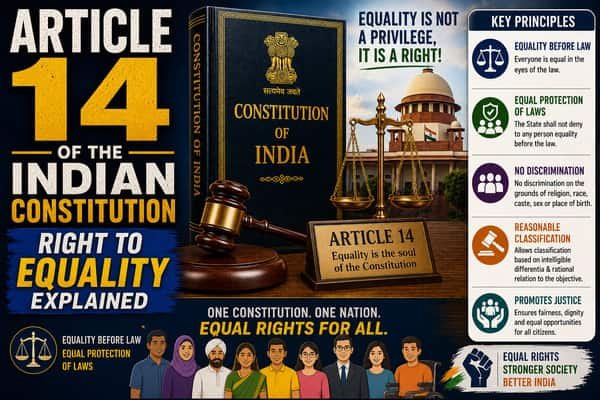
Article 14 of the Indian Constitution: Overview
| Particular | Important information |
|---|---|
| Constitutional provision | Article 14 |
| Located in | Part III—Fundamental Rights |
| Category | Right to Equality |
| Protection available to | Any person within the territory of India |
| Main guarantee | Equality before law and equal protection of laws |
| Applicable against | The State and authorities covered by Article 12 |
| Does it require identical treatment? | No, reasonable classification is permitted |
| Main classification tests | Intelligible differentia and rational connection with the objective |
| Arbitrary State action | Can be challenged under Article 14 |
| Main constitutional remedies | High Court under Article 226 and Supreme Court under Article 32 |
What Does Article 14 Say?
Article 14 provides that the State shall not deny any person equality before the law or equal protection of the laws within India.
The words “any person” are important. Article 14 is not limited only to Indian citizens. Foreign nationals and, in suitable legal contexts, companies and other recognised legal persons can also claim its protection.
However, Article 14 mainly controls the conduct of the State. Under Article 12, the expression “State” includes the Central Government, state governments, Parliament, state legislatures, local authorities and other authorities that qualify as government instrumentalities.
Equality Before Law and Equal Protection of Laws
Article 14 contains two connected guarantees.
Equality Before Law
Equality before law means no person is above the law. Ministers, government officials, wealthy individuals and ordinary citizens are all subject to the legal system.
A public authority cannot exercise power merely according to personal preference. It must act under a valid law, follow a fair procedure and remain within the limits of the power granted to it.
This does not mean every person holds the same position or performs the same duties. It means legal power cannot be used to create unjustified privilege or disadvantage.
Equal Protection of Laws
Equal protection means that people who are similarly placed should generally receive similar legal treatment.
For example, a government benefit cannot ordinarily be given to one family while another family meeting exactly the same eligibility conditions is rejected without a valid reason. Similarly, authorities should apply the same licensing or recruitment rules consistently to comparable applicants.
Equal protection also recognises that people facing different conditions may require different treatment. Providing additional support to persons with disabilities or economically weaker groups is not necessarily unequal. It may be required to create real and practical equality.
Does Article 14 Prohibit Every Classification?
No. The government regularly creates categories while framing laws and policies. Taxpayers may be divided according to income, licences may depend on the nature of a business, and welfare benefits may be limited to families below a prescribed financial level.
Article 14 prohibits unreasonable class legislation, not every form of classification. A classification is generally tested on two grounds:
- It must be based on an intelligible differentia that clearly separates the included group from those left outside it.
- That differentia must have a rational connection with the objective of the law or policy.
Suppose a scholarship is created to support students from low-income households. Using family income as an eligibility condition has an understandable connection with the scheme’s purpose. However, excluding students solely according to an unrelated characteristic may fail the constitutional test.
Equal Treatment Does Not Always Mean Identical Treatment
A common misunderstanding is that Article 14 requires the government to treat everyone exactly alike. In reality, identical treatment can itself create unfairness when people are differently situated.
A child and an adult may be governed by different legal rules. Senior citizens may receive concessions, while persons with disabilities may require accessible facilities. Tax rates can change according to income levels, and particular welfare programmes may be designed for disadvantaged groups.
The real question is whether the difference in treatment has a lawful and reasonable basis. The government should be able to explain why the category was created and how it helps achieve the intended objective.
Article 14 and Arbitrary Government Action
Article 14 has developed beyond the traditional classification test. Courts also use it to examine whether State action is arbitrary.
An order may be considered arbitrary when it is based on personal choice, ignores relevant facts, gives no understandable reason or applies standards inconsistently. A law may also face an Article 14 challenge when it is manifestly arbitrary—meaning that it is capricious, irrational, unsupported by an adequate principle, excessive or disproportionate.
Examples of potentially questionable State action may include:
- Cancelling a valid selection without a proper reason
- Applying different standards to comparable applicants
- Changing eligibility conditions selectively after a process has started
- Granting public benefits through favouritism
- Issuing an order without considering essential facts
- Creating a legal category unrelated to the law’s stated purpose
Every incorrect administrative decision is not automatically an Article 14 violation. The court examines the nature of the power, the reasons provided, the applicable rules and the actual effect of the decision.
Article 14 and Reservations
Reservations are not automatically contrary to equality. The Constitution recognises that formal equality alone may not correct long-standing social and educational disadvantage.
Articles 15 and 16 specifically permit different forms of affirmative action and reservation, subject to constitutional requirements. These provisions operate with Article 14’s broader goal of substantive equality.
However, every reservation policy must remain within the applicable constitutional framework. Its purpose, beneficiary group, supporting information and method of implementation may be examined by constitutional courts.
Can Article 14 Apply to Private Organisations?
Article 14 ordinarily protects against State action. A completely private dispute does not become an Article 14 matter merely because one party believes it was treated unfairly.
However, an organisation may come within constitutional scrutiny when it is substantially controlled by the government, performs an important public duty or otherwise qualifies as an authority under constitutional principles.
Even where Article 14 does not directly apply, unfair private conduct may still be challenged under employment law, consumer law, contract law, anti-discrimination provisions or another applicable statute.
How Can a Person Challenge Unequal State Action?
The first practical step is to obtain the written order, eligibility rule, notification or reason for rejection. A person should identify another individual or group in a genuinely comparable position and explain how the authority treated them differently.
Relevant documents may include:
- Application forms and acknowledgement receipts
- Government notifications and eligibility rules
- Rejection or cancellation orders
- Emails and written representations
- Selection lists or benefit records
- Documents showing comparable circumstances
A departmental appeal or written representation may resolve some disputes. Where a constitutional violation is alleged, a petition may be filed before the relevant High Court under Article 226. Article 32 allows a person to approach the Supreme Court for enforcement of Fundamental Rights, although the High Court may be the more practical forum in many cases.
Frequently Asked Questions
Does Article 14 mean that everyone must receive the same government benefit?
No. The government may restrict a scheme to a particular group based on income, age, disability, occupation or another relevant factor. The eligibility condition should have a reasonable connection with the scheme’s purpose.
Is Article 14 available only to Indian citizens?
No. Article 14 uses the term “any person,” so its protection is also available to non-citizens within India. Certain other Fundamental Rights, such as those under Article 19, are specifically limited to citizens.
Can a private company be sued directly for violating Article 14?
Usually, Article 14 is enforced against the State rather than a purely private company. The position may differ where the organisation functions as a government instrumentality or performs a public duty. Other laws may also provide remedies against private discrimination or unfair conduct.
Can a government rule be cancelled merely because it treats groups differently?
No. Different treatment is permitted when the classification is clear and reasonably connected with a legitimate objective. A rule becomes vulnerable when the distinction is irrational, irrelevant, arbitrary or constitutionally prohibited.
Disclaimer: This article is prepared for general information, education and constitutional awareness only. It does not constitute legal advice, an official interpretation of Article 14 or a substitute for the Constitution and judicial decisions. The application of equality principles depends on the facts, applicable law, nature of the authority and circumstances of each case. Readers facing discrimination, an arbitrary government order or a constitutional dispute should consult a qualified legal professional or approach the appropriate authority. The author and publisher are not responsible for decisions taken solely on the basis of this article.