Property and inheritance are among the most important legal matters affecting families in India. Whether it is a house, agricultural land, jewellery, bank deposits, or any other asset, questions about who inherits the property after a person’s death often lead to confusion and, in some cases, family disputes. Understanding the law governing inheritance can help families avoid unnecessary litigation and ensure that property is distributed according to legal provisions.
The Hindu Succession Act, 1956 is the primary law governing the succession and inheritance of property among Hindus, Buddhists, Jains, and Sikhs in India. It establishes clear rules regarding legal heirs, succession rights, and property distribution when a person dies with or without leaving a valid will. The Act has also undergone significant amendments, particularly in 2005, to strengthen the property rights of daughters. Whether you are planning your estate, resolving a family property issue, or simply seeking legal awareness, understanding this Act is essential.
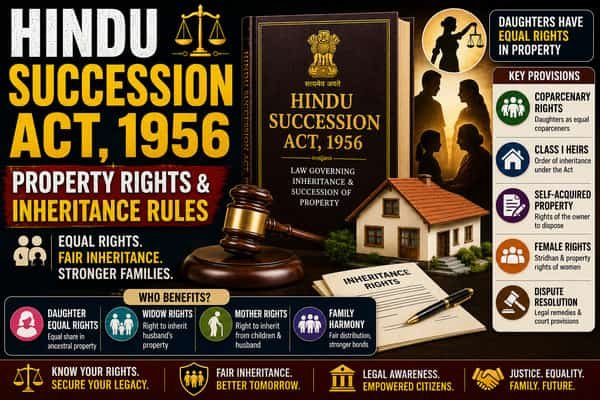
Hindu Succession Act, 1956: Overview
| Particular | Details |
|---|---|
| Full Name | Hindu Succession Act, 1956 |
| Enacted | 1956 |
| Applicable To | Hindus, Buddhists, Jains, and Sikhs (subject to the Act) |
| Objective | Regulate inheritance and succession of property |
| Covers | Intestate succession, legal heirs, coparcenary rights, and inheritance rules |
| Major Amendment | Hindu Succession (Amendment) Act, 2005 |
| Importance | Ensures lawful distribution of property and equal inheritance rights |
What is the Hindu Succession Act, 1956?
The Hindu Succession Act, 1956 is a central legislation that governs the inheritance and succession of property among persons covered by the Act. It applies when a Hindu dies intestate, that is, without leaving a valid will, and lays down the legal framework for determining who inherits the deceased person’s property.
The Act also deals with succession to both movable and immovable property and provides rules for identifying legal heirs and determining their respective shares. Over time, amendments to the law have strengthened gender equality, especially by recognizing daughters’ equal rights in ancestral property.
Why Was the Hindu Succession Act Introduced?
Before the Act was enacted, inheritance rules varied significantly across different schools of Hindu law and regions of India, often leading to uncertainty and unequal treatment.
The Act was introduced to:
- Create uniform succession rules.
- Protect the rights of legal heirs.
- Reduce inheritance disputes.
- Promote equality in property rights.
- Simplify succession laws.
- Modernize traditional inheritance principles.
The legislation brought greater consistency and fairness to property succession.
Who Does the Act Apply To?
The Hindu Succession Act generally applies to:
- Hindus
- Buddhists
- Jains
- Sikhs
It also applies to persons who are governed by Hindu law under the provisions of the Act.
The law does not generally apply to communities governed by separate personal laws unless specifically provided.
Types of Property Covered
The Act governs succession to different types of property.
These may include:
- Residential houses
- Agricultural land (subject to applicable laws)
- Commercial property
- Bank deposits
- Investments
- Jewellery
- Vehicles
- Other movable and immovable assets
The manner of succession may differ depending on the nature of the property and the applicable legal provisions.
What is Intestate Succession?
Intestate succession refers to the legal process of distributing a person’s property when they die without leaving a valid will.
In such cases, the Hindu Succession Act determines:
- Who the legal heirs are.
- The order of succession.
- The share each heir receives.
If a valid will exists, succession is generally governed by the terms of the will, subject to applicable law.
Class I Legal Heirs
The Act gives priority to Class I heirs when a Hindu dies intestate.
Depending on the circumstances, Class I heirs may include:
- Son
- Daughter
- Widow
- Mother
- Certain descendants of predeceased children as recognized under the Act
When multiple Class I heirs exist, they generally inherit simultaneously in accordance with the provisions of the Act.
Class II Legal Heirs
If there are no surviving Class I heirs, the property may pass to Class II heirs.
These may include relatives such as:
- Father
- Brother
- Sister
- Other relatives listed in the Schedule to the Act
Succession among Class II heirs follows the order prescribed by the legislation.
Rights of Daughters Under the 2005 Amendment
One of the most significant reforms in Hindu succession law came through the Hindu Succession (Amendment) Act, 2005.
The amendment granted daughters equal rights as sons in a Hindu coparcenary governed by the Mitakshara system.
As a result:
- Daughters became coparceners by birth.
- They received the same rights and liabilities as sons in coparcenary property.
- They acquired equal rights to seek partition, inherit, and manage ancestral property, subject to the law.
The amendment marked an important step toward gender equality in property rights.
Rights of Widows
The Act also protects the inheritance rights of widows.
A widow may inherit the deceased husband’s property in accordance with the provisions governing Class I heirs.
She is entitled to the legal share provided under the Act and enjoys ownership rights over the inherited property.
Succession to Property of a Female Hindu
The Act contains separate provisions regarding the succession of property belonging to a female Hindu.
When a female Hindu dies intestate, her property devolves upon her legal heirs in the order prescribed by the Act, taking into account her family relationships and the source of the property where relevant.
Importance of a Will
Although the Hindu Succession Act governs intestate succession, preparing a legally valid will remains an effective way to avoid future disputes.
A properly drafted will can:
- Clearly express the owner’s intentions.
- Reduce family conflicts.
- Simplify property distribution.
- Minimize legal uncertainty.
- Protect beneficiaries.
Individuals should ensure that wills comply with the applicable legal requirements.
Common Property Disputes Under the Act
Some common issues include:
- Disputes over ancestral property.
- Determination of legal heirs.
- Partition of family property.
- Rights of daughters.
- Validity of succession claims.
- Interpretation of wills.
- Distribution of self-acquired property.
Early legal advice and proper documentation can help resolve such disputes more effectively.
Importance of the Hindu Succession Act
The Act plays a vital role in ensuring fairness and legal certainty in matters of inheritance.
Its significance includes:
- Promoting equal property rights.
- Protecting family members.
- Reducing inheritance disputes.
- Strengthening women’s property rights.
- Supporting orderly succession.
- Providing a clear legal framework for property distribution.
It continues to be one of the most important personal laws governing inheritance in India.
Frequently Asked Questions (FAQs)
1. Does the Hindu Succession Act apply if a person leaves a valid will?
Generally, when a valid will exists, the property is distributed according to the terms of the will, subject to applicable law. The Act primarily governs intestate succession.
2. Do daughters have equal rights in ancestral property?
Yes. Following the Hindu Succession (Amendment) Act, 2005, daughters generally enjoy the same coparcenary rights and liabilities as sons under the applicable provisions of the law.
3. Who inherits the property if a Hindu dies without leaving a will?
The property devolves upon the legal heirs in the order prescribed by the Hindu Succession Act, beginning with Class I heirs where applicable.
4. Is self-acquired property treated differently from ancestral property?
Yes. The legal principles governing self-acquired property and ancestral property may differ depending on the circumstances. The mode of succession depends on the nature of the property, the existence of a valid will, and the applicable legal provisions.
Disclaimer: This article is intended for general informational and educational purposes only. It provides a simplified overview of the Hindu Succession Act, 1956 and should not be considered legal advice. The application of succession law depends on the facts of each case, the nature of the property, the existence of a valid will, applicable amendments, and judicial interpretation. Individuals dealing with inheritance or property disputes should consult a qualified legal professional for advice specific to their circumstances.