
Imagine a tribal village where a mining project is planned, forest produce is collected by outside traders or community land is transferred without properly hearing the people who have depended on it for generations. For residents of Scheduled Areas, these decisions are not merely administrative matters. They directly affect livelihood, culture, forests, water sources and the survival of the community itself.
The PESA Act gives tribal communities a stronger voice in such decisions by placing the Gram Sabha at the centre of local governance. It recognises that Scheduled Areas cannot always be governed through the same model used in ordinary villages. Traditional customs, community resources and local decision-making systems must also be respected. Understanding this law helps villagers, elected representatives and officials know when Gram Sabha consultation, approval or recommendation is legally important.
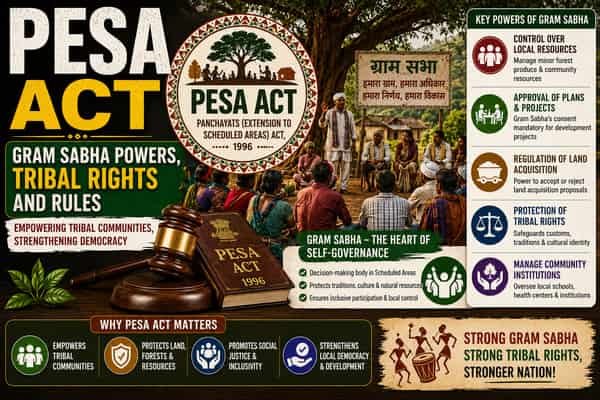
PESA Act Overview
| Particular | Key information |
|---|---|
| Full name | Provisions of the Panchayats (Extension to the Scheduled Areas) Act, 1996 |
| Common name | PESA Act |
| Act number | Central Act No. 40 of 1996 |
| Enforced from | 24 December 1996 |
| Main purpose | Extension of Panchayati Raj provisions to Fifth Schedule Areas |
| Constitutional connection | Part IX, Article 243M and the Fifth Schedule |
| Central institution | Gram Sabha |
| Main beneficiaries | Tribal communities living in notified Scheduled Areas |
| Major areas covered | Land, forests, water, markets, minor minerals and village development |
| PESA states | 10 states with notified Fifth Schedule Areas |
| Rules notified | Eight states, according to the December 2025 official update |
| Draft-rule states | Odisha and Jharkhand, according to the same update |
What Is the PESA Act?
The 73rd Constitutional Amendment established a structured Panchayati Raj system for rural local government. However, the ordinary provisions of Part IX of the Constitution were not automatically extended to tribal-dominated Scheduled Areas.
The PESA Act, enacted in 1996, extended these provisions to areas covered by the Fifth Schedule, with important exceptions and modifications. Its purpose is not simply to create more Panchayats. It is to ensure that local government in tribal areas respects customary law, traditional management practices, social and religious customs and community ownership of resources.
Under PESA, the meaning of a village can also reflect the traditional community arrangement. It may consist of a habitation, a group of habitations, a hamlet or a group of hamlets managing their affairs according to established customs.
Where Does the PESA Act Apply?
PESA applies only to notified Fifth Schedule Areas. It does not automatically apply to every tribal village or every district having a Scheduled Tribe population.
The ten states containing PESA areas are:
- Andhra Pradesh
- Chhattisgarh
- Gujarat
- Himachal Pradesh
- Jharkhand
- Madhya Pradesh
- Maharashtra
- Odisha
- Rajasthan
- Telangana
The tribal areas governed under the Sixth Schedule follow a different constitutional framework. Therefore, the legal position in parts of Assam, Meghalaya, Tripura and Mizoram should not be confused with PESA governance.
Whether a particular village falls within a PESA area must be checked through the applicable Scheduled Area notification and state records.
Why Is the Gram Sabha Important Under PESA?
A Gram Sabha consists of people whose names appear on the electoral roll of the village. Under PESA, it is not meant to function as a ceremonial body that merely confirms decisions already taken by officials.
The Gram Sabha is empowered to protect:
- Traditions and customs of the community
- Cultural identity of tribal people
- Community resources
- Traditional methods of resolving disputes
This recognition is important because tribal communities may have long-established systems for managing forests, grazing land, water sources and village affairs. State laws relating to Panchayats in Scheduled Areas must remain consistent with these traditional practices and the basic protections provided by PESA.
Approval of Development Plans and Beneficiaries
Before a social or economic development plan, programme or project is implemented at the village level, the Gram Sabha must approve it.
The Gram Sabha is also responsible for identifying or selecting beneficiaries under poverty alleviation and other development programmes. This reduces the possibility of beneficiary lists being prepared without local knowledge or being influenced by favouritism.
Panchayats are required to obtain certification from the Gram Sabha regarding the use of funds for development schemes. In practical terms, villagers can ask:
- What amount was sanctioned?
- Which work was approved?
- Who received the benefit?
- Whether the work was actually completed
- Whether the money was used for its approved purpose
For this power to work effectively, Gram Sabha meetings should be properly announced, attended and recorded.
Rights Over Land and Community Resources
Land is one of the most important issues covered by PESA. Gram Sabhas and Panchayats at the appropriate level must receive powers to prevent unlawful transfer of land in Scheduled Areas and to take action for restoring land that has been illegally alienated.
Before land is acquired for development projects in Scheduled Areas, or before people are resettled or rehabilitated, consultation with the Gram Sabha or the appropriate Panchayat is required.
The exact procedure can differ under state laws. Residents should therefore check whether the applicable state provision requires consultation, recommendation or stronger approval before assuming that every project can be completely stopped by a Gram Sabha resolution.
Minor Forest Produce and Village Markets
PESA recognises ownership of minor forest produce for Gram Sabhas or Panchayats at the appropriate level. Minor forest produce may include locally collected items such as bamboo, leaves, seeds, gums, medicinal plants, honey and other non-timber forest products, depending on the applicable legal classification.
This power is closely linked with tribal livelihoods. Local communities can seek greater control over collection, storage, pricing and sale instead of remaining dependent on exploitative middlemen.
PESA also gives local institutions power to manage village markets. This can help regulate market fees, trading practices and access for local producers.
Minor Minerals and Water Bodies
A recommendation from the Gram Sabha or the appropriate Panchayat is mandatory before granting a prospecting licence or mining lease for minor minerals in Scheduled Areas. A similar recommendation is required before granting minor-mineral concessions through auction.
Local institutions must also receive responsibility for planning and managing minor water bodies. This may include village ponds, small tanks or other locally managed water resources, depending on state law.
These powers allow communities to raise concerns about environmental damage, livelihood loss, unsafe mining and unfair use of local resources.
Control Over Liquor and Money Lending
PESA permits Gram Sabhas or Panchayats at the appropriate level to regulate or restrict the sale and consumption of intoxicants.
They must also be given control over money lending to Scheduled Tribes. This protection is important where unregulated loans, excessive interest and informal security arrangements result in loss of land or long-term debt.
The detailed enforcement mechanism depends on the state’s PESA rules, excise laws, money-lending laws and the powers delegated to local bodies.
Reservation in PESA Panchayats
Reservation for Scheduled Tribes in Panchayats located in Scheduled Areas must be proportionate to their population. However, the number of seats reserved for Scheduled Tribes cannot be less than half of the total seats.
The offices of chairpersons at all Panchayat levels in Scheduled Areas are also reserved for Scheduled Tribes. These provisions are designed to ensure that communities affected by local decisions have meaningful representation in the institutions making those decisions.
How Can Villagers Use Their PESA Rights?
Residents should first confirm that their village is located in a notified Fifth Schedule Area. They should then obtain the applicable state PESA Act, rules and Gram Sabha procedure.
Important practical steps include attending meetings, requesting agenda copies, asking for scheme and budget details and ensuring that resolutions are accurately entered in the meeting register. Copies of attendance sheets, resolutions and official communications should be preserved.
When a legally required consultation or recommendation is ignored, villagers may submit representations to the Gram Panchayat, Block Panchayat, District Panchayat, Collector, Panchayati Raj Department or Tribal Welfare Department. Serious violations may require assistance from a qualified advocate or an appropriate court.
Frequently Asked Questions
Does PESA apply to every village with a tribal population?
No. The village must fall within a formally notified Fifth Schedule Area. A high tribal population alone does not automatically make PESA applicable.
Can a Gram Sabha cancel every mining or development project?
Not automatically. PESA provides consultation, recommendation and other decision-making powers, but their exact legal effect depends on the subject, central legislation, state law and notified rules.
Are the Gram Sabha and Gram Panchayat the same?
No. The Gram Sabha includes all registered voters of the village. The Gram Panchayat is an elected local government body consisting of representatives such as members and the Sarpanch.
What can villagers do if officials ignore a Gram Sabha resolution?
They should preserve the signed resolution and submit a written objection to the competent Panchayat and district authorities. Legal advice may be needed where the resolution concerns land acquisition, mining, forest resources or another major statutory right.
Disclaimer: This article is intended only for general information and legal awareness. It does not constitute legal advice, an official interpretation of the PESA Act or a substitute for applicable central and state laws. The powers of a Gram Sabha or Panchayat may differ according to the Scheduled Area notification, state Panchayati Raj law, PESA rules and the subject involved. Readers dealing with land acquisition, mining, forest produce, displacement or local governance disputes should consult a qualified legal professional or contact the relevant Panchayati Raj, Tribal Welfare or district authority. The author and publisher are not responsible for decisions taken solely on the basis of this article.