
A factory releasing untreated waste into a river, a construction project spreading dangerous dust, or a business storing hazardous chemicals without safety precautions can affect thousands of people living nearby. The damage may appear as contaminated drinking water, breathing problems, damaged crops or unsafe neighbourhoods. Environmental violations are therefore not distant scientific issues—they directly influence health, livelihood and quality of life.
The Environment (Protection) Act, 1986 gives the Central Government broad authority to prevent pollution, set environmental standards, inspect industrial premises and restrict harmful operations. It also places clear responsibilities on industries and people handling hazardous substances. Recent amendments have significantly changed the penalty system, making it especially important for businesses, residents and environmental professionals to understand the current law.
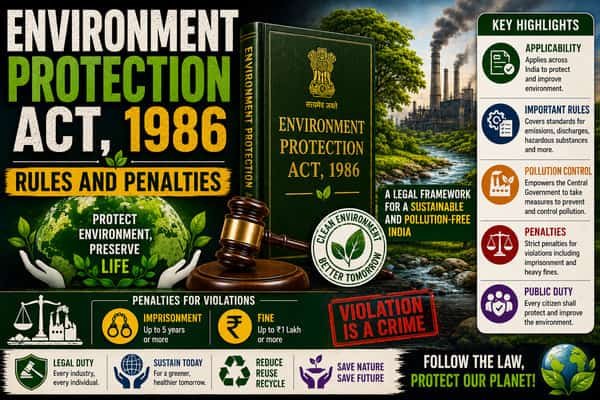
Environment Protection Act, 1986: Overview
| Particular | Important information |
|---|---|
| Official name | Environment (Protection) Act, 1986 |
| Act number | Central Act No. 29 of 1986 |
| Enacted on | 23 May 1986 |
| Came into force | 19 November 1986 |
| Territorial coverage | Entire India |
| Main purpose | Protection and improvement of the environment |
| Responsible ministry | Ministry of Environment, Forest and Climate Change |
| Major areas covered | Air, water, soil, hazardous substances and industrial pollution |
| Key government power | Regulation, restriction or closure of polluting operations |
| Inspection authority | Authorised environmental officers |
| Current penalty system | Primarily monetary penalties for contraventions |
| Appeal against penalty | National Green Tribunal |
| Major penalty changes effective from | 1 April 2024 |
Why Was the Environment Protection Act Introduced?
India already had separate legislation dealing with water and air pollution before 1986. However, the country needed a wider law capable of addressing different environmental risks through one coordinated framework.
The Act followed India’s participation in the 1972 United Nations Conference on the Human Environment in Stockholm. It was designed to protect people, animals, plants, property and natural resources from environmental hazards.
Unlike a law limited to one type of pollution, the Environment Protection Act covers the relationship between water, air, land, human beings, living creatures, plants, microorganisms and property. This wide scope is why it is often treated as India’s umbrella environmental legislation.
Powers of the Central Government
Section 3 gives the Central Government extensive powers to protect and improve environmental quality. It may coordinate the activities of state governments and environmental authorities, execute nationwide pollution-control programmes and prescribe environmental standards.
The government may also:
- Set limits for industrial emissions and discharges
- Restrict industries in environmentally sensitive areas
- Prescribe safeguards for hazardous substances
- Establish procedures for preventing environmental accidents
- Inspect premises, machinery and manufacturing processes
- Establish or recognise environmental laboratories
- Conduct environmental research and collect pollution-related information
Different standards may be prescribed for different industries, locations or pollution sources. This allows stricter requirements to be imposed where the environmental risk is greater.
Power to Close or Restrict an Industry
Section 5 allows the Central Government or an authorised authority to issue binding written directions to a person, officer or organisation.
These directions may include the closure, prohibition or regulation of an industry, operation or process. Authorities may also order the stoppage or regulation of electricity, water or another essential service supplied to a non-compliant unit.
This power can be used when an industrial activity creates serious pollution or repeatedly fails to follow environmental conditions. A person affected by a direction issued under Section 5 may challenge it before the National Green Tribunal under the applicable legal procedure.
Industrial Emission and Discharge Standards
Section 7 prohibits any person carrying on an industry, operation or process from releasing environmental pollutants beyond the prescribed limits.
These standards may regulate smoke, chemical discharge, wastewater, noise, dust, industrial residue and other pollutants. Compliance does not mean merely obtaining an approval at the beginning of a project. The unit must continue to follow the applicable limits throughout its operation.
Industries should maintain monitoring reports, laboratory results, authorisations and waste-disposal records. A valid approval does not protect a unit that subsequently violates emission or discharge standards.
Rules for Handling Hazardous Substances
Section 8 requires every person handling a hazardous substance to follow the prescribed procedures and safety precautions.
The word “handling” has a broad meaning. It can include manufacturing, processing, packaging, storing, transporting, using, selling, transferring, collecting or destroying the substance.
Businesses dealing with hazardous chemicals should maintain safe storage systems, emergency plans, employee training, protective equipment and accurate records. A failure may endanger workers as well as people living near the premises.
Duty to Report an Environmental Accident
When an accident or unexpected event causes, or may cause, pollution above the prescribed standards, the responsible person and the person in charge of the location must take immediate action.
They are expected to prevent or reduce the pollution, inform the prescribed authority and provide necessary assistance. Government agencies may carry out emergency remedial measures and recover the expenses, along with applicable interest, from the responsible person.
An industrial unit should therefore not wait for inspectors to discover a chemical leak, contaminated discharge or dangerous emission. Timely reporting and mitigation are legal responsibilities.
Inspection and Collection of Samples
Authorised officers may enter industrial premises at reasonable times to inspect equipment, plants, registers, documents and materials. They may conduct searches and seize items where there is reason to believe that a violation has occurred or evidence must be preserved.
The occupier must provide reasonable assistance during the inspection. Deliberately delaying or obstructing an authorised officer can attract a separate penalty.
Environmental officers can also collect samples of air, water, soil or another substance for laboratory analysis. The Act prescribes procedures for issuing notice, sealing the sample and sending it to a recognised environmental laboratory. Following the correct sampling procedure is important when the laboratory report is used in legal proceedings.
Current Penalties Under the Environment Protection Act
The penalty framework was substantially changed with effect from 1 April 2024.
For violating pollution standards under Section 7 or hazardous-substance safeguards under Section 8, the penalty ranges from ₹1 lakh to ₹15 lakh for each contravention. A continuing violation can attract an additional ₹50,000 for every day it continues.
Failure to report an environmental accident, assist an inspection or follow the sampling process may attract a penalty ranging from ₹10,000 to ₹5 lakh, along with an additional ₹10,000 per day for a continuing contravention.
Where no separate penalty is provided, a violation of the Act, rules, orders or directions may result in a penalty between ₹10,000 and ₹15 lakh. Companies may face penalties between ₹1 lakh and ₹15 lakh, with an additional penalty of ₹1 lakh for every day of continuing non-compliance.
How Are Environmental Penalties Decided?
An adjudicating officer appointed by the Central Government conducts the inquiry. The officer must provide the concerned person with a reasonable opportunity to be heard before imposing a penalty.
While deciding the amount, the officer may consider:
- The population and area affected
- Duration and frequency of the violation
- Vulnerability of affected people
- Actual or possible environmental damage
- Financial benefit gained through non-compliance
The monetary penalty is separate from any compensation or environmental relief that may be ordered under the National Green Tribunal Act.
Appeal and Non-Payment of Penalty
A person dissatisfied with the adjudicating officer’s order may appeal to the National Green Tribunal within 60 days of receiving it. The appellant must ordinarily deposit 10% of the imposed penalty before the appeal is entertained.
Failure to pay the penalty within 90 days is a criminal offence. It may result in imprisonment extending to three years, a fine extending to twice the penalty amount, or both.
How Can Citizens Report Environmental Pollution?
Residents can submit a written complaint to the concerned State Pollution Control Board, Pollution Control Committee, district administration, municipal authority or another department responsible for the activity.
A useful complaint should contain the exact location, nature and timing of the pollution, photographs or videos, names of affected water bodies or neighbourhoods and copies of previous complaints.
For initiating a court complaint concerning an offence under the Act, a private person must generally give at least 60 days’ prescribed notice to the Central Government or an authorised authority. Depending on the issue and relief required, proceedings may also be taken before the National Green Tribunal or another competent court.
Frequently Asked Questions
Does the Environment Protection Act apply only to factories?
No. It can apply to any person, company, operation or process that violates environmental standards, handles hazardous substances improperly or disobeys directions issued under the Act.
Can authorities close a polluting business without cancelling its other licences?
Environmental authorities can direct the closure, prohibition or regulation of an operation under Section 5. They may also order the stoppage of electricity, water or another service, subject to applicable procedure.
Is every environmental violation punishable with imprisonment?
No. Most contraventions now attract monetary penalties. However, failure to pay an imposed penalty within 90 days can result in imprisonment, a fine or both.
Can residents directly complain about pollution?
Yes. Residents may complain to the State Pollution Control Board, local administration or other competent authority. For a private court complaint regarding an offence under the Act, the prescribed 60-day notice requirement generally applies.
Disclaimer: This article is intended solely for general information, education and environmental-law awareness. It does not constitute legal advice, environmental compliance certification or an official interpretation of the Environment (Protection) Act, 1986. Applicable duties may vary according to the industry, location, environmental clearance, consent conditions, rules and government notifications. Businesses and individuals facing an inspection, penalty, closure direction or environmental dispute should consult a qualified environmental-law professional or contact the appropriate regulatory authority. The author and publisher are not responsible for decisions taken solely on the basis of this article.