
In today’s digital world, almost every aspect of our lives depends on technology. We shop online, transfer money through mobile apps, sign digital documents, store personal data in the cloud, and communicate through social media and email. While technology has made life more convenient, it has also increased the risk of cybercrimes such as hacking, online fraud, identity theft, data breaches, and digital forgery. To address these challenges, India enacted the Information Technology (IT) Act, 2000, which serves as the country’s primary cyber law.
The IT Act provides legal recognition to electronic records and digital transactions while also establishing penalties for various cyber offences. It is relevant for individuals, businesses, banks, government departments, technology companies, and anyone using digital services. Understanding the IT Act helps citizens protect themselves from cyber threats, ensures businesses comply with legal requirements, and promotes trust in India’s rapidly growing digital economy.
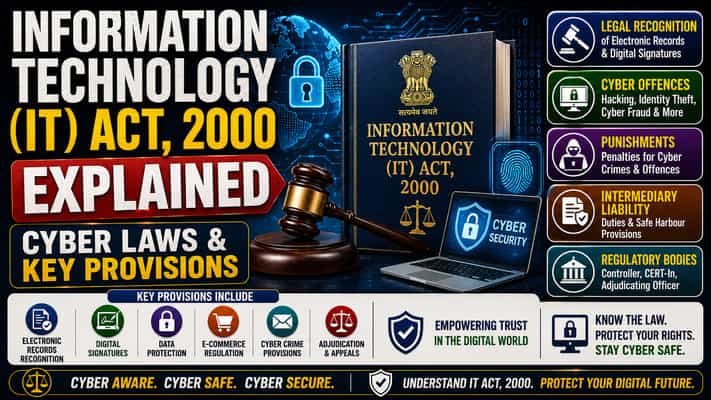
Information Technology (IT) Act, 2000: Overview
| Particular | Details |
|---|---|
| Full Name | Information Technology Act, 2000 |
| Common Name | IT Act, 2000 |
| Enacted | 2000 |
| Objective | Provide legal recognition to electronic transactions and regulate cyber activities |
| Applicable To | Electronic records, digital transactions, cyber offences, and related matters covered under the Act |
| Governing Authority | Government of India and designated authorities under the Act |
| Covers | Electronic records, digital signatures, cybercrimes, data protection provisions, and intermediary responsibilities |
| Importance | Promotes secure digital transactions and strengthens cybersecurity |
What is the Information Technology (IT) Act, 2000?
The Information Technology Act, 2000 is India’s principal legislation governing electronic records, digital transactions, electronic signatures, and cyber offences. It provides the legal framework for conducting business electronically while addressing crimes committed through computers, networks, and digital communication systems.
The Act has been amended over time, particularly through the Information Technology (Amendment) Act, 2008, to address emerging cyber threats and technological developments. Today, it remains one of the most important laws supporting India’s digital economy.
Why Was the IT Act Introduced?
As internet usage and electronic commerce expanded, India needed a legal framework to recognize digital transactions and deal with cybercrime.
The IT Act was introduced to:
- Recognize electronic records and electronic signatures.
- Facilitate e-commerce and digital governance.
- Prevent cybercrime.
- Promote secure online transactions.
- Protect electronic information.
- Regulate digital communication.
- Strengthen confidence in online services.
The Act has played a major role in India’s digital transformation.
Key Features of the IT Act
1. Legal Recognition of Electronic Records
The Act grants legal recognition to electronic records, enabling businesses and government departments to use digital documents in many situations where permitted by law.
This has significantly reduced paperwork and improved efficiency.
2. Recognition of Electronic Signatures
The IT Act recognizes electronic signatures, subject to the prescribed legal requirements.
Electronic signatures enable individuals and businesses to authenticate digital documents securely without relying solely on physical paperwork.
3. Promotion of E-Governance
The Act facilitates electronic interaction between citizens and government authorities.
It supports:
- Online filing of applications.
- Electronic submission of documents.
- Digital record keeping.
- Electronic communication with government departments.
These measures have improved accessibility and administrative efficiency.
4. Cybercrime Regulation
The Act defines various cyber offences and provides legal remedies and penalties.
It supports law enforcement agencies in investigating and prosecuting cyber-related crimes.
Common Cyber Offences Covered Under the IT Act
The IT Act addresses a wide range of cyber offences.
Some common examples include:
Unauthorized Access
Accessing computer systems or networks without permission may attract legal consequences under the Act.
Hacking
Unauthorized interference with computer systems that causes damage or disrupts normal functioning may amount to an offence under the law.
Identity Theft
Using another person’s digital identity, passwords, electronic credentials, or other identifying information without authorization is punishable under the Act.
Online Fraud
Cyber fraud may involve:
- Phishing
- Fake websites
- Online payment scams
- Digital impersonation
- Financial fraud
Such offences may attract action under the IT Act and other applicable laws.
Publishing or Transmitting Certain Unlawful Content
The Act contains provisions dealing with certain categories of unlawful electronic content, subject to the applicable legal requirements.
Electronic Commerce and the IT Act
The IT Act provides the legal foundation for electronic commerce (e-commerce) in India.
It supports:
- Online shopping.
- Digital contracts.
- Electronic invoices.
- Internet banking.
- Online business transactions.
- Digital payments.
Legal recognition of electronic transactions has contributed significantly to India’s digital economy.
Responsibilities of Intermediaries
The Act contains provisions relating to intermediaries such as social media platforms, online marketplaces, internet service providers, and other digital service providers.
Subject to applicable laws and rules, intermediaries are generally expected to:
- Exercise due diligence.
- Cooperate with lawful investigations.
- Comply with government directions where legally required.
- Establish grievance redressal mechanisms where applicable.
- Take appropriate action regarding unlawful content in accordance with the law.
Their obligations are governed by the IT Act and related rules.
Penalties Under the IT Act
The Information Technology Act prescribes civil and criminal consequences for various cyber offences.
Depending on the nature of the violation, the consequences may include:
- Monetary penalties.
- Imprisonment.
- Compensation for affected persons where provided by law.
- Confiscation of devices or equipment in appropriate cases.
The punishment depends on the specific offence and the facts established before the competent authority or court.
Importance of the IT Act in Modern India
The Information Technology Act has become increasingly important as digital services continue to expand.
Its significance includes:
- Supporting digital business.
- Protecting electronic transactions.
- Combating cybercrime.
- Encouraging secure online banking.
- Promoting digital governance.
- Strengthening cybersecurity awareness.
- Increasing confidence in electronic commerce.
The Act continues to evolve alongside technological developments and works alongside other laws relating to data protection, criminal law, and telecommunications.
Practical Cyber Safety Tips
While the IT Act provides legal protection, individuals should also adopt safe digital practices.
Some useful precautions include:
- Use strong and unique passwords.
- Enable two-factor authentication.
- Avoid clicking suspicious links.
- Verify websites before making payments.
- Update software regularly.
- Install reliable security software.
- Never share banking OTPs or passwords.
- Report cybercrime promptly to the appropriate authorities.
Responsible online behaviour helps reduce the risk of cyber fraud and identity theft.
Frequently Asked Questions (FAQs)
1. What is the main purpose of the Information Technology Act, 2000?
The IT Act provides legal recognition to electronic records and electronic transactions while establishing a legal framework for preventing and addressing cyber offences in India.
2. Does the IT Act apply to online banking fraud?
Yes. Depending on the facts of the case, online banking fraud and other cyber offences may attract provisions of the IT Act along with other applicable laws.
3. Are electronic signatures legally valid in India?
Yes. Electronic signatures are legally recognized under the Information Technology Act, subject to the conditions and requirements prescribed by the law.
4. What should I do if I become a victim of cybercrime?
You should preserve relevant evidence such as screenshots, emails, transaction details, and messages, report the matter to the appropriate cybercrime authorities or police, and notify your bank or service provider immediately if financial information has been compromised.
Disclaimer: This article is intended for general informational and educational purposes only. It provides a simplified overview of the Information Technology (IT) Act, 2000 and should not be considered legal, cybersecurity, or professional advice. The application of the Act depends on the facts of each case, subsequent amendments, related rules, and judicial interpretation. Individuals and organizations should consult a qualified legal professional or cybersecurity expert for advice on specific legal or compliance matters.