
A side business is very different from starting a full-time company. A working professional may have money to invest and useful industry experience, but usually has one major limitation: time.
That changes what makes a good business idea. A café requiring daily supervision may be difficult to manage after office hours, while consulting, digital products or a small online service can often be operated during evenings and weekends.
For salaried professionals in India, another issue comes first: check your employment contract. Moonlighting, outside employment, conflicts of interest, confidentiality and intellectual-property clauses may restrict what you can do alongside your job.
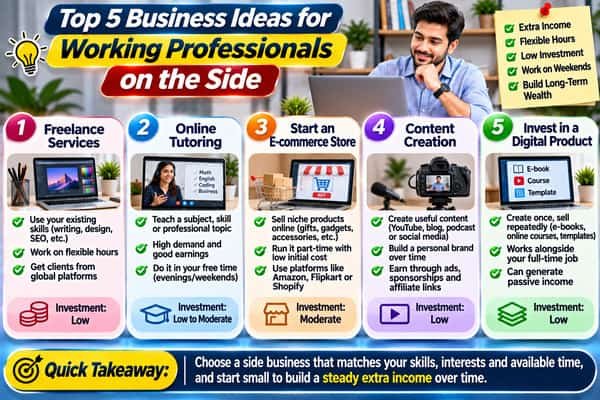
Once that is clear, these five business models can be practical starting points.
Side Business Ideas at a Glance
| Business Idea | Starting Cost | Time Flexibility | Revenue Model |
|---|---|---|---|
| Freelance consulting | Low | High | Project/hourly fee |
| Digital products | Low | Very High | Product sales |
| Niche online store | Low–Medium | Medium | Product margin |
| Online teaching | Low | High | Course/session fees |
| Website & digital services | Low | High | Project + retainer |
1. Freelance Consulting
The easiest business to start is often based on knowledge you already have.
An accountant could provide bookkeeping support to small businesses. A designer could take branding projects. A software professional could offer development services, while someone experienced in marketing could help local companies with digital campaigns.
Possible consulting areas include:
- Digital marketing
- Website development
- Graphic design
- Business consulting
- Recruitment support
- Accounting and bookkeeping
- SEO
- Data analysis
- Software development
The main advantage is low startup cost. You are primarily selling expertise rather than purchasing inventory.
It can also be managed around a job by accepting a limited number of clients.
However, professionals should keep their employment and side business clearly separated. Do not use an employer’s confidential information, client database, software licences, equipment or working hours for your own business without appropriate permission.
Best for: Professionals who already have a marketable specialist skill.
2. Sell Digital Products
Digital products offer an attractive feature for busy professionals: the same product can potentially be sold repeatedly without being recreated for every customer.
Examples include:
- Templates
- Checklists
- Worksheets
- Design assets
- Business spreadsheets
- E-books
- Study materials
- Website templates
- Printable planners
- Industry-specific document packs
Suppose someone regularly builds project-management spreadsheets at work. They might independently create an original generic project-tracking template for small businesses and sell it online, provided it does not contain or reproduce their employer’s confidential or proprietary material.
The biggest challenge is distribution.
Creating a digital product does not automatically produce customers. You still need a way to reach an audience through search engines, social media, professional communities, your own website or appropriate marketplaces.
Digital products work particularly well when they solve a narrow problem.
“Business template” is broad.
“Monthly inventory tracker for small clothing stores” is much clearer.
Best for: Designers, teachers, developers, marketers, finance professionals and people with specialised knowledge.
3. Start a Niche Online Store
E-commerce does not have to begin with hundreds of products and a warehouse.
A working professional can start with a narrow product category and keep operations relatively small.
Possible niches might include:
- Office accessories
- Handmade products
- Regional products
- Personalised gifts
- Home organisation products
- Stationery
- Hobby supplies
Instead of competing with large marketplaces on everything, focus on a specific customer group.
For example, a store selling generic stationery competes with thousands of sellers. A carefully designed collection aimed at journaling enthusiasts has a clearer audience.
The business can initially operate through a small independent website or appropriate marketplace, depending on the product.
Inventory management is the main concern. A professional with limited time should avoid purchasing large amounts of stock before knowing which products customers actually want.
Start with a few products, track sales and expand based on evidence.
If the business grows, packaging and fulfilment can eventually be delegated.
Best for: Professionals interested in retail, sourcing, branding and e-commerce.
4. Online Teaching and Skill-Based Courses
Professional knowledge can also be turned into education.
Someone who is good at Excel, coding, graphic design, spoken English, accounting, web development or another practical skill can teach online outside working hours.
There are two main models.
Live teaching: Students pay for individual or group classes conducted at scheduled times.
Recorded courses: Lessons are created in advance and sold repeatedly.
Live classes are easier to start because you do not need to produce an entire course first. They also provide direct feedback about what learners actually struggle with.
Once common questions become clear, those lessons can potentially be converted into recorded educational material.
A person teaching Excel, for instance, could begin with weekend classes and later create a structured beginner course.
Do not use copyrighted training materials belonging to your employer or another organisation. Create your own examples, slides and teaching resources.
Best for: Teachers and professionals who can explain a useful skill clearly.
5. Website and Digital Services for Small Businesses
Many small businesses need a professional online presence but do not require a large digital agency.
This creates an opportunity for working professionals with technical or marketing skills.
Services could include:
- WordPress websites
- Shopify stores
- Website maintenance
- Local SEO
- Google Business Profile support
- Website speed optimisation
- Landing pages
- Basic analytics setup
- E-commerce management
- Content publishing
This model is particularly suitable as a side business because much of the work can be scheduled.
For example, website development can be completed during evenings and weekends, while maintenance clients can be handled through predefined support windows.
Recurring services are especially valuable.
If you build a website once, you receive one project fee. If you also provide maintenance, backups, updates and technical support, the same client may generate monthly recurring revenue.
The key is setting boundaries. A side-business owner should avoid promising 24/7 support when they are unavailable during normal office hours.
Best for: Developers, WordPress professionals, designers, SEO specialists and digital marketers.
How to Choose the Right Side Business
The best side business should fit your existing life rather than forcing you to operate two full-time jobs.
Before starting, consider three things.
Use skills you already have. Learning an entirely new profession while working full-time increases the time required before earning anything.
Prefer low fixed costs. Office rent, employees and large inventory create monthly expenses even when sales are weak.
Look for recurring revenue. Website maintenance, consulting retainers, subscriptions and repeat customers can make revenue more predictable than continuously searching for new one-time projects.
Also check whether registrations or tax obligations apply as the business develops. The official Udyam Registration portal states that MSME registration is free and paperless for eligible enterprises.
Official Udyam Registration Portal
Depending on the business and turnover, GST and other regulatory requirements may also become relevant. These should be checked against current rules rather than assuming every small side business has identical obligations.
Avoid Conflicts With Your Full-Time Job
This deserves special attention.
Before taking clients, review your:
- Employment agreement
- HR policies
- Confidentiality agreement
- Intellectual-property clauses
- Non-solicitation obligations
- Conflict-of-interest rules
For example, if you work for a software company, privately approaching the same company’s clients for competing projects could create a serious conflict.
A safer side business usually operates independently, outside office hours, with your own equipment and customers.
If the contract is unclear, obtain appropriate professional advice before building a competing business.
Start Small Before Investing Heavily
A side business does not need an elaborate launch.
Test whether customers will actually pay first.
A consultant might find the first two clients before building an expensive website. A digital-product creator can release one useful template before creating 50. An e-commerce seller can test a small product range instead of filling a room with inventory.
This approach keeps financial risk manageable while helping you discover what customers genuinely value.
Once demand becomes consistent, you can decide whether the business should remain a side income, be automated or delegated, or eventually develop into a full-time venture.
FAQs
Q1. What is the easiest side business for a working professional?
A. Freelance consulting is often one of the easiest because it uses skills you already possess and usually requires little upfront investment.
Q2. Can I run a business while having a full-time job in India?
A. It depends on your employment terms and the nature of the business. Review your employment contract and company policies for restrictions concerning outside work, conflicts of interest, confidentiality and intellectual property.
Q3. Which side business requires very little investment?
A. Consulting, online teaching, digital products and certain digital services can often be started with relatively low upfront costs because they primarily rely on skills rather than physical inventory.
Q4. How much time should I spend on a side business?
A. There is no fixed requirement. Choose a workload that does not interfere with your employment, studies, health or other important responsibilities. Starting with one or two customers or a single product can make the workload easier to control.
Q5. Which side business can generate recurring income?
A. Website maintenance, consulting retainers, subscription-based digital services and products that attract repeat customers can create recurring revenue. However, no business model guarantees a particular level of income.