Reservation has always been one of the most discussed topics in India’s constitutional and social framework. While the Constitution originally provided reservation primarily for socially and educationally backward classes, Scheduled Castes (SCs), and Scheduled Tribes (STs), there was growing debate over whether economically weaker individuals from other communities should also receive similar support. To address this concern, Parliament enacted the 103rd Constitutional Amendment Act, 2019, introducing reservation for the Economically Weaker Sections (EWS) of society.
The 103rd Amendment is one of the most significant constitutional reforms in recent years because it inserted provisions for 10% reservation in education and public employment for eligible EWS candidates. The amendment added Articles 15(6) and 16(6) to the Constitution, expanding the scope of affirmative action beyond traditional social backwardness. Understanding this amendment is important for students, government job aspirants, legal professionals, policymakers, and citizens interested in constitutional law and reservation policies.
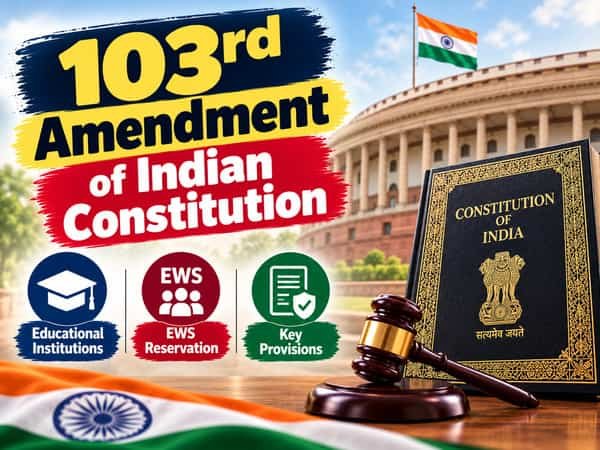
103rd Constitutional Amendment Act, 2019: Overview
| Particular | Details |
|---|---|
| Amendment | 103rd Constitutional Amendment Act, 2019 |
| Year Enacted | 2019 |
| Objective | Provide reservation to Economically Weaker Sections (EWS) |
| Articles Added | Article 15(6) and Article 16(6) |
| Reservation Introduced | Up to 10% for eligible EWS candidates |
| Applies To | Educational institutions and public employment, subject to constitutional provisions |
| Importance | Introduced economic criteria as a basis for reservation under the Constitution |
What is the 103rd Constitutional Amendment?
The 103rd Constitutional Amendment Act, 2019 amended the Constitution by introducing Articles 15(6) and 16(6). These provisions empower the State to provide reservation and special provisions for Economically Weaker Sections (EWS) of citizens who are not covered under the existing reservation categories for SCs, STs, and OBCs.
The amendment marked the first time that economic disadvantage was expressly recognized as a constitutional basis for reservation in education and public employment.
Why Was the 103rd Amendment Introduced?
Before this amendment, reservation was primarily linked to social and educational backwardness.
The amendment was introduced to:
- Support economically weaker citizens.
- Improve access to higher education.
- Increase opportunities in government employment.
- Promote social inclusion.
- Reduce financial barriers to education.
- Extend affirmative action based on economic criteria.
- Strengthen equal opportunities.
Its objective is to assist economically disadvantaged sections while maintaining the constitutional framework.
Key Features of the 103rd Constitutional Amendment
1. Introduction of EWS Reservation
The amendment enables the State to provide up to 10% reservation for eligible candidates belonging to the Economically Weaker Sections.
This reservation is in addition to the reservations available for SCs, STs, and OBCs, subject to constitutional interpretation and applicable laws.
2. Insertion of Article 15(6)
Article 15(6) empowers the State to make special provisions, including reservation, for EWS candidates in educational institutions.
The provision generally applies to admissions in educational institutions, including private educational institutions, whether aided or unaided by the State, except minority educational institutions protected under Article 30(1).
3. Insertion of Article 16(6)
Article 16(6) empowers the State to provide reservation for EWS candidates in appointments or posts under the State.
This provision extends reservation benefits to eligible candidates in government employment, subject to the applicable recruitment rules and constitutional provisions.
Who is Eligible for EWS Reservation?
The Constitution itself does not specify detailed eligibility criteria for EWS reservation. The Central Government and the respective State Governments prescribe eligibility conditions through notifications and applicable rules.
Generally, eligibility is based on:
- Annual family income.
- Ownership of agricultural land.
- Residential property.
- Other prescribed economic criteria.
Applicants are required to obtain a valid EWS certificate issued by the competent authority to claim the benefit.
Benefits of the 103rd Amendment
The amendment provides several important benefits.
These include:
Better Access to Education
Eligible EWS students receive reservation in admissions to educational institutions covered by the constitutional provision.
Increased Government Job Opportunities
Eligible candidates can avail reservation in recruitment to government posts under the applicable rules.
Promotion of Economic Inclusion
The amendment seeks to support individuals facing financial hardship by improving access to education and employment opportunities.
Constitutional Recognition of Economic Disadvantage
It acknowledges that economic hardship can also create barriers to equal opportunity.
Landmark Supreme Court Judgment
One of the most important developments relating to the 103rd Amendment came in the case of Janhit Abhiyan v. Union of India (2022).
The Supreme Court, by a majority, upheld the constitutional validity of the 103rd Constitutional Amendment.
The Court held that:
- Reservation based on economic criteria is constitutionally permissible.
- The 10% EWS reservation does not violate the Constitution’s basic structure.
- Excluding beneficiaries of existing reservation categories from the EWS quota does not render the amendment unconstitutional.
This judgment confirmed the constitutional validity of the amendment.
Significance of Articles 15(6) and 16(6)
The two newly inserted Articles have distinct purposes.
| Article | Purpose |
|---|---|
| Article 15(6) | Enables special provisions and reservation for EWS in educational institutions. |
| Article 16(6) | Enables reservation for EWS in public employment under the State. |
Together, these provisions create the constitutional basis for EWS reservation.
Importance of the 103rd Constitutional Amendment
The amendment has had a significant impact on India’s reservation policy.
Its importance includes:
- Expanding affirmative action.
- Supporting economically weaker citizens.
- Increasing educational access.
- Improving opportunities in government employment.
- Promoting inclusive development.
- Recognizing economic disadvantage in constitutional policy.
- Strengthening social welfare initiatives.
It represents a major constitutional development in India’s approach to equality and reservation.
Practical Significance for Citizens
Students and job aspirants should understand the practical implications of the amendment.
Eligible candidates should:
- Check the latest EWS eligibility criteria issued by the relevant government.
- Obtain an EWS certificate from the competent authority.
- Verify reservation provisions in recruitment and admission notifications.
- Keep income and property documents updated for certificate issuance.
Since eligibility criteria may be revised from time to time, applicants should always rely on the latest official notifications.
Frequently Asked Questions (FAQs)
Q1. What is the 103rd Constitutional Amendment?
A. The 103rd Constitutional Amendment Act, 2019 introduced 10% reservation for Economically Weaker Sections (EWS) by inserting Articles 15(6) and 16(6) into the Constitution.
Q2. Which Articles were added through the 103rd Amendment?
A. The amendment inserted Article 15(6), relating to reservation in educational institutions, and Article 16(6), relating to reservation in public employment for eligible EWS candidates.
Q3. Who can claim EWS reservation?
A. Eligible individuals belonging to the Economically Weaker Sections, who satisfy the income and asset criteria prescribed by the Central or State Government and are not covered under existing reservation categories, may claim EWS reservation by obtaining a valid EWS certificate.
Q4. Has the Supreme Court upheld the 103rd Constitutional Amendment?
A. Yes. In Janhit Abhiyan v. Union of India (2022), the Supreme Court upheld the constitutional validity of the 103rd Constitutional Amendment and the EWS reservation provisions.
Disclaimer: This article is intended for general informational and educational purposes only. It provides a simplified overview of the 103rd Constitutional Amendment Act, 2019 based on the Constitution of India, applicable laws, and important judicial decisions available at the time of writing. It should not be considered legal advice. The implementation of EWS reservation, eligibility criteria, and related procedures may vary according to Central or State Government notifications, recruitment rules, and future judicial interpretations. For advice regarding a specific legal or reservation-related matter, consult a qualified legal professional or the relevant government authority.