
When a large expense cannot comfortably be paid in one go, two borrowing options often come into consideration: converting the purchase or credit card outstanding into EMIs, or taking a personal loan. Both allow you to spread repayment over several months, but the actual cost can be very different.
A credit card EMI is convenient because an eligible transaction or outstanding balance can often be converted into instalments without applying for a completely separate loan. A personal loan, meanwhile, provides a lump sum that is repaid through fixed EMIs over an agreed tenure.
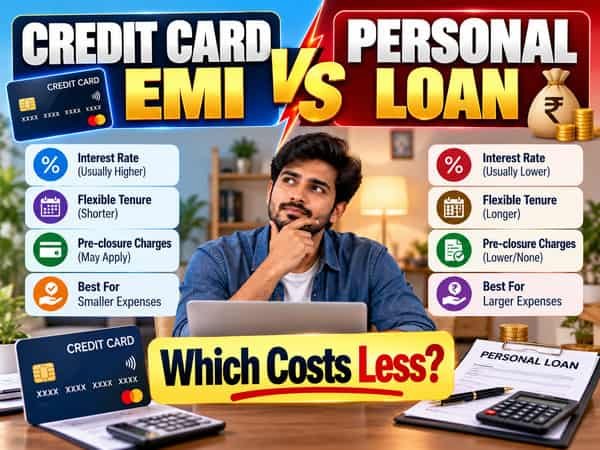
For relatively small purchases and short repayment periods, a competitive credit card EMI offer can be convenient. For larger borrowing needs or longer repayment periods, a personal loan may offer a lower total cost—particularly for borrowers with strong credit profiles. The correct comparison, however, requires looking beyond the advertised interest rate.
How Does a Credit Card EMI Work?
Credit card EMI allows an eligible card transaction or, in some cases, eligible outstanding dues to be converted into monthly instalments.
Suppose you purchase a laptop for ₹90,000. Instead of paying the entire amount in the next billing cycle, you may be able to convert the eligible transaction into a 6-, 9-, 12- or longer-month EMI plan, depending on your card issuer and available offer.
Your monthly payment generally consists of principal plus applicable interest and charges.
Credit card EMI can be attractive because:
- Conversion can be quick.
- A separate loan application may not be necessary.
- Short repayment options are often available.
- Certain purchases may qualify for promotional or no-cost EMI offers.
- The EMI appears within the regular credit card billing process.
Convenience, however, should not be confused with low cost.
How Does a Personal Loan Work?
A personal loan is generally an unsecured loan provided by a bank or NBFC based on factors such as your income, employment, credit history, existing obligations and repayment capacity.
Once approved, the lender disburses the loan amount and you repay it through EMIs over the agreed tenure.
Unlike credit card EMI, a personal loan is not restricted to financing a particular card purchase. The money can generally be used for legitimate personal requirements according to the lender’s terms.
Personal loans are commonly considered for:
- Medical expenses
- Weddings
- Home renovation
- Education-related expenses
- Travel
- Large purchases
- Debt consolidation
The interest rate offered can vary substantially according to the borrower’s credit profile.
Credit Card EMI Vs Personal Loan: Key Differences
A comparison table is useful because borrowers need to evaluate cost, convenience and repayment flexibility together.
| Factor | Credit Card EMI | Personal Loan |
|---|---|---|
| Borrowing method | Eligible card purchase/outstanding converted into EMI | Separate loan is sanctioned |
| Approval | Often quick for eligible cardholders | Requires lender approval |
| Interest cost | Depends on card and offer | Depends on borrower profile and lender |
| Loan amount | Constrained by card/eligible limits | Based on approved loan eligibility |
| Tenure | Commonly suited to shorter or medium periods | Can provide longer repayment options |
| Processing charges | May apply | Usually may apply |
| Access to funds | Primarily linked to card facility | Lump sum disbursed |
| Best suited for | Eligible purchases and smaller short-term needs | Larger or longer-term borrowing |
Why a Personal Loan Can Cost Less
Personal loan interest rates can sometimes be lower than standard interest-bearing credit card EMI rates, particularly for borrowers with strong credit scores, stable incomes and good repayment histories.
This difference becomes more important when the amount is large.
For example, financing ₹30,000 for a few months may produce a relatively modest rupee difference between two offers. Financing ₹5 lakh over several years can make even a few percentage points of interest difference financially significant.
Personal loans can therefore become more attractive as the borrowing amount and repayment period increase.
However, processing fees and other applicable charges must also be included before deciding that the lower advertised interest rate represents the cheaper loan.
When Can Credit Card EMI Be Cheaper?
Credit card EMI should not automatically be assumed to be expensive.
Banks and merchants sometimes provide promotional EMI arrangements for specific products or transactions. A particularly important example is no-cost EMI.
Under such arrangements, the interest component may effectively be offset through an upfront discount or another pricing mechanism, depending on how the offer is structured. However, processing fees, GST on applicable charges or the loss of a cash-purchase discount may still affect the real cost.
Credit card EMI may be competitive when:
- The amount is relatively small.
- The tenure is short.
- You receive a genuine promotional offer.
- Processing charges are low.
- You can comfortably pay every EMI on time.
- Taking a separate personal loan would create disproportionate processing costs.
Always calculate the final amount paid rather than relying solely on the phrase “no-cost EMI.”
The Credit Limit Factor Is Easy to Overlook
Using credit card EMI can affect the credit limit available on your card.
Suppose your credit card has a ₹2 lakh limit and you make an eligible ₹1.2 lakh purchase that is converted into EMI. A significant portion of the card limit may remain occupied and become available progressively according to the issuer’s rules as repayments are made.
This can leave less available credit for emergencies or regular spending.
A personal loan is a separate credit facility, although taking one will still add to your overall debt obligations and can affect future borrowing capacity.
Borrowers who regularly rely on their credit cards should consider this practical difference.
Why Total Cost Matters More Than the Interest Rate
Imagine a personal loan is advertised at a lower annual interest rate than a credit card EMI offer. It appears cheaper immediately.
But suppose the personal loan also carries a processing fee while the card EMI is available with a low conversion charge and a much shorter tenure.
The final difference may be smaller than expected.
Before choosing, calculate:
- Principal amount
- Interest payable
- Processing or conversion fee
- GST on applicable interest, fees or charges
- Repayment tenure
- Monthly EMI
- Prepayment or foreclosure charges
- Late-payment consequences
- Total amount payable
The option with the lower total repayment cost for the same borrowing amount and comparable tenure provides the more meaningful comparison.
Avoid Using Credit Card Revolving Debt as an Alternative
There is an important distinction between a structured credit card EMI and simply paying the minimum amount due on a credit card.
If you do not pay the total amount due and instead carry eligible outstanding balances forward, substantial finance charges can apply according to the card’s terms.
A planned EMI arrangement provides a defined repayment schedule. Revolving card debt can become much more expensive and difficult to manage.
If you already have a large credit card balance that you cannot clear, compare structured alternatives carefully rather than repeatedly relying on minimum payments.
Which Costs Less?
There is no universal winner.
A personal loan can often be more cost-effective for larger amounts and longer repayment periods, particularly when the borrower qualifies for a competitive interest rate.
A credit card EMI can be attractive for smaller, short-term purchases, especially when a genuine promotional or no-cost EMI arrangement is available.
For example, buying a ₹50,000 appliance through a competitive six-month card EMI may be simpler than applying for a separate loan. Financing several lakh rupees over three or four years may make a personal loan more practical.
The cheapest option is ultimately the one with the lowest total borrowing cost while keeping the EMI comfortably within your monthly budget.
FAQs
Q1. Is credit card EMI more expensive than a personal loan?
A. It can be, particularly when the card EMI carries a higher interest rate and the repayment period is long. However, promotional or no-cost EMI offers can sometimes make card EMI competitive for eligible purchases. Compare the total payable amount under both options.
Q2. Is no-cost EMI actually free?
A. Not necessarily in every respect. The interest may be offset through the merchant’s discount or offer structure, but processing fees, applicable taxes or the loss of another purchase discount can still create a cost. Check the complete payment breakdown before accepting the offer.
Q3. Does converting a credit card purchase to EMI reduce my available limit?
A. It can. The EMI transaction may occupy part of your credit limit, with the available limit being restored according to the card issuer’s repayment and limit-adjustment rules. Check your issuer’s specific conditions.
Q4. Which is better for borrowing ₹2 lakh: credit card EMI or personal loan?
A. Compare actual offers rather than choosing solely based on the amount. Check the interest rate, processing or conversion charges, tenure, EMI and total amount payable. A personal loan may be cheaper for a longer tenure, while a competitive short-term card EMI offer could be attractive if its overall cost is lower.


