
A serious illness can create two financial problems at the same time. The first is obvious: hospital bills, surgery, medicines and treatment costs. The second is easier to overlook: income may fall while household expenses, EMIs, children’s education and other commitments continue.
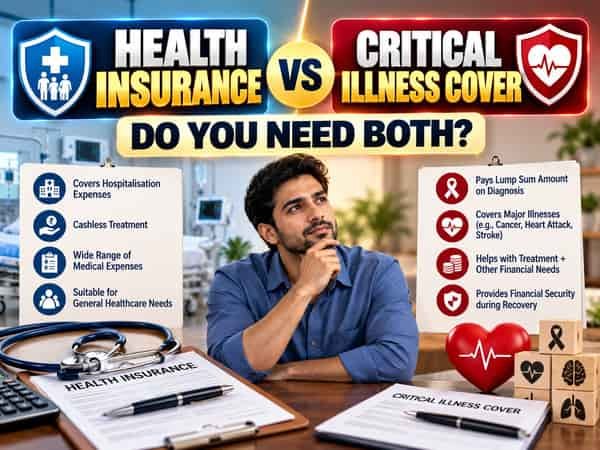
This is where health insurance and critical illness cover serve different purposes. A regular health insurance policy generally pays or reimburses eligible medical expenses according to the actual treatment costs and policy terms. Critical illness insurance typically provides a fixed lump-sum benefit when the insured is diagnosed with a covered critical illness and satisfies the policy’s defined conditions.
For many families, these products are therefore complementary rather than substitutes. Health insurance primarily addresses eligible healthcare expenses, while critical illness cover can provide additional financial support when a specified serious illness disrupts normal life and income.
How Does Regular Health Insurance Work?
Health insurance is designed primarily to cover eligible medical expenses arising from hospitalisation and other treatments included under the policy.
Depending on the plan, coverage may include:
- Hospitalisation expenses
- Day-care procedures
- Pre- and post-hospitalisation expenses
- Ambulance expenses
- Certain modern treatments
- Domiciliary treatment, where covered
- Other specified medical expenses
With cashless treatment, an eligible claim can be settled directly with a network hospital according to the insurer’s process. Under reimbursement, the policyholder pays the medical expenses first and later submits an eligible claim.
The amount paid is generally connected to admissible medical expenses rather than simply to the name of the disease.
What Is Critical Illness Cover?
Critical illness insurance works differently.
Instead of reimbursing every eligible hospital bill, it generally pays a predefined benefit amount when the insured is diagnosed with one of the critical illnesses listed in the policy and meets the specified definition and conditions.
Covered conditions vary between products and may include illnesses or procedures such as certain cancers, specified heart conditions, stroke, major organ transplant or kidney failure, depending on the policy.
For example, suppose a person has a ₹20 lakh critical illness policy and develops a covered illness that satisfies the insurer’s policy definition. The applicable benefit can be paid according to the policy conditions rather than being restricted to a hospital bill of exactly ₹20 lakh.
This lump-sum structure is what distinguishes critical illness cover from standard indemnity health insurance.
Health Insurance Vs Critical Illness Cover
A comparison is useful because the claim mechanisms and purposes are fundamentally different.
| Factor | Health Insurance | Critical Illness Cover |
|---|---|---|
| Primary purpose | Pay eligible medical expenses | Provide financial support after specified diagnosis |
| Benefit type | Usually indemnity-based | Usually fixed-benefit lump sum |
| Payment basis | Eligible treatment expenses | Covered illness meeting policy definition |
| Hospitalisation | Often central to coverage | Diagnosis/defined condition is central |
| Use of payout | Primarily eligible medical expenses | Generally greater flexibility after payout |
| Number of conditions | Broad medical coverage subject to terms | Limited to specifically listed critical illnesses |
| Income replacement | Not its primary purpose | Lump sum can help during income disruption |
| Main role | Medical-cost protection | Additional financial protection |
Why Health Insurance Should Usually Come First
If someone can initially afford only one type of protection, comprehensive health insurance will generally address a broader range of medical events.
A person could require hospitalisation because of:
- Dengue
- An accident
- Appendicitis
- Infection
- Gallbladder surgery
- Fracture
- Pneumonia
- Another covered medical condition
A critical illness policy would not automatically pay merely because treatment was expensive. The diagnosis must be one of the specified covered conditions and satisfy the policy definition.
Health insurance therefore creates a broader foundation for managing eligible hospital expenses.
Critical illness cover is better viewed as an additional layer for specific high-impact health events.
Why Health Insurance Alone May Not Solve Every Financial Problem
Imagine a 42-year-old earning member is diagnosed with a serious covered illness and needs several months away from work.
A health insurance policy may take care of eligible hospital and treatment expenses. But what happens to:
- Home loan EMI
- Rent
- School fees
- Groceries
- Utility bills
- Travel for treatment
- Household help
- Business income lost during recovery?
These are not necessarily hospital expenses and may fall outside a regular health insurance claim.
This is where a critical illness lump sum can be valuable. Depending on the product terms, the benefit can provide financial breathing room beyond direct hospital costs.
A Critical Illness Policy Does Not Cover Every Serious Disease
One of the biggest mistakes buyers make is assuming that anything medically serious qualifies as a critical illness claim.
It does not.
The policy contains a specific list of covered illnesses and detailed definitions describing when a claim becomes payable.
For example, simply being diagnosed with a condition carrying a familiar disease name may not be sufficient if the diagnosis does not meet the severity or clinical definition stated in the policy.
Buyers should therefore examine:
- List of covered illnesses
- Definitions of each illness
- Waiting period
- Survival-period requirements, where applicable
- Pre-existing disease provisions
- Exclusions
- Age limits
- Claim conditions
The number of illnesses advertised on the front page of a policy should never replace reading the actual definitions.
Should You Buy Critical Illness as a Rider or Separate Policy?
Critical illness protection may be available as a standalone policy or as a rider attached to another insurance product.
The better choice depends on factors such as coverage amount, premium, covered conditions, policy duration and how the benefit interacts with the underlying policy.
A standalone critical illness policy can provide independent coverage, while a rider may offer the convenience of adding protection to an existing policy.
Do not compare them only on premium.
Check whether the coverage continues for the required period, what happens after a claim, which illnesses are covered and whether the benefit amount is adequate for your financial responsibilities.
How Much Critical Illness Cover May Be Needed?
The appropriate amount is not necessarily equal to your regular health insurance sum insured.
Critical illness protection should reflect the wider financial impact a major illness could have.
Consider:
- Monthly household expenses
- Outstanding EMIs
- Number of dependants
- Emergency savings
- Potential income interruption
- Existing health insurance
- Employer benefits
- Other financial assets
For example, someone with a large emergency fund, strong employer benefits and few financial dependants may require a different level of additional protection from the sole earner of a family with a home loan and young children.
Do You Need Both?
For many working individuals with financial dependants, health insurance and critical illness cover can work together effectively because they address different risks.
Health insurance can form the primary layer by covering eligible medical expenses. Critical illness cover can provide an additional lump-sum financial cushion when a specified severe condition occurs.
Critical illness cover can deserve greater consideration if:
- You are the family’s primary earner.
- Your household depends heavily on your monthly income.
- You have significant EMIs.
- Your emergency fund is limited.
- A long break from work would create financial stress.
- You want protection beyond hospital bills.
However, buying additional critical illness insurance should not come at the cost of maintaining adequate basic health insurance or essential household liquidity.
FAQs
Q1. Can critical illness insurance replace health insurance?
A. Generally, no. Critical illness insurance covers only specified illnesses that meet the definitions and conditions in the policy. Regular health insurance can cover a much broader range of eligible hospitalisations and medical treatments.
Q2. Can I claim health insurance and critical illness cover for the same illness?
A. Potentially, yes, if the event independently satisfies the terms of both policies. Health insurance can address eligible medical expenses, while a critical illness policy may pay its defined fixed benefit. Each insurer will assess the claim according to its own policy conditions.
Q3. Does critical illness insurance pay the full sum insured?
A. Critical illness policies are generally fixed-benefit products, but payment depends on the insured condition meeting the exact policy definition and other applicable requirements. Buyers should check the benefit structure, exclusions, waiting periods and claim conditions.
Q4. Is critical illness cover worth considering for a young person?
A. Age alone should not determine the decision. A younger person who is the primary family earner, has substantial loans or has limited emergency savings may still value additional protection against the financial impact of a serious covered illness.