Every day, people face situations where they believe a government authority has acted unfairly, denied them their rights, or failed to perform a legal duty. Whether it’s an illegal demolition, wrongful dismissal from a government job, denial of a public benefit, or an arbitrary administrative order, citizens need a quick and effective legal remedy. This is where Article 226 of the Indian Constitution becomes highly significant.
Article 226 empowers every High Court in India to issue writs for the enforcement of Fundamental Rights and for “any other purpose.” This makes it one of the most powerful constitutional provisions available to citizens. Unlike some constitutional remedies that are limited to protecting Fundamental Rights, Article 226 gives High Courts broader authority to ensure fairness, legality, and accountability in government actions.
For law students, competitive exam aspirants, legal professionals, and ordinary citizens, understanding Article 226 is essential because it forms the backbone of judicial review and constitutional protection at the state level.
Overview of Article 226
| Particular | Details |
|---|---|
| Article | Article 226 of the Constitution of India |
| Applies To | High Courts of India |
| Main Purpose | Protection of legal and Fundamental Rights |
| Power Granted | Issue writs, directions, and orders |
| Who Can File | Any person whose legal or Fundamental Rights are affected |
| Covers | Government authorities, public bodies, and statutory authorities |
| Nature of Power | Constitutional and discretionary |
| Key Objective | Ensure justice, legality, and accountability |
What is Article 226 of the Indian Constitution?
Article 226 authorises every High Court to issue writs, directions, or orders to any government authority, public body, or person performing a public duty within its territorial jurisdiction.
Its primary objective is to protect individuals from illegal actions of public authorities and ensure that government agencies perform their legal responsibilities fairly.
One of the biggest strengths of Article 226 is that it is available not only for enforcing Fundamental Rights but also for protecting other legal rights recognised under law.
Why is Article 226 Important?
Article 226 plays a crucial role in India’s constitutional framework because it gives citizens direct access to the High Courts when public authorities misuse their powers.
Its importance includes:
- Protects Fundamental Rights.
- Safeguards legal rights beyond the Constitution.
- Prevents arbitrary government action.
- Ensures public authorities follow the law.
- Provides speedy constitutional remedies.
- Strengthens judicial review over administrative decisions.
This broad jurisdiction makes High Courts an accessible forum for resolving many constitutional and administrative disputes.
Powers of High Courts Under Article 226
High Courts enjoy wide powers while exercising jurisdiction under Article 226.
1. Issue Constitutional Writs
High Courts can issue various writs to enforce rights and control unlawful actions of public authorities.
2. Protect Fundamental Rights
If any government authority violates a citizen’s Fundamental Rights, the High Court can intervene and grant appropriate relief.
3. Protect Other Legal Rights
Unlike Article 32, Article 226 also covers ordinary legal rights arising under statutes, rules, or government actions.
4. Review Administrative Decisions
The High Court can examine whether administrative authorities have acted lawfully, fairly, and within their legal powers.
5. Ensure Performance of Public Duties
Where a public authority fails to perform its statutory duty, the High Court may issue appropriate directions requiring compliance.
Types of Writs Under Article 226
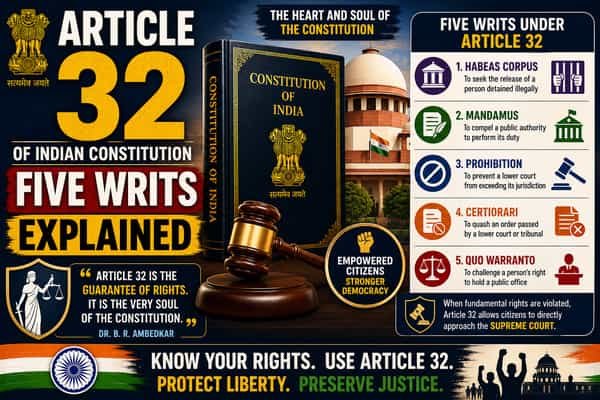
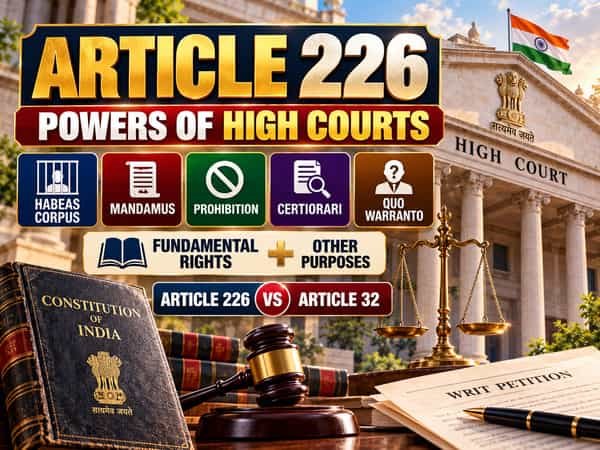
High Courts can issue five constitutional writs.
Habeas Corpus
Meaning “produce the body,” this writ protects personal liberty by directing authorities to produce a person who has been unlawfully detained.
Common use:
- Illegal detention
- Unlawful police custody
- Wrongful imprisonment
Mandamus
This writ directs a public authority to perform a legal or statutory duty that it has failed or refused to perform.
Common use:
- Delay in issuing licences
- Failure to process pensions
- Non-performance of statutory obligations
Certiorari
This writ allows the High Court to quash an order passed by a lower court, tribunal, or authority when it has acted without jurisdiction or violated principles of natural justice.
Prohibition
Issued before a decision is made, this writ prevents a lower court or tribunal from exceeding its legal authority.
Quo Warranto
This writ questions the legality of a person’s appointment to a public office.
It helps ensure that only legally qualified individuals hold public positions.
Difference Between Article 226 and Article 32
| Basis | Article 226 | Article 32 |
|---|---|---|
| Court | High Court | Supreme Court |
| Scope | Fundamental Rights and other legal rights | Only Fundamental Rights |
| Jurisdiction | Territorial | Entire India |
| Nature | Discretionary | Fundamental Right itself |
| Accessibility | Easier for most citizens | Direct approach to Supreme Court |
Because of its wider scope, many cases are first filed before the High Courts under Article 226.
Who Can File a Petition Under Article 226?
A petition under Article 226 may generally be filed by:
- A person whose Fundamental Rights have been violated.
- A person whose legal rights have been affected.
- A company or organisation affected by government action.
- Public interest petitioners in appropriate cases.
- Any person seeking judicial review of unlawful administrative action.
The petitioner must usually demonstrate that they have been directly affected or have sufficient legal interest in the matter.
Limitations of Article 226
Although Article 226 provides broad powers, certain limitations apply.
- High Courts generally do not interfere in purely private disputes.
- The Court may refuse relief if an effective alternative legal remedy is available.
- The power is discretionary, not automatic.
- The authority against whom relief is sought should ordinarily fall within the High Court’s territorial jurisdiction.
- Courts avoid deciding disputed questions of fact that require detailed evidence in writ proceedings.
These limitations ensure that Article 226 is used appropriately while preserving the role of other legal forums.
Landmark Importance of Article 226
Over the years, Article 226 has been used in numerous cases involving:
- Illegal government orders
- Service and employment disputes
- Environmental protection
- Education matters
- Land acquisition disputes
- Election-related issues
- Public interest litigation
- Protection of civil liberties
Its wide jurisdiction has made High Courts an essential constitutional safeguard for citizens across India.
FAQs
Q1. What is Article 226 of the Indian Constitution?
A. Article 226 empowers High Courts to issue writs, directions, or orders for the enforcement of Fundamental Rights as well as other legal rights against public authorities.
Q2. What are the five writs under Article 226?
A. The five writs available under Article 226 are Habeas Corpus, Mandamus, Certiorari, Prohibition, and Quo Warranto.
Q3. Can Article 226 be used for legal rights other than Fundamental Rights?
A. Yes. Unlike Article 32, Article 226 can be invoked for the enforcement of Fundamental Rights as well as other legal rights recognised under law.
Q4. Can a High Court refuse to hear a petition under Article 226?
A. Yes. Jurisdiction under Article 226 is discretionary. A High Court may decline to grant relief in appropriate circumstances, particularly where an effective alternative remedy is available or where the dispute is otherwise unsuitable for exercise of writ jurisdiction.
Disclaimer: This article is intended for general educational and informational purposes only. It explains Article 226 of the Constitution of India in simple language and should not be treated as legal advice. For advice relating to a specific legal issue, consult a qualified legal professional and refer to the latest constitutional provisions and judicial decisions.