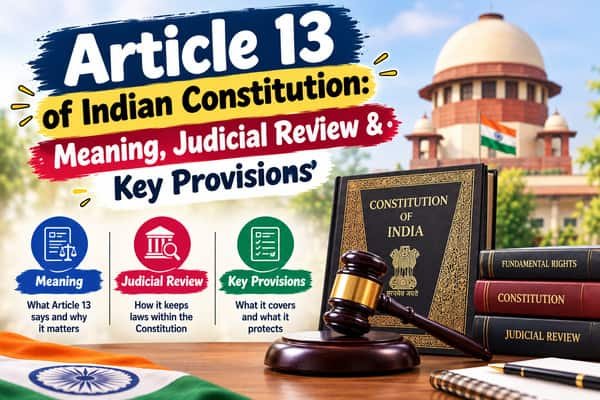
The Constitution of India gives every citizen several Fundamental Rights such as equality, freedom, protection against exploitation, freedom of religion, cultural rights, and constitutional remedies. But what happens if Parliament or a State Legislature makes a law that violates these rights? Can such a law continue to exist? The answer lies in Article 13 of the Indian Constitution, one of the most important constitutional provisions that protects citizens from unconstitutional laws.
Article 13 acts as a constitutional safeguard by ensuring that no law can take away or violate the Fundamental Rights guaranteed under Part III of the Constitution. It empowers courts to examine laws and declare unconstitutional provisions void if they conflict with Fundamental Rights. This principle, known as judicial review, has become one of the cornerstones of India’s democratic system. Whether you are a law student, UPSC aspirant, legal professional, or an informed citizen, understanding Article 13 is essential because it helps explain how the Constitution remains the supreme law of the land.
Article 13 of the Indian Constitution: Overview
| Particular | Details |
|---|---|
| Article | Article 13 |
| Part of Constitution | Part III – Fundamental Rights |
| Objective | Protect Fundamental Rights from unconstitutional laws |
| Applies To | Existing laws and future laws made by the State |
| Key Principle | Judicial Review |
| Declares | Laws inconsistent with Fundamental Rights as void to the extent of inconsistency |
| Importance | Upholds constitutional supremacy and protects citizens’ rights |
What is Article 13 of the Indian Constitution?
Article 13 ensures that every law in India must comply with the Fundamental Rights guaranteed under the Constitution. If any law is inconsistent with or violates these rights, it can be declared void by the courts to the extent of such inconsistency.
The Article emphasizes that the Constitution is the supreme law of the country, and all legislative actions must conform to its provisions. It also forms the constitutional basis for judicial review, allowing courts to examine the validity of laws passed by Parliament and State Legislatures.
Why is Article 13 Important?
Without Article 13, legislatures could enact laws that restrict or even remove Fundamental Rights.
The Article was included to:
- Protect Fundamental Rights.
- Ensure constitutional supremacy.
- Prevent arbitrary legislation.
- Empower courts to review laws.
- Maintain the rule of law.
- Protect citizens from unconstitutional actions.
- Strengthen democracy.
It acts as a shield against laws that violate constitutional guarantees.
Key Provisions of Article 13
Article 13 consists of four important clauses, each serving a specific constitutional purpose.
Article 13(1): Existing Laws
Article 13(1) states that laws that were in force before the Constitution came into effect on 26 January 1950 will become void to the extent that they are inconsistent with the Fundamental Rights.
This does not mean that the entire law automatically becomes invalid. Only the inconsistent portion loses its legal effect.
Article 13(2): Future Laws
Article 13(2) prohibits the State from making any law that takes away or abridges the Fundamental Rights guaranteed under Part III of the Constitution.
If such a law is enacted, it becomes void to the extent of the violation.
This provision acts as a constitutional limitation on legislative power.
Article 13(3): Meaning of “Law”
Article 13 gives a broad meaning to the term “law.”
It includes:
- Acts passed by Parliament.
- State laws.
- Ordinances.
- Rules.
- Regulations.
- Notifications.
- Bye-laws.
- Orders.
- Customs and usages having the force of law.
This wide definition ensures that Fundamental Rights cannot be bypassed through subordinate legislation or customary practices.
Article 13(4): Constitutional Amendments
Article 13(4) was inserted by the 24th Constitutional Amendment Act, 1971.
It clarifies that constitutional amendments made under Article 368 are not treated as “law” for the purposes of Article 13.
However, this does not mean constitutional amendments are beyond judicial scrutiny.
Doctrine of Judicial Review
One of the greatest contributions of Article 13 is the principle of Judicial Review.
Judicial review allows the Supreme Court and High Courts to examine whether a law is consistent with the Constitution.
If a law violates Fundamental Rights or other constitutional provisions, the court may declare it unconstitutional.
Judicial review helps maintain the balance of power among the Legislature, Executive, and Judiciary.
Doctrine of Severability
Article 13 also gives rise to the Doctrine of Severability.
According to this principle:
- If only a part of a law violates Fundamental Rights, only that portion becomes void.
- The remaining valid provisions continue to operate if they can function independently.
This prevents the unnecessary invalidation of entire statutes.
Doctrine of Eclipse
Another important constitutional principle associated with Article 13 is the Doctrine of Eclipse.
According to this doctrine:
- A pre-Constitution law inconsistent with Fundamental Rights is not completely dead.
- It remains dormant or eclipsed.
- If the constitutional inconsistency is removed in the future, the law may become enforceable again, subject to legal principles.
This doctrine generally applies to pre-Constitution laws rather than post-Constitution legislation.
Landmark Supreme Court Judgments
Several important judgments have shaped the interpretation of Article 13.
Shankari Prasad v. Union of India (1951)
The Supreme Court initially held that constitutional amendments were not considered “law” under Article 13.
Golak Nath v. State of Punjab (1967)
The Court ruled that Parliament could not amend Fundamental Rights through constitutional amendments.
This decision significantly expanded the scope of Article 13.
Kesavananda Bharati v. State of Kerala (1973)
This landmark judgment introduced the Basic Structure Doctrine, holding that although Parliament can amend the Constitution, it cannot alter its basic structure.
This remains one of the most significant constitutional decisions in India.
Importance of Article 13
Article 13 is regarded as one of the strongest safeguards of constitutional democracy.
Its significance includes:
- Protecting Fundamental Rights.
- Ensuring constitutional supremacy.
- Preventing unconstitutional legislation.
- Empowering the judiciary.
- Maintaining the rule of law.
- Strengthening democratic governance.
- Protecting citizens against arbitrary State action.
Without Article 13, constitutional rights could be significantly weakened.
Practical Significance for Citizens
Although many people never directly invoke Article 13, its impact is reflected in everyday life.
It protects citizens whenever courts strike down laws that violate Fundamental Rights, ensuring that government actions remain within constitutional limits.
Students preparing for competitive examinations, legal professionals, and anyone interested in constitutional law should have a clear understanding of Article 13 because it forms the basis of judicial review in India.
Frequently Asked Questions (FAQs)
1. What is the main purpose of Article 13 of the Indian Constitution?
A. Article 13 protects Fundamental Rights by declaring laws that violate these rights void to the extent of their inconsistency and empowers courts to review the constitutionality of laws.
2. Does Article 13 apply only to laws made after the Constitution?
A. No. Article 13 applies to both laws that existed before the Constitution came into force and laws enacted afterward. It deals with existing laws under Article 13(1) and future laws under Article 13(2).
3. What is judicial review under Article 13?
A. Judicial review is the power of the Supreme Court and High Courts to examine whether laws are consistent with the Constitution. If a law violates Fundamental Rights or other constitutional provisions, the courts may declare it unconstitutional.
4. Which important constitutional doctrine is closely associated with Article 13?
A. Article 13 is closely associated with the Doctrine of Severability, the Doctrine of Eclipse, and the principle of Judicial Review, all of which help protect the supremacy of the Constitution.
Disclaimer: This article is intended for general informational and educational purposes only. It provides a simplified overview of Article 13 of the Indian Constitution based on the Constitution of India and important judicial interpretations available at the time of writing. It should not be considered legal advice. Constitutional provisions may be interpreted differently depending on the facts of a case and subsequent judgments or amendments. For legal advice relating to a specific issue, consult a qualified legal professional.