Health insurance often feels sufficient when your employer already provides medical coverage. A company-sponsored policy can reduce the financial burden of hospitalisation and, for many salaried employees in India, serves as their first layer of health protection. However, problems can arise when you change jobs, the employer reduces insurance benefits, or a major hospital bill exceeds the available sum insured.
A personal health insurance policy works differently. You purchase and maintain the policy yourself, which means the coverage is not normally dependent on your employment. This gives you greater control over the sum insured, policy features and long-term continuity.
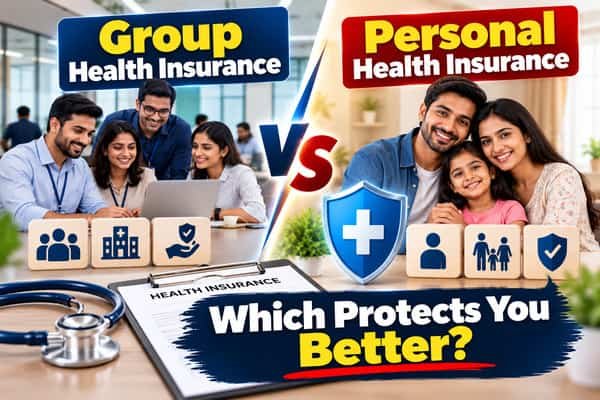
So, when comparing group health insurance vs personal health insurance, the real question is not simply which policy is better. You need to consider which one can protect you consistently as your job, family responsibilities, age and healthcare needs change.
What Is Group Health Insurance?
Group health insurance covers a defined group of people under one master policy. In a workplace, the employer generally purchases the policy and provides coverage to eligible employees as part of their employment benefits.
Depending on the plan selected by the employer, coverage may also extend to a spouse, children or parents.
Some common benefits of group health insurance include:
- Little or no premium cost for employees
- Convenient enrolment through the employer
- Cashless treatment at eligible network hospitals
- Possible coverage for dependent family members
- Benefits negotiated by the employer for employees
However, employees generally have limited control over the policy. The employer determines the insurer, coverage amount and benefits available under the group plan.
What Is a Personal Health Insurance Policy?
Personal health insurance is purchased directly by an individual. You can buy an individual policy for yourself or choose a family floater that covers eligible family members under a shared sum insured.
Unlike employer insurance, a personal policy belongs to you. You can choose coverage based on your healthcare requirements, budget and family circumstances.
Depending on the available policy, you may be able to choose the sum insured, deductible, optional benefits and other features.
Most importantly, the policy is not tied to a particular employer. Changing jobs does not automatically mean losing your personal health insurance.
Group Health Insurance Vs Personal Policy: Key Differences
A comparison table is useful for this topic because several important differences can be understood quickly.
| Factor | Group Health Insurance | Personal Health Insurance |
|---|---|---|
| Policy ownership | Usually employer/master policyholder | Individual policyholder |
| Premium | Often paid fully or partly by employer | Paid by policyholder |
| Coverage choice | Limited employee control | Greater individual control |
| Sum insured | Decided under the group plan | Chosen according to available options |
| Job change | Coverage may end after leaving | Continues independently of employment |
| Customisation | Usually limited | Generally more flexible |
| Long-term control | Depends on group membership | Controlled by policyholder |
| Family coverage | Depends on employer benefits | Can be selected according to needs |
Where Group Health Insurance Works Well
The biggest advantage of employer health insurance is convenience. Employees can receive medical coverage without having to independently arrange their primary insurance protection.
The employer may pay the entire premium or a significant portion of it, making group insurance particularly valuable for salaried employees.
Some corporate plans may also offer useful benefits for employees and their families. The actual coverage varies considerably from one organisation to another.
For younger employees with limited financial responsibilities, a good employer policy can provide a useful starting point. However, it is important to understand exactly what is covered instead of assuming that every medical expense will be paid.
Risks of Depending Only on Employer Health Insurance
The biggest weakness of group insurance is its connection with employment.
If you resign, retire, are laid off or move to another organisation, your existing coverage may end according to the terms of the group policy. Your next employer may provide a different sum insured or fewer benefits.
Another issue is the coverage amount. An employer may offer ₹3 lakh, ₹5 lakh or another amount based on its employee benefit structure. A lower sum insured may not be sufficient for expensive hospitalisation, surgery or multiple medical claims within the same policy period.
Employees also usually have little influence over future changes. The employer may change the insurer, coverage structure or benefits when the group policy is renewed.
Why Personal Health Insurance Offers Greater Control
Personal health insurance gives you independent control over your medical coverage.
You can compare policies and select coverage according to your age, family size, healthcare requirements and financial situation.
Important features to compare include:
- Sum insured
- Room-rent conditions
- Co-payment requirements
- Deductibles
- Waiting periods
- Hospital network
- Disease-specific sub-limits
- Restoration benefits
- Exclusions
- Optional covers
Having a personal policy also allows you to maintain continuous health coverage while moving between jobs.
Buying suitable health insurance earlier in life can also help you complete applicable waiting periods before certain medical needs arise later.
What Happens When You Change Jobs?
Job changes are one of the most important situations where personal insurance becomes valuable.
There may be a gap between your last working day at one company and the start of insurance coverage at your new organisation. Even when the new employer provides insurance, its benefits may be different.
For example, your previous employer might provide ₹10 lakh of family coverage while your new employer provides only ₹5 lakh.
If you already have a personal health policy, your core insurance protection does not depend entirely on these changes.
This can be particularly important for professionals who change jobs frequently, take career breaks, become self-employed or start their own businesses.
Should You Have Both Group and Personal Health Insurance?
For many salaried individuals, maintaining both can provide stronger protection.
The employer policy can serve as the first layer of medical coverage, while your personal policy provides independent long-term protection.
Having personal insurance becomes particularly worth considering when:
- Your employer provides a relatively low sum insured.
- You have a spouse or children depending on you.
- Your parents need separate medical coverage.
- You frequently change jobs.
- You want insurance that remains under your control.
- Your corporate plan contains significant sub-limits.
- You are planning to become self-employed.
- Medical costs in your city are relatively high.
The appropriate amount of coverage will differ for every person. Age, city, family size, medical history, preferred hospitals, existing employer benefits and long-term premium affordability should all be considered.
Which Protects You Better?
When independence and long-term control are the priorities, personal health insurance generally offers stronger protection because it is not tied to your employer.
That does not make group health insurance unnecessary. Employer coverage can be highly valuable, particularly when the company pays the premium and provides useful benefits.
For many people, the stronger strategy is therefore not choosing one and rejecting the other. Instead, employer insurance can provide workplace-linked coverage while a personal policy creates an independent safety net.
Before purchasing any health insurance policy, carefully examine the policy wording rather than focusing only on the premium or advertised sum insured. Check waiting periods, exclusions, room eligibility, co-payments, deductibles, sub-limits, network hospitals and claim conditions.
FAQs
Q1. Is employer health insurance enough in India?
A. It depends on the sum insured, family coverage and policy conditions. Employer insurance may provide useful protection, but relying entirely on it can create a coverage gap if you leave the organisation or face medical expenses beyond the available limit.
Q2. Can I buy personal health insurance if my company already provides insurance?
A. Yes. You can maintain your own health insurance even when your employer provides group coverage. Having both can provide additional protection while ensuring that you have insurance independent of your job.
Q3. What happens to group health insurance after resignation?
A. Employer-sponsored health coverage generally depends on your eligibility under the company’s group policy. Coverage may end when your employment ends, depending on the policy terms. Therefore, employees should check the applicable exit conditions before leaving an organisation.
Q4. Is it better to buy personal health insurance at a younger age?
A. Starting appropriate personal health coverage at a younger age can help establish continuous insurance and allow applicable waiting periods to begin earlier. However, policy features, exclusions, premium affordability and long-term healthcare requirements should always be considered before purchasing.