
For an Indian startup, hiring decisions can determine how long available capital lasts. A founder may need a developer, designer, content writer, accountant or marketing specialist, but may not have enough continuous work—or predictable revenue—to justify building a large permanent team. This makes freelancers an attractive alternative to traditional employees.
At first glance, freelancers appear cheaper because businesses can pay for specific projects or agreed deliverables without maintaining a full-time salary throughout the year. Employees, however, provide continuity, availability and deeper involvement in the company. As workload becomes consistent, repeatedly outsourcing essential work can sometimes cost more than developing an internal team.
The real question is therefore not simply salary versus freelance fee. Startups need to compare total employment costs, utilisation, management requirements, quality, availability and how strategically important the work is to the business.
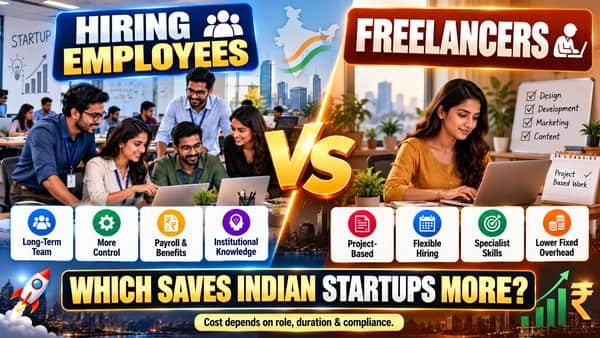
How Does Hiring a Full-Time Employee Work?
An employee becomes part of the startup’s regular workforce and normally works according to an employment arrangement defining responsibilities, compensation, working conditions and other applicable terms.
The cost to the startup can extend beyond basic salary.
Depending on the organisation and applicable laws or policies, employee-related expenses may include:
- Salary
- Employer-side statutory contributions
- Gratuity-related obligations where applicable
- Paid leave
- Insurance or employee benefits
- Bonuses or incentives
- Laptop and equipment
- Software subscriptions
- Office space
- Recruitment expenses
- Training
- HR and payroll administration
This is why a ₹50,000 monthly salary does not necessarily mean the employee costs the company exactly ₹6 lakh per year.
How Does Hiring a Freelancer Work?
A freelancer is generally an independent professional engaged to provide specified services rather than becoming part of the regular employee workforce.
Payment structures can include:
- Hourly rates
- Daily rates
- Fixed project fees
- Monthly retainers
- Milestone-based payments
For example, a startup needing a new website could hire a freelance developer for the project rather than employing a developer throughout the year.
Once the project is complete, the engagement may end or continue only when additional work is required.
This flexibility can be extremely useful during the early stages of a startup.
Employees Vs Freelancers: Key Differences
The right option depends on the nature and frequency of the work.
| Factor | Full-Time Employees | Freelancers |
|---|---|---|
| Cost structure | Regular salary + associated costs | Project/hour/retainer based |
| Commitment | Long-term | Flexible |
| Availability | Generally consistent | Depends on freelancer’s schedule |
| Training investment | Usually higher | Often hired for existing expertise |
| Business knowledge | Develops deeply over time | May remain project-specific |
| Scaling team down | More complex | Generally easier after contract/project |
| Best for | Continuous core functions | Specialist or fluctuating work |
| Management | Ongoing people management | Deliverable/project management |
| Equipment | Often provided by company | Frequently self-managed |
| Knowledge retention | Usually stronger | Requires documentation and handover |
Why Freelancers Can Save Money in the Early Stage
The main financial advantage of freelancers is variable cost.
Imagine a startup requires graphic design for approximately 30 hours in one month but only five hours the next month.
A full-time designer must still receive regular compensation even when design requirements are low.
With a freelancer, the startup can potentially purchase only the capacity it requires.
This makes freelancers useful for activities such as:
- Logo and branding projects
- Website development
- Video editing
- Copywriting
- Legal drafting or specialist consultation
- Photography
- SEO projects
- Performance marketing
- UI/UX design
- Short-term technical work
Instead of building every capability internally, founders can access specialised skills when required.
When Freelancers Can Become More Expensive
Freelancers are not automatically the cheaper option.
Experienced specialists may charge significantly higher hourly or daily rates than the equivalent cost of an employee.
Suppose a startup requires a developer for approximately 160 hours every month. Paying premium freelance rates for that amount of recurring work may eventually cost more than employing someone full-time.
The business may also incur hidden costs through:
- Repeated onboarding
- Searching for available freelancers
- Coordination
- Revision cycles
- Knowledge transfer
- Delays
- Inconsistent working styles
When a role becomes predictable and consistently busy, an employee can provide better economic value even if the initial fixed commitment is higher.
Availability Is an Important Hidden Cost
A freelancer may work with several clients simultaneously.
This can create a problem when the startup suddenly needs urgent work.
For example, imagine an e-commerce startup experiences a serious website issue during a major sale. Its freelance developer may already be committed to another client’s project.
A full-time technical employee is more likely to be available as part of their normal responsibilities.
This availability has financial value even though it does not appear directly in a salary comparison.
For business-critical roles, reliability can matter more than obtaining the lowest hourly cost.
Employees Build Institutional Knowledge
Over time, employees learn how the company operates.
They understand:
- Customers
- Internal systems
- Products
- Previous decisions
- Brand voice
- Team members
- Processes
- Long-term objectives
This accumulated knowledge can improve decision-making and reduce the need to explain the same context repeatedly.
Freelancers can also build strong long-term relationships with a startup, particularly under retainer arrangements, but project-based freelancers may leave after completing their assignment.
Without proper documentation, important knowledge can disappear with them.
Freelancers Can Provide Skills a Startup Cannot Yet Hire Full-Time
A small startup may need several senior-level skills but cannot afford full-time specialists in every area.
For example, it might need:
- A developer for 40 hours
- A designer for 20 hours
- An SEO specialist for 15 hours
- A financial consultant for a few hours
Hiring four employees could be unnecessary.
Using specialised freelancers allows the startup to create a flexible talent network and access experienced professionals without maintaining four permanent positions.
This can be especially useful while the business is still experimenting with its product and market.
Be Careful About Worker Classification
Startups should not assume that calling someone a “freelancer” automatically makes the relationship an independent contractor arrangement.
The actual working relationship matters.
If an individual effectively works like an employee under the level of control, integration and conditions associated with employment, merely using a freelance contract or invoice may not necessarily eliminate employment-related considerations.
Startups should maintain clear written agreements covering matters such as:
- Scope of work
- Deliverables
- Fees
- Payment schedule
- Confidentiality
- Intellectual property
- Termination
- Data access
- Dispute terms
For important engagements, appropriate professional advice can help structure the relationship correctly.
Intellectual Property Needs Special Attention
This issue is particularly important when freelancers create:
- Software
- Designs
- Logos
- Photographs
- Videos
- Marketing material
- Written content
A startup should not simply assume that paying an invoice automatically resolves every intellectual-property question.
The contract should clearly address ownership or permitted use of work created during the engagement.
This becomes particularly important when the startup later raises investment, sells the business or undergoes due diligence. Investors may want evidence that the company has appropriate rights over its technology, branding and other important assets.
A Hybrid Team Often Makes More Sense
Startups do not necessarily need to choose an all-employee or all-freelancer model.
A practical approach is to maintain a small core team and use freelancers for specialised or fluctuating work.
For example:
Employees: product manager, core developer, operations executive and salesperson.
Freelancers: video editor, specialist designer, photographer and occasional technical consultant.
This keeps strategically important knowledge inside the company while allowing variable costs for work that does not require full-time capacity.
As the startup grows, frequently used freelance roles can gradually move in-house.
Which Saves Indian Startups More?
For an early-stage startup with uncertain workloads, freelancers can often save more because they convert some fixed staffing costs into variable expenses.
However, once a role becomes continuous, predictable and central to daily operations, a full-time employee may provide better value.
Founders can use a simple test:
How many hours of this skill do we genuinely need every month, and how damaging would it be if that person were unavailable tomorrow?
If the requirement is occasional and specialised, freelancing can be efficient.
If the person is needed almost every working day and holds important business knowledge, hiring an employee may be the more sustainable choice.
FAQs
Q1. Are freelancers always cheaper than full-time employees?
A. No. Freelancers can be cheaper for occasional or project-based work, but skilled freelancers may charge high hourly rates. If the startup requires the same person’s services continuously, a full-time employee may eventually provide better value.
Q2. Which startup roles are suitable for freelancers?
A. Project-based and specialist roles such as design, writing, photography, video production, certain development projects and specialist consulting can work well on a freelance basis. Core roles requiring continuous availability may be better suited to employees.
Q3. Can a startup hire both employees and freelancers?
A. Yes. A hybrid model can be highly practical. The startup can maintain employees for essential ongoing functions while using freelancers for specialised, temporary or fluctuating requirements.
Q4. What should an Indian startup include in a freelancer agreement?
A. The agreement should clearly address scope, deliverables, fees, payment terms, timelines, confidentiality, intellectual-property rights, termination and other relevant responsibilities. The arrangement should also reflect the actual nature of the working relationship rather than relying only on the “freelancer” label.