
When someone needs ₹20,000, ₹50,000 or ₹1 lakh urgently, an instant loan app can appear far more convenient than approaching a bank. The application may take only a few minutes, documentation can be digital, and eligible borrowers may receive a decision quickly. That convenience, however, can make borrowers focus on how fast the money arrives rather than how much the loan actually costs.
Bank personal loans usually involve more structured eligibility checks and may not be suitable for every borrower. But eligible customers can often access longer repayment periods and competitive pricing. Digital lending apps, meanwhile, vary enormously: some facilitate loans from regulated banks or NBFCs, while borrowers should be cautious about unregulated or misleading operators.
The right comparison is therefore not simply app versus bank. Borrowers should identify the actual lender and compare the annualised cost, processing charges, taxes, late-payment consequences and total repayment.
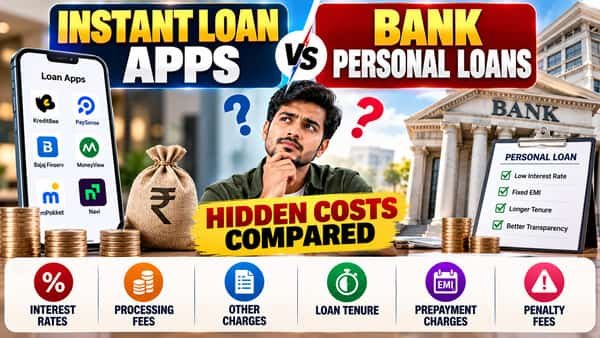
How Do Instant Loan Apps Work?
An instant loan app generally provides a digital interface through which users can apply for credit.
Importantly, the app visible on the phone may not itself be the entity lending the money. It may operate as a digital lending platform or lending service provider working with a regulated lender.
Before borrowing, consumers should identify the actual regulated entity behind the loan.
Digital applications commonly involve:
- Mobile-based application
- PAN and identity verification
- Digital KYC
- Bank-account information
- Credit assessment
- Electronic loan documents
- Digital disbursal and repayment
The major attraction is speed and convenience, particularly for relatively small short-term requirements.
How Do Bank Personal Loans Work?
A bank personal loan is generally an unsecured loan provided based on factors such as income, employment, existing debt and credit profile.
Because it is unsecured, the borrower normally does not pledge property or another asset as collateral.
Banks may offer personal loans through branches as well as fully digital channels. Existing customers with strong banking relationships may even receive pre-approved offers.
Repayment is usually made through fixed EMIs over an agreed tenure.
Instant Loan Apps Vs Bank Personal Loans
| Factor | Instant Loan Apps | Bank Personal Loans |
|---|---|---|
| Application | Usually digital | Digital and/or branch-based |
| Speed | Can be very fast | Varies; can also be quick for eligible customers |
| Typical use | Often small, urgent borrowing | Small to relatively larger personal needs |
| Interest/pricing | Varies significantly | Often competitive for eligible borrowers |
| Repayment tenure | Can be shorter | Often wider tenure choices |
| Processing charges | Need careful checking | Usually disclosed in loan terms |
| Actual lender | May be bank/NBFC behind the app | Bank itself |
| Convenience | Very high | Increasingly high |
| Best suited for | Genuine short-term need after cost checks | Borrowers qualifying for suitable bank terms |
The exact offer matters more than the channel through which it is obtained.
Hidden Cost 1: Processing Fees
Processing fees are among the first charges borrowers should examine.
Suppose you apply for a ₹50,000 loan and a processing charge is deducted before disbursal.
You may owe repayment based on the sanctioned loan terms even though the amount actually credited to your bank account is lower than ₹50,000.
This difference becomes particularly important for small, short-tenure loans.
A charge of a few thousand rupees may look small in absolute terms, but relative to a ₹20,000 or ₹30,000 loan repaid over only a few months, it can materially increase the effective borrowing cost.
Always check both:
Loan amount sanctioned and net amount actually disbursed.
Hidden Cost 2: Looking Only at the Advertised Interest Rate
A low-looking interest figure does not tell the entire story.
Borrowers need to understand:
- Whether the quoted rate is annualised
- Whether it is calculated on a reducing balance
- Applicable processing fees
- Other permitted charges
- Repayment tenure
- Total amount payable
A short-duration loan can look inexpensive because the total rupee interest appears small.
For example, paying ₹2,000 or ₹3,000 in combined borrowing costs may not initially seem significant. But if the amount borrowed is small and the repayment period is only a few months, the annualised cost can be substantial.
This is why borrowers should pay close attention to the Annual Percentage Rate (APR) disclosed for the loan.
Hidden Cost 3: GST on Applicable Fees
Another amount borrowers may overlook is GST on applicable lender or service charges.
For example, if a processing fee is charged, applicable GST can increase the amount deducted or payable.
Borrowers sometimes calculate their cost using only:
Principal + stated interest
when the actual cash outflow can also involve applicable fees and taxes.
Review the complete cost disclosure rather than estimating the loan from an advertisement.
Hidden Cost 4: Late-Payment and Penal Charges
An affordable loan can become considerably more expensive when repayments are missed.
Depending on the loan agreement and applicable rules, consequences can include:
- Penal charges
- Payment-return or bounce-related charges
- Additional collection activity
- Credit-reporting consequences
A missed payment can therefore create both an immediate cost and a longer-term borrowing problem.
This risk can be greater when borrowers take several small loans from different apps and lose track of repayment dates.
Borrowing from five different platforms does not create five independent budgets. All repayments ultimately come from the same monthly income.
Hidden Cost 5: Short Repayment Tenure
Short tenure is not technically a hidden fee, but it can create a hidden cash-flow cost.
Suppose two lenders offer the same amount.
One allows repayment over 24 months.
The other requires repayment over six months.
Even if the shorter loan looks manageable when approved, its monthly repayment can consume a much larger portion of the borrower’s salary.
That increases the risk of needing another loan to repay the first one.
This is how small digital loans can potentially turn into a borrowing cycle.
A loan should be judged not only by whether you can obtain it today, but also by whether your future monthly income can comfortably repay it.
Are Bank Personal Loans Always Cheaper?
No.
Banks do not automatically provide the cheapest loan to every customer.
A borrower with a weak credit profile or unstable income may receive:
- A higher interest rate
- A smaller approved amount
- Less favourable terms
- Or no approval
At the same time, a strong borrower may receive a highly competitive digital loan offer from a regulated NBFC.
Therefore, the comparison should be made between actual offers.
For the same loan amount, compare:
- APR
- EMI
- Net disbursal
- Total interest
- Processing charges
- Other applicable charges
- Tenure
- Total repayment
The lender offering the smallest EMI is not automatically the cheapest if the tenure is substantially longer.
Check Who Is Actually Lending the Money
This is particularly important when using a loan app.
A professional-looking mobile application does not by itself prove that the loan is being provided through a legitimate regulated lending arrangement.
Before accepting an offer, check the identity of the bank or NBFC actually providing the credit and carefully review the loan documentation.
Borrowers should be cautious when an app:
- Does not clearly identify the lender
- Provides unclear cost information
- Makes unrealistic promises
- Requests unnecessary permissions
- Uses suspicious repayment methods
- Pressures the borrower into immediate acceptance
Speed should never replace basic verification.
Read the Key Fact Statement Before Accepting
Borrowers should review the Key Fact Statement (KFS) or equivalent mandatory loan disclosures applicable to the product before accepting a digital or personal loan.
Important information can include:
- Loan amount
- Interest rate
- APR
- Repayment schedule
- Processing charges
- Other applicable charges
- Penal charges
- Loan tenure
The APR is particularly useful because it is designed to provide a more complete annualised representation of borrowing cost than looking at the headline interest rate alone.
A borrower who compares only advertisements can miss expenses that become obvious in the formal loan disclosure.
Prepayment Can Also Have Conditions
A borrower may expect to take a three-year personal loan and repay it after one year when a bonus arrives.
Before relying on that plan, check the lender’s prepayment and foreclosure conditions.
Depending on the product, there may be:
- A minimum period before foreclosure
- Part-payment restrictions
- Applicable foreclosure or prepayment charges
- Specific procedures for closing the loan
Some products may offer more favourable prepayment conditions than others.
If early repayment is likely, these terms should be compared before borrowing rather than after the money has been disbursed.
Convenience Can Encourage Unnecessary Borrowing
Perhaps the most overlooked cost of instant credit is behavioural.
When obtaining ₹10,000 or ₹20,000 takes only a few taps, borrowing can begin to feel similar to spending money already available in the bank.
It is not.
Every instant loan represents future income that has already been committed.
Using short-term loans repeatedly for:
- Shopping
- Entertainment
- Holidays
- Gadgets
- Regular household deficits
can gradually create multiple repayment obligations.
Instant credit is most useful when speed solves a genuine temporary funding problem and there is a clear repayment source.
Which Option Should Borrowers Choose?
For borrowers who qualify for both options, a bank personal loan may often be worth checking first for a planned borrowing requirement, particularly when a larger amount or longer repayment tenure is required.
A loan obtained through an app can still be appropriate when the underlying lender is regulated, the costs are transparent and the offer is competitive.
The safest comparison is:
How much money will reach my bank account, and exactly how much money will I pay back in total?
If two offers provide ₹1 lakh but one ultimately costs substantially more after interest and charges, faster approval alone may not justify the difference.
FAQs
Q1. Are instant loan apps more expensive than bank personal loans?
A. They can be, particularly for small, short-duration loans with significant fees, but not every app-based loan is expensive. Compare the APR, net disbursal, charges and total repayment of the actual offers rather than assuming one channel is always cheaper.
Q2. How can I check whether a loan app is legitimate?
A. Identify the bank or NBFC actually providing the loan and verify that the regulated lender is clearly disclosed in the loan documentation. Avoid platforms that hide the lender’s identity, provide unclear charges or use suspicious collection and payment practices.
Q3. What is the most important cost to check before taking an instant loan?
A. APR is an important comparison measure because it provides an annualised view of the borrowing cost using applicable components prescribed for the disclosure. Borrowers should also check the net amount disbursed and total amount repayable.
Q4. Can taking several instant loans affect my credit profile?
A. Yes. Multiple credit applications and outstanding loans can affect how lenders assess your overall indebtedness and repayment capacity. Missed or delayed payments reported to credit bureaus can also damage your credit history and make future borrowing more difficult or expensive.


