In everyday life, people enter into agreements for buying property, lending money, providing services, starting businesses, or even making personal promises. However, not every promise becomes a legally enforceable contract. One of the most fundamental principles of contract law is that a valid contract must generally be supported by consideration—something of value exchanged between the parties. This principle is clearly reflected in Section 25 of the Indian Contract Act, 1872, which states that an agreement made without consideration is generally void, subject to certain important exceptions.
Section 25 is one of the most frequently studied provisions of the Indian Contract Act because it explains when a promise without consideration may still be legally enforceable. Whether you are a law student, judiciary aspirant, business owner, or someone interested in understanding contracts, knowing this section helps you distinguish between a simple promise and a legally binding agreement.
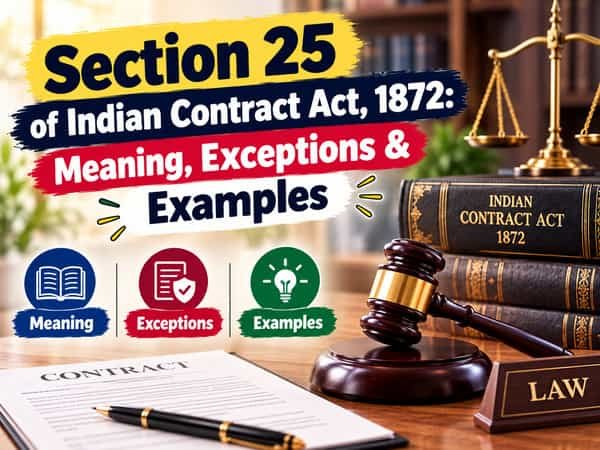
Section 25 of the Indian Contract Act, 1872: Overview
| Particular | Details |
|---|---|
| Act | Indian Contract Act, 1872 |
| Section | Section 25 |
| Subject | Agreements without consideration |
| General Rule | Agreements without consideration are void |
| Main Exceptions | Natural love and affection, past voluntary services, and promise to pay a time-barred debt |
| Applies To | Contracts and agreements governed by the Indian Contract Act |
| Importance | Explains when an agreement without consideration can still be legally enforceable |
What is Section 25 of the Indian Contract Act?
Section 25 lays down the general rule that an agreement made without consideration is void, unless it falls within one of the statutory exceptions mentioned in the section.
Consideration is one of the essential elements of a valid contract. It refers to something of value exchanged between the parties. If there is no consideration, the law generally does not treat the agreement as enforceable.
However, recognizing that some promises deserve legal protection even without consideration, Section 25 provides certain well-defined exceptions.
Why is Section 25 Important?
Section 25 protects the integrity of contract law while also recognizing genuine situations where fairness requires enforcement of a promise.
Its objectives include:
- Ensuring contracts involve mutual obligations.
- Preventing frivolous or casual promises from becoming legal disputes.
- Protecting genuine family arrangements.
- Recognizing voluntary acts deserving compensation.
- Allowing recovery of certain legally enforceable debts.
- Providing certainty in commercial transactions.
It balances contractual freedom with legal certainty.
General Rule Under Section 25
The basic principle is straightforward:
An agreement without consideration is void unless it falls within the exceptions provided under Section 25.
For example, if a person simply promises to give another person a valuable gift in the future without receiving anything in return, that promise generally cannot be enforced in a court of law unless it satisfies one of the statutory exceptions.
Exceptions Under Section 25
Section 25 contains three major exceptions where an agreement without consideration may still be valid.
1. Agreement Made Out of Natural Love and Affection
An agreement is valid even without consideration if it satisfies all of the following conditions:
- It is made out of natural love and affection.
- It is between parties standing in a near relationship.
- It is made voluntarily.
- It is expressed in writing.
- It is registered wherever registration is required by law.
Example
A father voluntarily executes and registers a written document promising to transfer certain property to his daughter out of natural love and affection. Subject to compliance with legal requirements, such an agreement may be enforceable even without consideration.
2. Promise to Compensate for Past Voluntary Services
A promise is valid if it is made to compensate a person who has voluntarily done something for the promisor or performed an act that the promisor was legally bound to do.
Example
Suppose a person voluntarily saves another person’s valuable property from destruction. Later, the owner promises to pay compensation for that voluntary service. Such a promise may be legally enforceable under Section 25.
3. Promise to Pay a Time-Barred Debt
A written and signed promise to pay a debt that has become time-barred under the law of limitation may still be enforceable.
For this exception to apply:
- The debt must be legally recoverable but barred by limitation.
- The promise must be in writing.
- It must be signed by the person making the promise or by an authorized representative.
This exception allows a debtor to voluntarily revive the obligation to pay an otherwise time-barred debt.
Meaning of Consideration
Although Section 25 focuses on agreements without consideration, understanding the concept of consideration is equally important.
Consideration generally means:
- Payment of money.
- Supply of goods.
- Rendering of services.
- Performing or refraining from an act.
- Any lawful benefit or detriment recognized under contract law.
In most contracts, consideration forms the foundation of the agreement.
Difference Between a Gift and a Contract
Many people confuse a gift with a contract.
| Gift | Contract |
|---|---|
| Usually made voluntarily without consideration | Generally requires consideration |
| Governed by property laws where applicable | Governed by contract law |
| May require registration depending on the property involved | Must satisfy essential elements of a valid contract |
Section 25 helps distinguish between these legal concepts.
Landmark Judicial Principles
Indian courts have interpreted Section 25 in several important decisions.
The judiciary has consistently held that:
- Consideration remains an essential element of a valid contract.
- The exceptions under Section 25 must be interpreted carefully.
- Every condition prescribed for an exception should be satisfied before an agreement without consideration can be enforced.
These principles help maintain consistency in contract law.
Practical Importance of Section 25
Section 25 is highly relevant in everyday legal and commercial transactions.
It is important in matters relating to:
- Family settlements.
- Property arrangements.
- Business promises.
- Compensation for voluntary services.
- Recovery of time-barred debts.
- Contract drafting.
Understanding this provision helps individuals avoid making assumptions about the enforceability of informal promises.
Practical Tips Before Entering Into Agreements
To avoid future disputes:
- Put important agreements in writing.
- Ensure lawful consideration exists wherever required.
- Verify whether registration is legally necessary.
- Preserve supporting documents.
- Seek legal advice before executing significant contracts.
- Clearly understand your rights and obligations.
Proper documentation often prevents unnecessary litigation.
Frequently Asked Questions (FAQs)
Q1. What does Section 25 of the Indian Contract Act state?
A. Section 25 provides that an agreement made without consideration is generally void unless it falls within one of the exceptions specifically mentioned in the Act.
Q2. What are the main exceptions under Section 25?
A. The three principal exceptions relate to agreements made out of natural love and affection, promises to compensate for past voluntary services, and written promises to pay time-barred debts.
Q3. Can every promise without consideration be enforced?
A. No. Only those promises that satisfy the conditions laid down under Section 25 are legally enforceable despite the absence of consideration.
Q4. Why is consideration important in a contract?
A. Consideration is one of the essential elements of a valid contract because it represents the exchange of value between the parties and helps distinguish legally enforceable agreements from mere promises.
Disclaimer: This article is intended for general informational and educational purposes only. It provides a simplified overview of Section 25 of the Indian Contract Act, 1872 and should not be considered legal advice. The enforceability of any agreement depends on its specific facts, applicable statutory provisions, judicial interpretations, and related laws. If you require advice regarding a contract or any legal dispute, consult a qualified legal professional.