
A trader buying products in Surat and selling them in Bengaluru faces a very different set of risks from a business importing components from China or exporting Indian products to Europe. Both models can generate attractive margins, but the number of variables outside the entrepreneur’s control is much greater once a transaction crosses national borders.
For a new Indian entrepreneur, domestic trading is generally easier to understand and carries fewer layers of operational risk. Payments are in rupees, transportation is within one country, and businesses operate primarily within the Indian commercial and regulatory environment. Import-export trading can open much larger markets and sometimes better margins, but it introduces foreign exchange, customs, international logistics, geopolitical and country-specific compliance risks.
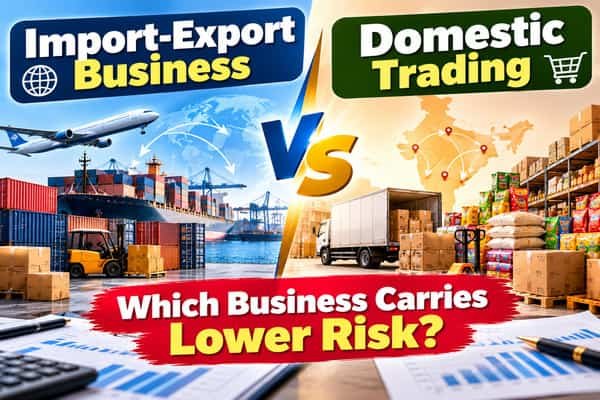
That does not make international trade a bad business. It simply means higher potential opportunity must be supported by stronger systems and risk management.
How Domestic Trading Works
A domestic trader purchases products from manufacturers, wholesalers or distributors within India and resells them to customers elsewhere in the country.
The business may operate as:
- A wholesaler
- Distributor
- B2B supplier
- Retail trader
- Online seller
- Regional stockist
- Institutional supplier
Because both buyer and seller are within India, transactions are generally conducted in Indian rupees and governed by the applicable Indian tax, commercial and regulatory framework.
The supply chain can still be complex, but international borders are not involved.
How Import-Export Trading Is Different
International trading involves buying from or selling to businesses outside India.
An importer might source electronics, machinery, components or raw materials from another country and sell them in India.
An exporter could sell Indian products such as:
- Textiles
- Engineering goods
- Handicrafts
- Food products
- Chemicals
- Auto components
- Leather products
- Agricultural products
International trading can expose a business to customers and suppliers across much larger markets.
But every additional country can introduce another layer of regulations, documentation, currency and logistics.
Import-Export Vs Domestic Trading: Risk Comparison
| Risk Factor | Domestic Trading | Import-Export Trading |
|---|---|---|
| Currency risk | Low for INR transactions | Can be significant |
| Logistics complexity | Moderate | Higher |
| Customs procedures | Not applicable to ordinary domestic movement | Important |
| International freight | Not required | Required |
| Geopolitical exposure | Lower | Higher |
| Payment recovery | Comparatively simpler | Can be difficult across jurisdictions |
| Documentation | Comparatively simpler | More extensive |
| Market size | Primarily India | Global |
| Delivery timelines | Generally shorter | Often longer |
| Working-capital requirement | Can be lower | Often higher |
| Beginner suitability | Generally easier | Requires greater trade knowledge |
Actual risk still depends heavily on the product, customer, supplier and business model.
Currency Risk Is a Major Difference
Domestic traders normally buy and sell in rupees.
International traders may deal in currencies such as the US dollar, euro, pound or other currencies.
Consider an Indian importer who places a $50,000 order when the exchange rate is favourable but makes payment several weeks later.
If the rupee weakens before payment, the same $50,000 invoice can cost significantly more in rupee terms.
The importer may not be able to increase the selling price immediately, so the exchange-rate movement can reduce or eliminate the expected profit margin.
Exporters face their own currency exposure.
Businesses engaged in significant international transactions may therefore need appropriate foreign-exchange risk-management practices.
International Logistics Creates More Uncertainty
A domestic shipment may travel by road, rail or domestic air cargo.
International shipments can involve several stages:
Supplier → inland transport → origin port → customs → international shipping → destination customs → local transport → buyer
Problems at any stage can cause delays.
International traders may encounter:
- Port congestion
- Shipping delays
- Container shortages
- Freight-rate changes
- Customs examination
- Documentation errors
- Cargo damage
- Route disruptions
A shipment expected in four weeks may take considerably longer if disruption occurs.
That uncertainty can increase the amount of working capital tied up in inventory.
Customs and Product Compliance Add Another Risk Layer
Importers and exporters cannot assume that a product legally sold in one country can automatically enter another market without additional requirements.
Depending on the goods, businesses may need to deal with:
- Customs classification
- Import duties
- Product standards
- Labelling requirements
- Testing or certification
- Restricted or prohibited goods rules
- Country-specific import requirements
- Export documentation
Indian businesses entering international trade may also require an Importer Exporter Code (IEC) where applicable and other registrations, licences or approvals depending on the product and transaction.
Incorrect product classification or documentation can lead to delays, unexpected costs or regulatory difficulties.
Domestic Trading Has Risks Too
Domestic trading should not be mistaken for a low-risk business by default.
A trader can still lose money because of:
- Customers not paying
- Excess inventory
- Supplier failure
- Price competition
- Product damage
- Fraud
- GST or documentation errors
- Poor demand forecasting
- Thin margins
For example, a domestic electronics distributor purchasing ₹20 lakh of inventory before a major price reduction can suffer a significant loss without any international exposure.
The advantage is not that domestic trading is risk-free. It is that there are generally fewer categories of risk to manage simultaneously.
Payment Risk Can Be Harder Internationally
Credit sales always involve collection risk.
Within India, a supplier may have easier access to customer information, local references and domestic legal mechanisms.
Recovering money from an overseas customer can be more complicated.
Differences in:
- Jurisdiction
- Contract law
- Banking systems
- Language
- Commercial practices
can make disputes more difficult and expensive.
International traders therefore need to think carefully about payment structures.
Depending on the transaction, mechanisms such as advance payments, letters of credit or other trade-finance arrangements may help manage risk.
The safest structure varies according to the buyer, country and commercial relationship.
Import-Export Can Require More Working Capital
Imagine a domestic trader purchasing inventory that arrives within five days and is sold within another 20 days.
The capital cycle could be relatively short.
Now consider an importer who:
- Places an overseas order.
- Pays a deposit.
- Waits for production.
- Waits for international shipping.
- Completes customs clearance.
- Stores the goods.
- Sells them to Indian customers.
- Waits for customer payment.
Money may remain tied up for months.
Even a profitable transaction can create cash-flow pressure if the operating cycle is too long.
This is why working-capital planning is particularly important in international trade.
International Trading Offers Greater Market Diversification
Higher risk can come with meaningful advantages.
An Indian manufacturer or trader limited to domestic customers depends heavily on Indian demand.
Exporting can provide access to multiple markets.
If demand slows in one country, opportunities may exist elsewhere.
Similarly, importing can allow an Indian business to source products, technology or components that are unavailable domestically or are commercially attractive when sourced internationally.
The wider opportunity set can justify the additional complexity for businesses with appropriate expertise.
Geopolitical Risk Cannot Be Ignored
International traders are exposed to events that an ordinary domestic trader may rarely need to consider.
These can include:
- Wars and conflicts
- International sanctions
- Trade restrictions
- Tariff changes
- Shipping-route disruption
- Political instability
- Sudden regulatory changes
A business may have a profitable product and reliable customer but still experience losses because a trade route becomes expensive or a country’s rules suddenly change.
Diversifying suppliers, buyers and shipping routes can reduce dependence on a single country.
Which Is Better for a Beginner?
For someone entering trading for the first time, domestic business can provide a simpler environment in which to learn:
- Supplier negotiation
- Inventory management
- Pricing
- Customer acquisition
- Credit control
- Logistics
- Cash-flow management
Once these fundamentals are working, the business can explore international opportunities.
However, someone with existing industry experience, reliable overseas relationships and strong product knowledge may be capable of entering import-export directly.
Experience matters more than simply choosing the market with the highest apparent margin.
Which Business Carries Lower Risk?
For most new Indian entrepreneurs, domestic trading generally carries lower operational complexity and fewer external risks than import-export trading.
It removes or substantially reduces several issues associated specifically with cross-border transactions, including foreign-exchange movements, customs clearance, international freight and foreign-jurisdiction payment recovery.
Import-export trading can nevertheless offer greater market reach, sourcing opportunities and potential margins.
A useful way to decide is to ask:
Is the additional expected profit from international trading large enough to compensate for the additional currency, logistics, compliance and working-capital risk?
If the advantage is small, domestic sourcing or selling may be the more sensible business model. If the international opportunity is substantial and the business has systems to manage the additional risks, import-export can become a powerful route for expansion.
FAQs
Q1. Is import-export business riskier than domestic trading?
A. Generally, international trade involves additional risks such as currency fluctuations, customs procedures, international shipping and foreign-country regulations. However, actual risk depends on the product, countries involved, payment structure and experience of the business.
Q2. Does every Indian import-export business need an IEC?
A. An Importer Exporter Code is generally required for importing or exporting goods in India, subject to applicable rules and exemptions. Certain products or activities can also require additional licences, registrations or approvals.
Q3. How can an exporter reduce the risk of an overseas buyer not paying?
A. Businesses can conduct buyer due diligence, use appropriate contracts, negotiate advance or secured payment arrangements and consider suitable trade-finance or credit-risk mechanisms. The appropriate method depends on the buyer, country and transaction value.
Q4. Should a new entrepreneur start with domestic trading before exporting?
A. It can be a practical approach because domestic trading allows the entrepreneur to learn sourcing, pricing, inventory, logistics and credit management with fewer cross-border complications. Once the business model is proven, international markets can be added gradually where commercially attractive.