Education is one of the strongest foundations for personal growth and national development. It empowers children with knowledge, skills, confidence, and opportunities to build a better future. However, for many years, access to quality education was not guaranteed as a constitutional right in India. To ensure that every child receives basic education regardless of economic or social background, the Constitution was amended to introduce Article 21A, making education a Fundamental Right.
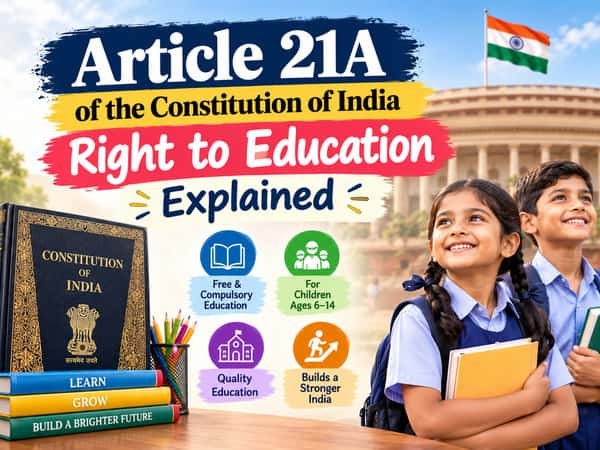
Article 21A is one of the most significant constitutional provisions relating to children’s welfare. It guarantees free and compulsory education to children between the ages of 6 and 14 years in the manner determined by law. This provision led to the enactment of the Right of Children to Free and Compulsory Education (RTE) Act, 2009, which provides the legal framework for implementing this constitutional guarantee. Understanding Article 21A is important for parents, students, teachers, school administrators, policymakers, and every citizen because it reflects India’s commitment to providing equal educational opportunities.
Article 21A of the Constitution of India: Overview
| Particular | Details |
|---|---|
| Article | Article 21A |
| Part of Constitution | Part III – Fundamental Rights |
| Inserted By | 86th Constitutional Amendment Act, 2002 |
| Came Into Force | 1 April 2010 (through the RTE Act, 2009) |
| Objective | Guarantee free and compulsory education to children |
| Age Group Covered | Children aged 6 to 14 years |
| Related Law | Right of Children to Free and Compulsory Education (RTE) Act, 2009 |
| Importance | Recognizes education as a Fundamental Right |
What is Article 21A of the Constitution?
Article 21A provides that the State shall provide free and compulsory education to all children between the ages of 6 and 14 years in such manner as the law may determine.
This provision transformed elementary education from a policy objective into a Fundamental Right enforceable under the Constitution. It reflects the principle that education is essential for the exercise of other rights and for the overall development of individuals and society.
Why Was Article 21A Introduced?
Before Article 21A was inserted, education was primarily treated as a Directive Principle of State Policy under Article 45. Although governments made efforts to expand educational access, there was no enforceable constitutional right guaranteeing free education.
The 86th Constitutional Amendment introduced Article 21A to:
- Make elementary education a Fundamental Right.
- Increase school enrollment.
- Reduce child labour.
- Promote literacy.
- Ensure equal educational opportunities.
- Improve social and economic development.
- Strengthen children’s rights.
The amendment marked a major step towards universal elementary education in India.
Key Features of Article 21A
1. Free Education
Article 21A guarantees that eligible children should receive education without paying tuition fees or other charges that could prevent them from completing elementary education in schools covered under the applicable law.
The objective is to ensure that financial constraints do not become a barrier to education.
2. Compulsory Education
The Constitution places responsibility on the State to ensure that every child within the specified age group has access to elementary education.
Compulsory education means the State must make suitable arrangements so that eligible children can attend school.
3. Age Group Covered
Article 21A applies to children aged 6 to 14 years.
The constitutional guarantee specifically covers elementary education for this age group as provided by law.
86th Constitutional Amendment Act, 2002
Article 21A was introduced through the 86th Constitutional Amendment Act, 2002.
The amendment also made two other important changes:
- Modified Article 45 to focus on early childhood care and education for children below six years of age.
- Inserted Article 51A(k), making it a Fundamental Duty of parents or guardians to provide educational opportunities to children between the ages of 6 and 14 years.
These provisions together strengthened India’s constitutional commitment to education.
Relationship Between Article 21A and the RTE Act, 2009
The Right of Children to Free and Compulsory Education (RTE) Act, 2009 was enacted to implement Article 21A.
The Act lays down detailed provisions relating to:
- Free and compulsory education.
- Admission of children.
- School infrastructure.
- Teacher qualifications.
- Student rights.
- Responsibilities of governments and schools.
The RTE Act came into force on 1 April 2010, making Article 21A operational in practice.
Rights of Children Under Article 21A
Article 21A and the RTE Act together aim to ensure that eligible children receive quality elementary education.
Some of the important protections include:
- Access to free education.
- Equal opportunity to attend school.
- Non-discriminatory admission procedures.
- Child-friendly learning environment.
- Qualified teachers in accordance with prescribed standards.
- Basic educational facilities as required under applicable laws.
These measures seek to improve both access and quality in elementary education.
Responsibilities of the Government
The State has an important role in implementing Article 21A.
Its responsibilities include:
- Establishing and maintaining schools.
- Improving educational infrastructure.
- Recruiting qualified teachers.
- Ensuring access to education.
- Promoting inclusive education.
- Monitoring compliance with education laws.
These efforts help strengthen India’s education system and improve learning outcomes.
Importance of Article 21A
Article 21A has transformed India’s approach to education.
Its significance includes:
- Recognizing education as a Fundamental Right.
- Promoting universal elementary education.
- Reducing educational inequality.
- Encouraging school enrollment.
- Supporting social justice.
- Empowering future generations.
- Contributing to national development.
Education not only benefits individual children but also strengthens society by improving literacy, employment opportunities, and civic awareness.
Practical Significance for Parents and Students
Parents and guardians should be aware of the constitutional right to education available to eligible children.
Some practical points include:
- Ensure timely school admission.
- Encourage regular attendance.
- Maintain school records.
- Support children’s learning at home.
- Contact the appropriate education authorities if eligible children are denied admission or face unlawful discrimination.
Awareness of educational rights helps families secure better opportunities for their children.
Frequently Asked Questions (FAQs)
1. What does Article 21A of the Constitution guarantee?
A. Article 21A guarantees free and compulsory education to all children between the ages of 6 and 14 years in the manner prescribed by law.
2. Which constitutional amendment introduced Article 21A?
A. Article 21A was inserted by the 86th Constitutional Amendment Act, 2002.
3. How is Article 21A implemented in India?
A. Article 21A is implemented primarily through the Right of Children to Free and Compulsory Education (RTE) Act, 2009, which came into force on 1 April 2010.
4. Is education a Fundamental Right in India?
A. Yes. Under Article 21A, free and compulsory elementary education for children aged 6 to 14 years is a Fundamental Right.
Disclaimer: This article is intended for general informational and educational purposes only. It provides a simplified overview of Article 21A of the Constitution of India and the Right of Children to Free and Compulsory Education (RTE) Act, 2009. It should not be considered legal advice. The interpretation and implementation of constitutional provisions may change due to amendments, judicial decisions, or government notifications. For advice regarding a specific legal or educational matter, consult a qualified legal professional or the appropriate education authority.