Whether you are buying property, starting a business, filing a court case, or seeking legal advice, advocates play an essential role in protecting your legal rights. They represent clients before courts, interpret laws, draft legal documents, and help resolve disputes. However, not everyone can legally practice law in India. The legal profession is regulated by a comprehensive law known as the Advocates Act, 1961, which lays down the rules for legal education, enrollment, professional conduct, and the regulation of advocates.
The Advocates Act is one of the most important legislations governing the legal profession in India. It establishes the Bar Council of India (BCI) and State Bar Councils, provides a uniform system for the enrollment of advocates, and regulates professional ethics and disciplinary proceedings. Whether you are a law student, aspiring advocate, client, or simply interested in India’s legal system, understanding the Advocates Act is essential for knowing how the legal profession functions.
Advocates Act, 1961: Overview
| Particular | Details |
|---|---|
| Full Name | Advocates Act, 1961 |
| Enacted | 1961 |
| Objective | Regulate the legal profession and establish Bar Councils in India |
| Applicable To | Advocates, Bar Councils, and legal practitioners covered under the Act |
| Governing Bodies | Bar Council of India (BCI) and State Bar Councils |
| Covers | Enrollment, legal practice, professional ethics, disciplinary proceedings, and legal education |
| Importance | Ensures professional standards and regulates the legal profession in India |
What is the Advocates Act, 1961?
The Advocates Act, 1961 is the principal legislation regulating the legal profession in India. It provides a unified framework for the enrollment of advocates, recognition of legal qualifications, regulation of professional conduct, and the administration of Bar Councils.
Before the enactment of this law, different categories of legal practitioners existed across various regions of India. The Act introduced a single class of legal practitioners known as Advocates, thereby creating a uniform legal profession throughout the country.
Why Was the Advocates Act Introduced?
The Act was enacted to modernize and standardize the legal profession across India.
Its major objectives include:
- Regulate the legal profession.
- Establish Bar Councils.
- Promote professional ethics.
- Standardize legal education.
- Ensure discipline among advocates.
- Protect the interests of clients.
- Improve the quality of legal services.
The legislation continues to serve as the foundation of India’s legal profession.
Key Features of the Advocates Act
1. Establishment of the Bar Council of India
One of the most important features of the Act is the establishment of the Bar Council of India (BCI).
The BCI is responsible for:
- Regulating legal education.
- Prescribing standards of professional conduct.
- Recognizing law degrees for enrollment.
- Protecting the rights and interests of advocates.
- Supervising State Bar Councils.
The BCI plays a central role in maintaining the quality and integrity of the legal profession.
2. State Bar Councils
The Act also provides for the establishment of State Bar Councils.
Their functions include:
- Enrolling advocates.
- Maintaining the roll of advocates.
- Protecting advocates’ rights.
- Conducting disciplinary proceedings.
- Promoting legal aid and welfare schemes.
Every advocate generally enrolls with the appropriate State Bar Council.
3. One Class of Legal Practitioners
The Act abolished the earlier distinction among different categories of legal practitioners and introduced a single class known as Advocates.
This brought uniformity to legal practice throughout India.
Who Can Become an Advocate?
A person wishing to practice law in India must satisfy the eligibility requirements prescribed under the Advocates Act and the relevant rules.
Generally, the process includes:
- Obtaining a recognized law degree.
- Fulfilling the eligibility conditions prescribed by the Bar Council.
- Applying for enrollment with the appropriate State Bar Council.
- Successfully completing any additional requirements applicable under the prevailing legal framework, such as qualifying the All India Bar Examination (where required).
The specific requirements may change based on amendments and regulatory rules.
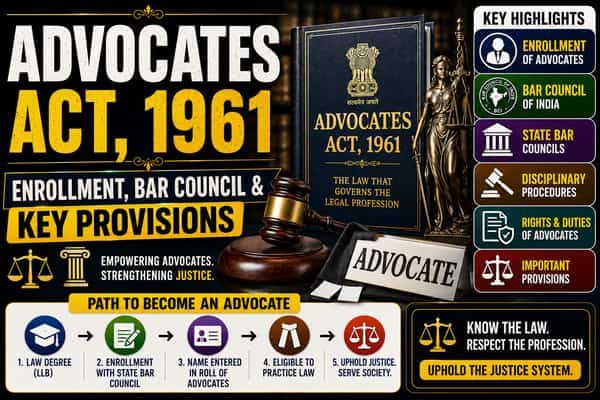
Enrollment Process
The enrollment process generally involves the following steps:
Step 1: Obtain a Law Degree
Complete an LL.B. degree from a recognized institution.
Step 2: Apply to the State Bar Council
Submit the prescribed application along with the required documents and fees.
Step 3: Verification
The State Bar Council verifies the applicant’s qualifications and eligibility.
Step 4: Enrollment
Upon approval, the applicant is enrolled as an advocate.
Step 5: Fulfil Practice Requirements
An advocate must comply with the applicable legal requirements before practicing law, including qualifying examinations where applicable.
Rights of Advocates
The Advocates Act provides several important rights to advocates.
These include:
- Right to practice law, subject to the provisions of the Act.
- Representation of clients before competent courts and tribunals where permitted.
- Membership in Bar Associations.
- Participation in professional development activities.
- Protection under professional regulations.
Advocates also enjoy professional independence while discharging their legal duties.
Duties of Advocates
The Act emphasizes ethical conduct and professional responsibility.
Advocates are expected to:
- Act honestly and fairly.
- Maintain client confidentiality.
- Avoid conflicts of interest.
- Respect court procedures.
- Uphold the dignity of the legal profession.
- Follow the rules framed by the Bar Council.
Professional ethics are fundamental to the administration of justice.
Professional Misconduct
The Advocates Act provides disciplinary mechanisms for dealing with professional misconduct.
Examples may include:
- Misuse of client funds.
- Professional negligence in appropriate circumstances.
- Breach of professional ethics.
- Conduct unbecoming of an advocate.
- Violation of Bar Council rules.
Complaints may be examined by the appropriate disciplinary authorities.
Disciplinary Proceedings
State Bar Councils have disciplinary committees that examine complaints against advocates.
Depending on the findings, disciplinary action may include:
- Warning.
- Reprimand.
- Suspension from practice.
- Removal of the advocate’s name from the roll in serious cases.
The process follows the procedure prescribed under the Act and applicable rules.
Importance of the Advocates Act
The Advocates Act plays a vital role in India’s justice system.
Its significance includes:
- Maintaining professional standards.
- Regulating legal education.
- Protecting clients’ interests.
- Promoting ethical legal practice.
- Strengthening the judicial system.
- Ensuring competent legal representation.
Without such regulation, maintaining public confidence in the legal profession would be difficult.
Practical Tips Before Hiring an Advocate
Before engaging an advocate:
- Verify enrollment with the appropriate Bar Council.
- Discuss legal fees clearly.
- Request written documentation where appropriate.
- Share complete facts honestly.
- Preserve all legal documents.
- Maintain regular communication regarding your case.
Choosing a qualified and ethical advocate helps improve legal representation.
Frequently Asked Questions (FAQs)
1. Who regulates advocates in India?
The legal profession is regulated by the Bar Council of India and the respective State Bar Councils under the Advocates Act, 1961.
2. Can every law graduate immediately start practicing in court?
A law graduate must fulfil the requirements prescribed under the Advocates Act and the applicable Bar Council rules, including enrollment and other regulatory requirements such as the All India Bar Examination where applicable.
3. What happens if an advocate commits professional misconduct?
Complaints may be examined by the disciplinary committee of the appropriate State Bar Council, which may impose disciplinary action in accordance with the law.
4. Why is the Advocates Act important?
The Act regulates the legal profession, maintains ethical standards, ensures proper legal education, protects clients’ interests, and strengthens the administration of justice in India.
Disclaimer: This article is intended for general informational and educational purposes only. It provides a simplified overview of the Advocates Act, 1961 and should not be considered legal advice. The application of the Act depends on applicable amendments, Bar Council of India rules, State Bar Council regulations, and judicial interpretation. Individuals seeking guidance on enrollment, legal practice, or professional disciplinary matters should consult the relevant Bar Council or a qualified legal professional.