Every day, millions of people across India travel by cars, motorcycles, buses, taxis, and commercial vehicles. Whether you’re commuting to work, driving on highways, or riding a two-wheeler in your city, following traffic laws is essential for your safety and the safety of others. Unfortunately, road accidents caused by speeding, drunk driving, driving without a licence, or ignoring traffic rules continue to be a major concern. To regulate road transport and promote safer roads, India enacted the Motor Vehicles Act, 1988.
The Motor Vehicles Act provides the legal framework for vehicle registration, driving licences, road safety, insurance, traffic violations, permits, and compensation for accident victims. It also empowers authorities to enforce traffic laws and impose penalties for violations. With several important amendments over the years, particularly the Motor Vehicles (Amendment) Act, 2019, the law has become stricter to improve road safety and encourage responsible driving. Understanding this Act is important for every driver, vehicle owner, passenger, transport operator, and road user.
Motor Vehicles Act, 1988: Overview
| Particular | Details |
|---|---|
| Full Name | Motor Vehicles Act, 1988 |
| Enacted | 1988 |
| Major Amendment | Motor Vehicles (Amendment) Act, 2019 |
| Objective | Regulate motor vehicles, road transport, traffic safety, and licensing |
| Applicable To | Motor vehicle owners, drivers, transport operators, and road users across India |
| Administered By | Ministry of Road Transport and Highways, State Transport Authorities, and Traffic Police |
| Covers | Driving licences, vehicle registration, permits, insurance, traffic offences, and compensation |
| Importance | Promotes road safety, legal compliance, and efficient transport regulation |
What is the Motor Vehicles Act, 1988?
The Motor Vehicles Act, 1988 is the primary legislation governing motor vehicles and road transport in India. It establishes rules for the registration of vehicles, issuance of driving licences, regulation of transport vehicles, road safety measures, compulsory motor insurance, and penalties for traffic violations.
The Act also provides legal procedures for accident compensation and regulates various aspects of public and private transport. The 2019 amendment introduced stricter penalties, improved digital services, and enhanced measures to reduce road accidents.
Why Was the Motor Vehicles Act Introduced?
With the increasing number of vehicles on Indian roads, there was a need for a comprehensive law to regulate road transport and improve traffic safety.
The Act was introduced to:
- Promote road safety.
- Regulate motor vehicle use.
- Standardize vehicle registration.
- Establish driving licence procedures.
- Improve accident compensation.
- Reduce traffic violations.
- Strengthen transport administration.
Its primary objective is to create a safer and more efficient road transport system.
Key Features of the Motor Vehicles Act
1. Driving Licence
A valid driving licence is generally mandatory for driving a motor vehicle on public roads.
Applicants must satisfy the prescribed eligibility conditions and successfully complete the required tests before obtaining a licence.
Driving without a valid licence may attract legal penalties.
2. Vehicle Registration
Every motor vehicle must generally be registered with the appropriate Regional Transport Office (RTO) before it can be legally driven on public roads.
Registration helps establish vehicle ownership and ensures regulatory compliance.
3. Motor Vehicle Insurance
The Act requires certain categories of motor vehicles to have mandatory third-party insurance before being used on public roads.
Motor insurance helps provide financial protection in case of accidents, injuries, or damage covered under the policy and applicable law.
4. Vehicle Fitness and Permits
Commercial and transport vehicles are required to comply with fitness certification and permit requirements prescribed under the Act and related rules.
These measures help ensure that vehicles remain safe for public use.
Important Traffic Rules Under the Act
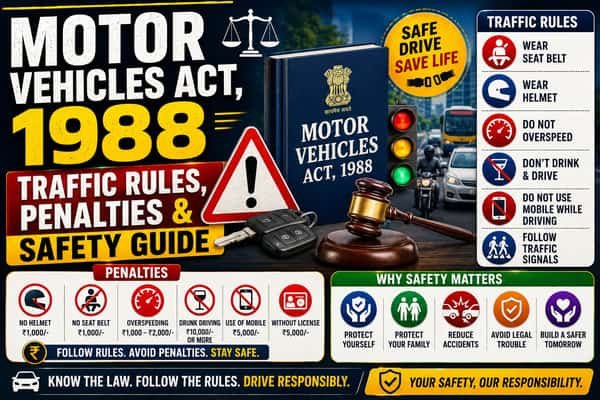
The Act requires drivers to follow various traffic rules designed to protect road users.
Some important rules include:
- Obey traffic signals and road signs.
- Wear helmets while riding two-wheelers where required.
- Wear seat belts while driving or travelling where mandated.
- Follow prescribed speed limits.
- Avoid driving under the influence of alcohol or drugs.
- Avoid using mobile phones while driving unless permitted by law.
- Carry the required vehicle documents.
Following these rules significantly reduces the risk of accidents.
Common Traffic Offences
Some frequently reported traffic violations include:
- Driving without a valid licence.
- Over-speeding.
- Drunk driving.
- Dangerous or reckless driving.
- Driving without insurance.
- Driving without vehicle registration.
- Jumping traffic signals.
- Not wearing a helmet.
- Not wearing a seat belt.
- Overloading commercial or passenger vehicles.
The nature of the offence determines the applicable legal consequences.
Penalties Under the Motor Vehicles Act
The Motor Vehicles (Amendment) Act, 2019 substantially increased penalties for several traffic violations to encourage greater compliance.
Depending on the offence, penalties may include:
- Monetary fines.
- Suspension or cancellation of the driving licence in appropriate cases.
- Imprisonment for specified offences.
- Vehicle seizure where permitted by law.
- Additional legal consequences for repeat violations.
The exact penalty depends on the specific offence and the applicable provisions of the Act.
Compensation for Road Accident Victims
The Act contains provisions relating to compensation for victims of motor vehicle accidents.
Depending on the circumstances, affected persons or their legal representatives may seek compensation in accordance with the applicable legal framework.
Compensation claims may relate to:
- Death.
- Permanent disability.
- Bodily injuries.
- Property damage.
The law aims to provide financial relief to victims and their families.
Responsibilities of Vehicle Owners and Drivers
Vehicle owners and drivers have several important legal responsibilities.
These include:
- Maintaining valid registration.
- Renewing driving licences where required.
- Maintaining valid insurance.
- Following traffic rules.
- Keeping vehicles roadworthy.
- Producing documents when lawfully required.
- Cooperating with enforcement authorities.
Responsible driving contributes to safer roads for everyone.
Recent Reforms Under the Motor Vehicles (Amendment) Act, 2019
The 2019 amendment introduced several important reforms.
Some major changes include:
- Increased penalties for traffic offences.
- Promotion of electronic enforcement.
- Better protection for Good Samaritans assisting accident victims.
- Improved licensing procedures.
- Enhanced road safety measures.
- Greater accountability of vehicle manufacturers and transport authorities in specified areas.
These reforms aim to reduce accidents and improve compliance with traffic laws.
Importance of the Motor Vehicles Act
The Motor Vehicles Act plays a critical role in India’s transportation system.
Its benefits include:
- Promoting road safety.
- Reducing traffic violations.
- Regulating vehicle ownership.
- Improving accident compensation.
- Encouraging responsible driving.
- Supporting efficient transport administration.
Awareness of the law helps drivers avoid penalties while making roads safer for everyone.
Practical Road Safety Tips
To remain compliant and safe on the road:
- Always carry the required vehicle documents or digital equivalents where legally accepted.
- Drive within the prescribed speed limits.
- Never drive under the influence of alcohol or drugs.
- Service your vehicle regularly.
- Wear helmets and seat belts.
- Avoid distractions while driving.
- Follow lane discipline and traffic signals.
- Respect pedestrians and emergency vehicles.
Simple precautions can prevent serious accidents and legal complications.
Frequently Asked Questions (FAQs)
1. Is third-party motor insurance compulsory in India?
Yes. For most motor vehicles used on public roads, third-party insurance is mandatory under the Motor Vehicles Act, subject to applicable legal provisions.
2. What happens if I drive without a valid driving licence?
Driving without a valid licence may result in fines, legal action, and other consequences prescribed under the Motor Vehicles Act.
3. Can traffic fines be issued electronically?
Yes. Many States use electronic monitoring systems such as CCTV cameras and automated enforcement tools to detect traffic violations and issue electronic challans in accordance with applicable laws.
4. Can accident victims claim compensation under the Motor Vehicles Act?
Yes. Depending on the circumstances of the accident and the applicable legal provisions, victims or their legal representatives may seek compensation through the appropriate legal process.
Disclaimer: This article is intended for general informational and educational purposes only. It provides a simplified overview of the Motor Vehicles Act, 1988 and should not be considered legal advice. The application of the Act depends on the facts of each case, subsequent amendments, State-specific rules, notifications, and judicial interpretation. Individuals should consult the appropriate transport authority or a qualified legal professional for advice regarding specific legal or regulatory matters.